12V Car Refrigerators for Road Trips and Overlanding
The Dometic CFX3 45 leads on insulation quality, app control and long term durability. The ICECO GO20 is the best value compressor fridge for smaller vehicles, and the Alpicool C15 is the cheapest unit here we would still trust on a long trip.
For serious road trips the Dometic CFX3 45 is the fridge to beat, with the ICECO GO20 offering most of the capability for far less and the Alpicool C15 covering budget builds and small cabins.
Choosing is harder than the spec sheets suggest because quoted power draw assumes a mild ambient temperature and a full, cold load, neither of which matches a hot car park in summer. We compared compressor types, insulation, capacity, battery protection cut off levels and app features, then weighed those against what owners report about noise, lid seal quality and real world consumption.
What to look for
Compressor beats thermoelectric for anything serious Thermoelectric coolers only pull the interior a fixed number of degrees below ambient, which means they struggle badly on a hot day and cannot freeze anything. Every unit here uses a compressor, so it holds a set temperature regardless of how warm the car gets. That is the difference between chilled drinks and food you can safely keep for several days.
Power draw depends on insulation and ambient temperature Manufacturers quote average amp hours per day under mild conditions with a pre chilled load. In real use, a poorly insulated fridge in a hot vehicle will cycle far more often and draw considerably more. Thicker walls cost usable interior volume but pay for themselves in reduced battery consumption, which is why the Dometic gives up capacity for its footprint.
Set the battery cut off to match your setup Every model here offers low voltage protection with two or three levels. If the fridge is running from the vehicle starter battery, use the highest protection setting so it stops well before you cannot start the engine. On a dedicated leisure battery you can safely use a lower setting and get more runtime, especially with a lithium bank that tolerates deeper discharge.
Measure the space before you fall for the capacity number Litres and quarts tell you nothing about whether the lid can open in your load space. Check the height available when the fridge sits on a slide or a platform, confirm the lid clears the tailgate or hatch, and remember that most units need airflow around the compressor vents. Owners report blocked vents are the single most common cause of poor cooling and high consumption.
The top picks, ranked

Dometic CFX3 45
The CFX3 45 uses a variable speed compressor and thick insulation, which together keep average draw low even when the cabin is warm. A colour display, app control and a genuinely rugged case make it the choice for people who expect to keep a fridge for a decade. Owners report the lid seal and hinge quality are noticeably better than budget rivals, which is where cheap coolers usually fail first.
Pros
- Excellent insulation keeps duty cycle low
- Rugged construction with strong hinges and seals
- Detailed app monitoring and temperature history
Cons
- Heaviest and most expensive option here
- Single zone at this capacity

ICECO GO20
The GO20 packs a proper compressor into a case small enough for a back seat footwell or a compact SUV boot. It reaches freezing temperatures rather than just chilling, which separates it from thermoelectric coolers at similar sizes. Owners report the removable battery option makes it practical away from the vehicle, and the build feels a step above its price bracket.
Pros
- Small footprint fits vehicles a 45 litre unit cannot
- Reaches true freezer temperatures
- Optional battery pack extends off vehicle use
Cons
- Capacity is limiting for more than two people
- No app control at this level

Alpicool C15
Alpicool has built its reputation on delivering real compressor cooling at the lowest workable price, and the C15 is the compact version of that formula. It cools fast, runs from 12V, 24V or mains, and includes a basic low voltage cut off to protect the starter battery. Owners report louder operation than premium units and thinner insulation, so it works harder in hot conditions.
Pros
- Genuine compressor cooling at an entry price
- Light enough to carry loaded
- Simple controls that are hard to get wrong
Cons
- Thinner insulation means a higher duty cycle in heat
- Compressor noise is noticeable in a quiet cabin
BougeRV CR45
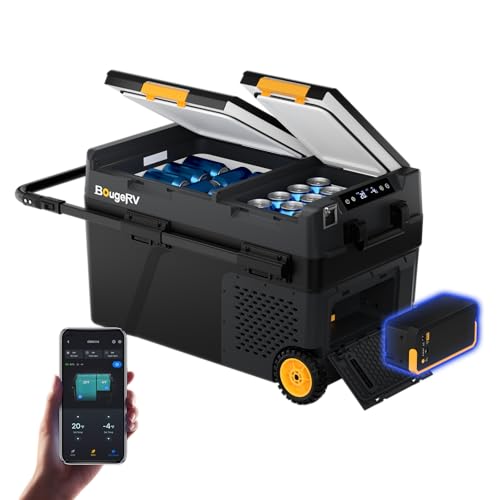
The CR45 splits its interior into two independently controlled zones, so you can run one side as a freezer and the other as a fridge. That flexibility matters on longer trips where frozen meat and cold drinks need different temperatures. Owners report the divider is removable for bulky loads, though the two zone layout costs some usable volume.
Pros
- Fridge and freezer in one case
- Removable divider for larger items
- Good capacity for the money
Cons
- Dividers reduce effective usable space
- Heavier than single zone units of similar volume

Setpower AJ30
The AJ30 targets the awkward middle ground where a 45 litre box will not fit but 15 litres is not enough. It runs quietly for the class and includes a USB output for charging phones from the same power feed. Owners report it holds temperature well overnight on a modest auxiliary battery, which is the practical test that matters.
Pros
- Capacity and footprint suit mid size vehicles
- Quieter than most budget compressor units
- USB output is genuinely handy in a camp setup
Cons
- Single zone only
- Basic display compared with premium rivals

Whynter FM-45G
Whynter’s FM-45G has been a long running favourite because it works equally well as a chest freezer in a garage and a fridge in a vehicle. The fast freeze mode and simple digital controls make it easy to switch roles. Owners report a boxier shape than modern overlanding units, which suits flat load spaces more than tightly packed builds.
Pros
- Works as a spare freezer at home between trips
- Long track record and easy parts availability
- Wide temperature range including deep freeze
Cons
- Boxy shape is awkward in tight vehicle builds
- No app monitoring or connectivity

Anker EverFrost Powered Cooler 40
The EverFrost bundles a removable battery into the cooler itself, so it keeps running long after the vehicle is switched off without draining the starter battery. Solar input and app control extend that further for camping. Owners report the integrated battery adds real weight, which makes the wheels and handle less of a luxury than they first appear.
Pros
- Runs for extended periods with the engine off
- Solar charging supported for long stays
- Wheels and handle help with the weight
Cons
- Heavy once the battery pack is fitted
- Costs more than similar capacity fridges without a battery
How they compare
| # | Model | Capacity | Best for | Score | Price |
|---|---|---|---|---|---|
| 1 | Dometic CFX3 45 | About 46 litres | Best overall | 9.4 | Check price |
| 2 | ICECO GO20 | About 20 litres | Best value | 9.2 | Check price |
| 3 | Alpicool C15 | About 15 litres | Best budget | 9.0 | Check price |
| 4 | BougeRV CR45 | About 45 litres split | Best for camping families | 8.8 | Check price |
| 5 | Setpower AJ30 | About 30 litres | Best for small SUVs | 8.6 | Check price |
| 6 | Whynter FM-45G | About 45 quarts | Best for home and vehicle use | 8.3 | Check price |
| 7 | Anker EverFrost Powered Cooler 40 | About 40 litres | Best for off grid runtime | 8.0 | Check price |
Common questions
Will a 12V fridge drain my car battery overnight?
It can if the fridge runs directly from the starter battery with the engine off. Use the highest low voltage cut off setting, or better still run the fridge from a dedicated auxiliary battery, which is what most owners eventually do.
Can these fridges freeze food as well as chill it?
Most compressor models here reach well below freezing and can act as a freezer. Dual zone units let you run freezer and fridge temperatures at the same time, which is the practical solution for longer trips.
How much power do they actually use?
Based on published specifications, well insulated units draw modest average amp hours per day in mild conditions, and considerably more in hot weather. Pre chilling the fridge and its contents at home on mains power dramatically reduces the first day load.
Are they loud?
Compressor cycling produces a hum similar to a small home fridge. Owners report premium variable speed units are noticeably quieter than fixed speed budget models, which matters if the fridge sits inside a camper rather than a boot.
Do I need a dual zone model?
Only if you regularly need frozen and chilled items at once. Dual zone costs usable volume and adds weight, so a single zone unit plus a good cool bag is often the simpler answer for weekend trips.
Can I run one on solar?
Yes, and it is a common setup. You need a battery in between rather than running the fridge directly from panels, because the compressor needs steady voltage and will cycle whenever a cloud passes over otherwise.
Do they work while driving on rough roads?
Modern compressors tolerate a reasonable amount of tilt and vibration, and most units specify a maximum operating angle. Secure the fridge properly, because an unrestrained unit is both a cooling problem and a safety hazard.
How long will food stay cold if the power stops?
Insulation quality decides this. A well insulated unit holds safe temperatures for many hours with the lid closed, while thin walled budget models warm up considerably faster. Keeping the fridge full reduces the air volume and slows warming.
The bottom line
The Dometic CFX3 45 remains the benchmark because its insulation and build quality reduce both power draw and long term hassle, which is what you actually pay for in this category. Buyers who want compressor cooling without the outlay should look at the ICECO GO20 for compact vehicles or the BougeRV CR45 for family camping. Whichever you choose, plan the power supply and the mounting space before the fridge arrives.