The 35mm Film Cameras Still Worth Shooting Today
The Kodak Ektar H35 leads for pure point-and-shoot fun and double the frames per roll, the Pentax K1000 is the honest all-manual learning SLR, and the Canon AE-1 rewards anyone ready for aperture-priority control and swappable glass.
If you want the quickest answer, the Kodak Ektar H35 half-frame is the easiest way into film, the Pentax K1000 is the SLR to learn on, and a clean used Canon AE-1 is the upgrade path once you crave control. Everything after that comes down to how much manual work you enjoy.
Buying film gear is tricky because most of it is decades old, condition varies wildly, and light seals or foam can crumble without warning. We weighed each pick on how reliably the model turns up in working shape, how forgiving it is for a returning shooter, and whether film and batteries are still easy to find.
The best picks, ranked

Kodak Ektar H35 Half-Frame Camera
The H35 shoots two vertical frames on every single 35mm exposure, so a 36-shot roll stretches to 72 pictures. It is fixed-focus and fully automatic, which makes it the least intimidating film camera you can hand a beginner.
Pros
- Doubles the shots per roll of film
- Pocketable and genuinely light
- No settings to learn before you shoot
Cons
- Plastic lens is soft at the edges
- No control over exposure

Pentax K1000 35mm SLR
The K1000 is famous as the teaching SLR because everything is manual and nothing is hidden. A simple match-needle meter is the only electronic help, so you learn the exposure triangle by doing rather than guessing.
Pros
- Bulletproof mechanical build
- Teaches manual exposure fast
- Huge supply of affordable K-mount lenses
Cons
- No autofocus or auto exposure
- Meter needs a battery to read light

Canon AE-1 35mm SLR
The AE-1 pairs a real manual body with shutter-priority automation, so you set the shutter and it handles the aperture. The Canon FD lens lineup behind it is deep, sharp, and still reasonably priced on the used market.
Pros
- Automation with full manual override
- Excellent and affordable FD glass
- Bright, easy-to-focus viewfinder
Cons
- Older bodies can develop a shutter squeal
- Foam light seals often need replacing
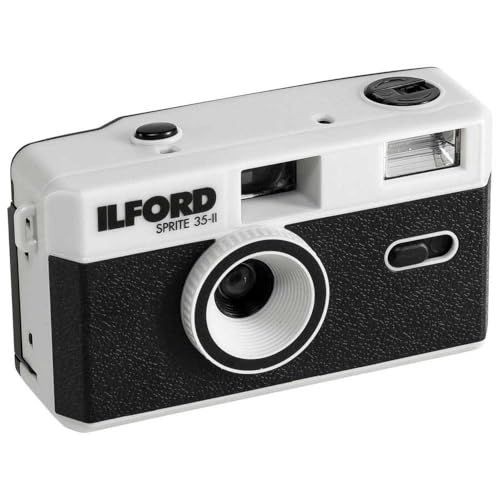
Ilford Sprite 35-II Reusable Camera
The Sprite 35-II is a reusable plastic point-and-shoot with a fixed-focus wide lens and a built-in flash you can flip on. It is the cheapest honest way to shoot full-frame 35mm without hunting for a working vintage body.
Pros
- Very inexpensive and brand new
- Wide lens suits everyday scenes
- Simple enough for a child to use
Cons
- Single shutter speed limits low light
- Build feels toy-like

Kodak M35 35mm Film Camera
The M35 is a bright, reusable full-frame point-and-shoot sold in candy colors, aimed squarely at casual film fun. Load a roll, flip the flash on when needed, and wind between shots without thinking about settings.
Pros
- Cheerful, easy to find colors
- Reusable for many rolls
- Truly point and shoot
Cons
- Soft plastic lens detail
- No exposure adjustment at all

Canon AE-1 Program 35mm SLR
The AE-1 Program adds a full program auto mode on top of the original’s shutter-priority setup, so it can act like a fully automatic camera or a fully manual one. It is a smart middle ground for shooters who want options on the same body.
Pros
- Program mode for grab shots
- Shares the huge FD lens pool
- Comfortable, familiar handling
Cons
- Depends on a working battery
- Used prices creep above the plain AE-1

Minolta X-700 35mm SLR
The X-700 offers program, aperture-priority, and manual modes with one of the brightest viewfinders of its era. Minolta MD lenses are known for pleasing rendering, and the whole system stays cheaper than the equivalent Canon or Nikon kit.
Pros
- Bright, generous viewfinder
- Flexible exposure modes
- Undervalued MD lens selection
Cons
- Electronics can fail on old units
- Aging capacitors sometimes need service
How they compare
| # | Model | Format | Best for | Score | Price |
|---|---|---|---|---|---|
| 1 | Kodak Ektar H35 Half-Frame Camera | Half-frame 35mm | Best overall | 9.4 | Check price |
| 2 | Pentax K1000 35mm SLR | Manual SLR | Best for beginners | 9.2 | Check price |
| 3 | Canon AE-1 35mm SLR | Shutter-priority SLR | Best for control | 9.1 | Check price |
| 4 | Ilford Sprite 35-II Reusable Camera | Full-frame 35mm | Best budget | 8.7 | Check price |
| 5 | Kodak M35 35mm Film Camera | Full-frame 35mm | Best for color pop | 8.5 | Check price |
| 6 | Canon AE-1 Program 35mm SLR | Program auto SLR | Best for versatility | 8.9 | Check price |
| 7 | Minolta X-700 35mm SLR | Multi-mode SLR | Best viewfinder | 8.6 | Check price |
Before you buy
Half-frame, point-and-shoot, or SLR The first fork is how much you want the camera to do for you. Half-frame bodies like the Ektar H35 stretch a roll further and stay effortless, plastic point-and-shoots keep things cheap and casual, and SLRs like the K1000 or AE-1 give you real focus and exposure control at the cost of a learning curve.
Buying used means buying condition Most classic SLRs are decades old, so the sticker on the box matters less than the state of the foam seals, the meter, and the shutter. Look for descriptions that mention fresh light seals and a confirmed working meter, and treat any squealing shutter on a Canon AE-1 as a service item rather than a dealbreaker.
Batteries, film, and running costs Every meter and every automatic mode here needs a small battery, so check the type before you buy and keep a spare. Film and developing are the real ongoing cost, which is another reason the half-frame H35 appeals, since it doubles the pictures you get from each roll you pay to develop.
Lenses are half the picture On an SLR the body is only a light-tight box, and the lens does the heavy lifting. Canon FD, Pentax K, and Minolta MD mounts all have deep, affordable used lens catalogs, so picking any of those systems keeps your options open as you grow beyond the single lens the camera arrives with.
Good to know
Is 35mm film still easy to buy?
Yes. Color and black-and-white 35mm rolls are widely stocked online and in many camera shops, and mail-in developing labs make processing simple even if you have none nearby.
What does half-frame actually mean?
A half-frame camera exposes two smaller vertical images in the space a normal camera uses for one, so a 36-exposure roll gives you about 72 shots. The trade-off is slightly lower detail per frame.
Which camera is best for a complete beginner?
For zero-effort shooting, the Kodak Ektar H35. For learning how photography actually works, the fully manual Pentax K1000 is the classic first SLR.
Do these cameras need batteries?
The point-and-shoots need a battery for the flash and film advance, and the SLRs need one for the light meter or automatic modes. The K1000 will still fire mechanically without a battery, but the meter goes dark.
Why do some old SLRs squeal?
The Canon AE-1 in particular can develop a chirp from dried lubricant in the shutter mechanism. It is common, usually harmless at first, and can be cleaned by a technician.
Can I change lenses on the point-and-shoots?
No. The Ektar H35, Ilford Sprite, and Kodak M35 all have fixed lenses. Only the SLRs on this list accept interchangeable lenses.
What are light seals and why do they matter?
Light seals are thin foam strips that keep stray light out of the film chamber. On aged cameras they crumble, which can fog your pictures, so replacing them is a cheap and common bit of upkeep.
Full-frame or half-frame for sharper photos?
Full-frame 35mm captures more detail per shot, so an SLR or a full-frame point-and-shoot will look sharper than a half-frame body. Choose half-frame when frame count and cost per shot matter more than fine detail.
The bottom line
The Kodak Ektar H35 is the camera to grab if you just want to shoot film today with no friction and twice the frames. When you are ready to actually control the image, the Pentax K1000 teaches you the craft and the Canon AE-1 gives you room to grow into a full lens system.