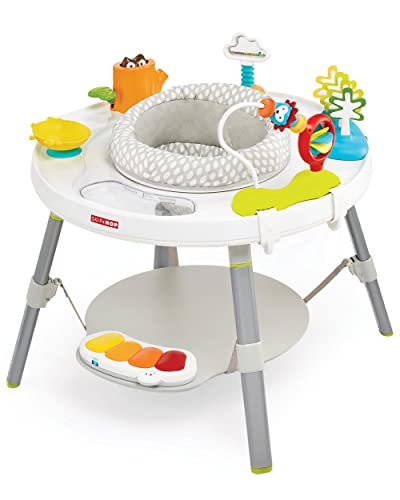
Activity Cubes Toddlers Can Play With Independently
Melissa and Doug Deluxe Wooden Activity Center wins on variety, because every face works a different skill. VTech Busy Learners suits babies who respond to light and sound before fine motor control arrives. Hape Country Critters is the wooden cube parents leave out on display.
Melissa and Doug Deluxe Wooden Activity Center leads here, since a bead maze, gears, sorting and sliders give a toddler four genuinely different things to do. Under a year old? VTech Busy Learners earns more attention through light and sound. Hape Country Critters looks right in a living room.
Cubes photograph almost identically, yet one gets played with daily and another gathers dust by week two. Variety across the faces decides that, not size. We compared activity mix, wooden against electronic play, base weight and tipping resistance, assembly requirements and stated age ranges. Parent reports on which faces still get used after a month settled the ranking.
What matters most
What should you look for in an activity cube? Count the interactive faces before anything else. A large cube with one bead maze and four printed panels holds a child for a fraction of the time a smaller cube with five working mechanisms does. Gears, sliders, sorters, mazes and sound elements each engage a different skill. Look at photographs of every side, not just the hero image, because the marketing shot rarely shows the plain faces.
Wooden or electronic: which activity cube is better? Age decides this more than preference. Under a year, electronic cubes win, because a baby without fine motor control still gets a response from slapping a key. Past eighteen months, wooden cubes win, since manipulation itself becomes the reward and battery tunes become background noise. Wooden versions also stay quiet and survive longer. Households owning both usually keep the wooden one after the batteries die.
How stable does an activity cube need to be? A cube that tips when a standing toddler leans on it stops being a toy. Weight and footprint width both matter, and a child who pulls to stand should be the test case. Heavier bases such as the Melissa and Doug and Anatex cubes stay planted. Check for small detachable parts on cheaper models, confirm painted surfaces use child safe finishes, and follow the minimum age, which is set by choking risk.
How do you keep a toddler interested in a cube? Rotation works better than buying another toy. Put the cube away for a fortnight and interest usually returns intact when it reappears. Playing alongside and narrating what the child is doing adds language to the activity, which is where most of the developmental value sits. Cubes with removable pieces double as floor sorting games, stretching the same toy into a second kind of play.
What we recommend
Melissa and Doug Deluxe Wooden Activity Center
Each face here does something structurally different rather than repeating one idea in a new colour. A bead maze sits on top, with gears, shape sorting and sliding elements around the sides. Weight is the hidden benefit: it stays put when a toddler leans on it, though that same mass makes moving it between rooms a chore.
Pros
- Every face works a different skill
- Heavy base resists sliding and tipping
- Wooden joints survive years of hard play
Cons
- Assembly takes real time out of the box
- Too heavy to shift between rooms easily

VTech Busy Learners Activity Cube
Babies who are only just sitting up cannot work a bead maze, but they can slap a piano key and get a response. Instant light and sound feedback is what holds attention at that stage. Small enough for a lap or play mat, it also runs loud at the default setting, so find the volume switch on day one.
Pros
- Feedback works before fine motor control develops
- Sits on a lap or travels in a bag
- Two volume levels plus an off switch
Cons
- Tunes repeat often enough to wear on adults
- Needs batteries kept on hand

Hape Country Critters Wooden Activity Play Cube
Hape finishes this well enough that it reads as furniture rather than a plastic intrusion, using water based paints and rounded edges throughout. Five faces cover a bead maze, gears, a clock, shape work and animal sliders. Its lower weight is the trade off, since a child leaning hard on one side can tip it.
Pros
- Finish suits a shared living space
- Five faces each carry a distinct activity
- Water based paint and rounded edges throughout
Cons
- Lighter build tips under sideways pressure
- Costs more than plainer wooden cubes

Anatex Deluxe Mini Play Cube
Anatex supplies the cubes found in paediatric waiting rooms, which tells you how they survive constant unsupervised use. Hardwood panels and thicker steel bead wires mean nothing works loose after a year. That commercial construction carries a commercial outlay, so it only pays off across several children or many years.
Pros
- Built for shared and public use
- Thick bead wires resist bending out of shape
- Holds value through a second or third child
Cons
- Costs far more than home grade cubes
- Heavy and awkward to reposition

TOP BRIGHT Wooden Activity Cube
Five faces here carry a bead maze, shape sorter, gears, xylophone and fishing game, which is more variety than anything near this outlay. A toddler who tires of one activity has four alternatives without moving. Finish quality trails premium wooden brands, so check edges and fittings on arrival.
Pros
- Most activities per outlay in this roundup
- Xylophone and fishing game widen the play
- Sensible footprint for a play corner
Cons
- Finish sits below premium wooden brands
- Loose fishing pieces need supervision
Battat Wooden Activity Cube
Battat keeps the activity count low, which suits a one year old still working out cause and effect. Busy cubes overwhelm at that age. Its low profile lets a kneeling child reach every face, though older toddlers move past it sooner than they do the more crowded designs.
Pros
- Simple layout suits a first cube
- Low centre of gravity resists tipping
- Wipes clean in seconds
Cons
- Outgrown sooner than busier cubes
- Fewer activities than similar wooden rivals

Labebe Wooden Activity Cube
Labebe covers the core bead maze and sorting play in a body small enough for a flat or a grandparent’s spare room. As a first cube or a second home cube it does the job without a large outlay. Fewer activities per face and a light frame that slides on laminate are the compromises.
Pros
- Lowest cost wooden cube here
- Compact enough for a small room
- Light enough to carry one handed
Cons
- Fewer activities than larger cubes
- Slides across hard floors when pushed
How they compare
| # | Model | Material | Best for | Score | Price |
|---|---|---|---|---|---|
| 1 | Melissa and Doug Deluxe Wooden Activity Center | Wood | Best overall | 9.4 | Check price |
| 2 | VTech Busy Learners Activity Cube | Plastic with electronics | Best for babies | 9.2 | Check price |
| 3 | Hape Country Critters Wooden Activity Play Cube | Wood with water based paint | Best looking wooden cube | 9.0 | Check price |
| 4 | Anatex Deluxe Mini Play Cube | Hardwood and steel bead wire | Best for durability | 8.8 | Check price |
| 5 | TOP BRIGHT Wooden Activity Cube | Wood | Best value wooden cube | 8.6 | Check price |
| 6 | Battat Wooden Activity Cube | Wood | Best for younger toddlers | 8.3 | Check price |
| 7 | Labebe Wooden Activity Cube | Wood | Best budget | 8.0 | Check price |
Good to know
What age is an activity cube for?
Electronic cubes generally start around six months, while wooden bead maze and sorter designs are aimed at twelve to eighteen months and up. Age ratings reflect choking hazards from small parts, so treat the minimum as a rule rather than a suggestion.
Are wooden or plastic activity cubes better?
Wooden cubes last longer, stay quiet and keep working as fine motor skills develop. Plastic electronic cubes hold a younger baby’s attention through lights and sound. Choose by the child’s age and how much noise your home tolerates.
How long do children play with activity cubes?
Most see real use between roughly one and three years old, with busier cubes holding interest longest. Early sessions run a few minutes and lengthen as concentration builds.
Do activity cubes need assembly?
Larger wooden cubes usually arrive flat packed and take twenty to thirty minutes with the included fittings. Smaller wooden and electronic cubes generally need nothing beyond fitting batteries.
Are activity cubes worth the floor space?
A cube with five working faces replaces several single purpose toys and never needs putting away, which is why parents accept the footprint. One with a single real activity does not earn it.
Can activity cubes help development?
They support fine motor control, hand eye coordination, cause and effect learning and early sorting logic. Benefit rises sharply when an adult plays alongside and talks through what the child is doing.
How do you clean a wooden activity cube?
Wipe with a barely damp cloth and dry immediately, since soaking loosens joints and lifts paint. Electronic cubes take a mild cleaner on a cloth, kept well away from battery compartments and speakers.
Are noisy electronic activity cubes a problem?
In a small home, often yes. Check for a volume switch and a full off switch before buying, because some models offer only one level. Wooden cubes avoid the issue entirely.
Which activity cube is best for a first birthday?
A wooden cube rated from twelve months with a simple layout, such as the Battat, suits a child still learning cause and effect. Busier cubes tend to overwhelm at that age.
Can two children share an activity cube?
Yes, and a wider cube with activities on all four sides works best for it. Commercial grade builds like the Anatex handle the extra wear that shared use brings.
Our pick
Melissa and Doug Deluxe Wooden Activity Center is the cube to buy for one toy that keeps working through toddlerhood, because the faces genuinely differ and the build survives daily use. VTech Busy Learners gets far more engagement from a baby under a year. Choose Hape Country Critters when the cube has to live in a living room.