Adjustable Wrenches That Grip Without Rounding Nuts
Crescent AT Series 8-inch takes the top spot for a slim head paired with 1.25 inches of jaw capacity. Channellock 8WCB opens to 1.5 inches at the same length, which is unusual. Craftsman covers household work with a full lifetime warranty behind it.
Crescent AT Series 8-inch is the wrench to reach for first, combining 1.25 inches of jaw capacity with a head slim enough for recessed fittings. Channellock 8WCB opens wider still at 1.5 inches. Craftsman covers general household work and carries a full lifetime warranty.
Two numbers separate a good adjustable wrench from a fastener-wrecking one: jaw play and head thickness. Play between the fixed and movable jaw is what rounds hex corners under torque. A thick head simply will not enter a crowded engine bay or a sink cabinet. We compared published jaw capacity against overall length, measured head profiles from listings, worm screw action, and durability patterns owners describe after months of use.
What we recommend
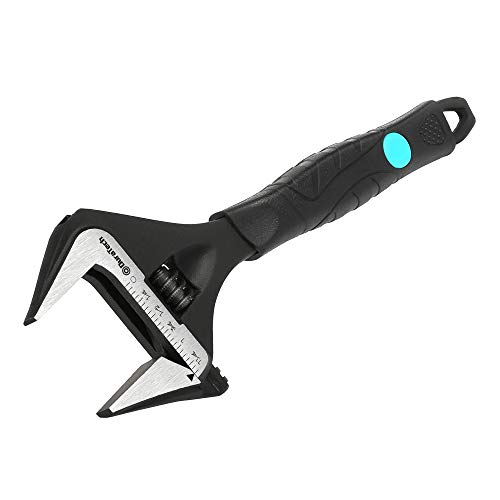
Crescent AT Series 8-Inch Wide Jaw Adjustable Wrench
Jaw capacity reaches 1.25 inches on an 8-inch body, which is wider than a standard wrench of the same length. Its slim head enters recessed fittings that block chunkier tools. Tight tolerances between the jaws keep hex corners intact under real torque.
Pros
- 1.25 inch capacity on an 8 inch handle
- Slim head reaches recessed fittings
- Minimal play keeps hex corners intact
Cons
- Bare steel handle with no cushioning
- Costs more than basic household wrenches

Channellock 8WCB WideAzz Adjustable Wrench
Jaws open to 1.5 inches on an 8-inch handle, so this wrench reaches nuts that normally demand a 10-inch tool. Laser-etched scale markings on the fixed jaw make repeat settings quick. Chrome plating resists rust but shows scuffs on job site use.
Pros
- Largest opening per inch of handle here
- Etched scale speeds repeat settings
- Worm screw turns smoothly under load
Cons
- Heavier in hand than rival 8 inch models
- Chrome shows wear marks over time

Craftsman 8-Inch Adjustable Wrench
Capacity stops at 1.06 inches, enough for garden taps, furniture bolts and most household plumbing. A full lifetime warranty backs the tool, which matters at this level. Polished chrome and clear jaw markings keep it easy to read in a dim cabinet.
Pros
- Full lifetime warranty on the tool
- Jaw markings stay legible in poor light
- Sensible first wrench for a home toolbox
Cons
- Standard head is thicker than premium picks
- 1.06 inch capacity limits plumbing work

Knipex Pliers Wrench 10-Inch
Smooth parallel jaws clamp like pliers rather than pivoting like a wrench, so chrome tap bodies and compression fittings survive the job unmarked. Push-button adjustment sets the opening in one motion, up to 2 inches. Clamping force builds as you squeeze the handles.
Pros
- Parallel jaws leave chrome fittings unmarked
- Push-button sets opening in one motion
- 2 inch capacity handles large plumbing nuts
Cons
- Highest cost of any pick in this ranking
- Two-handed operation slows quick jobs

Irwin Vise-Grip 10-Inch Adjustable Wrench
Ten inches of handle multiplies leverage on seized suspension and trailer hardware. Jaws open to 1.31 inches, covering most automotive nuts under an inch and a quarter. Nickel plating and a slip-resistant grip suit damp outdoor work.
Pros
- Extra handle length breaks seized hardware
- Nickel plating resists rust in a damp garage
- Grip stays secure with oily hands
Cons
- Too bulky for tight engine bay work
- Adds noticeable weight to a tool belt

Stanley MaxSteel 6-Inch Adjustable Wrench
Six inches of forged steel fits a glovebox, a bike bag or a back pocket. Jaws open to 0.75 inch, covering bike hardware, faucet nuts and flat-pack furniture bolts. Bi-material grip absorbs the pressure a bare handle transfers to your palm.
Pros
- Fits a glovebox or bike repair kit
- Cushioned grip suits repeated small turns
- Forged body resists flex at full load
Cons
- 0.75 inch ceiling rules out plumbing nuts
- Short handle gives limited leverage

Tekton 8-Inch Wide Jaw Adjustable Wrench
Head thickness here is the selling point, sliding into gaps where standard heads stall. Capacity reaches 1.19 inches, which covers most automotive and plumbing sizes. An oversized contoured handle keeps repeated worm screw turns comfortable across a long job.
Pros
- Thinnest head profile in this ranking
- Oversized handle eases long sessions
- Worm screw turns without binding
Cons
- Utilitarian finish scratches easily
- Printed scale markings fade with use
How they stack up
| # | Model | Size | Best for | Score | Price |
|---|---|---|---|---|---|
| 1 | Crescent AT Series 8-Inch Wide Jaw Adjustable Wrench | 8 inch | Best overall | 9.4 | Check price |
| 2 | Channellock 8WCB WideAzz Adjustable Wrench | 8 inch | Best value | 9.2 | Check price |
| 3 | Craftsman 8-Inch Adjustable Wrench | 8 inch | Best budget | 9.0 | Check price |
| 4 | Knipex Pliers Wrench 10-Inch | 10 inch | Best for chrome and soft fittings | 8.7 | Check price |
| 5 | Irwin Vise-Grip 10-Inch Adjustable Wrench | 10 inch | Best for large fasteners | 8.5 | Check price |
| 6 | Stanley MaxSteel 6-Inch Adjustable Wrench | 6 inch | Best compact | 8.2 | Check price |
| 7 | Tekton 8-Inch Wide Jaw Adjustable Wrench | 8 inch | Best thin head | 8.0 | Check price |
How to pick the right one
What size adjustable wrench do most jobs need? Length sets both leverage and jaw capacity. Six inches suits bike hardware and flat-pack furniture. Eight inches covers household plumbing, appliance work and most automotive nuts, which is why it outsells every other size. Ten inches and up handles trailer hardware and large compression fittings. Two wrenches, one 8-inch and one 10-inch, cover nearly everything a homeowner meets.
Why head thickness and jaw capacity matter together Capacity tells you the largest nut the tool grips. Head thickness tells you whether it reaches that nut at all. Wide-jaw designs like the Channellock 8WCB open 1.5 inches on an 8-inch handle, so a shorter tool covers larger hardware. Pair that width with a slim head if your work involves engine bays, sink cabinets or panel recesses.
How to spot worm screw quality and jaw play Run the worm screw through its full travel. It should turn evenly with no binding at either end and hold position once loaded. Then close the jaws and rock the movable jaw by hand. Any perceptible wobble becomes rounded hex corners under torque. Tight tolerances cost more up front and save fasteners for years.
Which adjustable wrench suits plumbing and soft fittings? Chrome tap bodies, brass compression nuts and polished trap fittings mark easily under serrated or loose jaws. A pliers wrench such as the Knipex clamps with smooth parallel faces and leaves no witness marks. For steel pipe and rough hardware, a conventional wrench with a corrosion-resistant chrome or nickel finish is the more practical daily tool.
Frequently asked questions
What size adjustable wrench should I buy first?
Eight inches. That length gives roughly 1.06 to 1.5 inches of jaw capacity depending on model, enough leverage for household and automotive nuts, and a body compact enough for cabinets.
Why do adjustable wrenches round off nuts?
Play between the jaws lets the wrench slip across the hex corners under load. Snug the worm screw fully against the flats before pulling, and keep force on the fixed jaw side.
What is a wide jaw adjustable wrench?
A model whose jaws open further than the standard opening for its length. Channellock 8WCB reaches 1.5 inches on an 8-inch handle, where a conventional 8-inch stops near 1 inch.
Is a pliers wrench better than an adjustable wrench?
For chrome, brass and other soft fittings, yes, because parallel smooth jaws clamp without marking. Conventional adjustables stay faster and lighter for general nut and bolt work.
Do adjustable wrenches fit both metric and SAE fasteners?
Yes. Opening is continuously variable within the jaw range, so one wrench covers 13 mm and half inch alike, provided both fall inside its capacity.
How do I keep the worm screw turning smoothly?
Wipe grit off the screw threads after dirty jobs, store the tool dry, and add a drop of light machine oil to the screw occasionally. Grit is what makes an adjustment bind.
Is a thin head worth paying extra for?
If you work in engine bays, under sinks or inside appliance panels, yes. A slim head reaches fasteners a standard head cannot approach, without losing meaningful strength.
Can I use an adjustable wrench for high torque?
Use a six-point socket or box-end wrench instead, since those surround the fastener. Adjustable wrenches suit moderate torque, and reaching for a longer model beats cheating with a pipe extension.
Which adjustable wrench is best for bike repairs?
A 6-inch model such as the Stanley MaxSteel. Its 0.75 inch capacity covers pedal, seat clamp and axle hardware, and the short body fits a saddle bag.
Crescent AT Series vs Channellock 8WCB: what is the difference?
Crescent runs a slimmer head with 1.25 inches of capacity, better in confined spaces. Channellock opens to 1.5 inches and adds an etched scale, better when fastener size varies.
Our take
Crescent AT Series 8-inch is the wrench most toolboxes should carry, balancing 1.25 inches of capacity against a head slim enough for confined work. Channellock 8WCB opens wider and reads its own scale, which suits varied fastener sizes. Anyone working on chrome or brass fittings should add the Knipex Pliers Wrench.