Air Fryer Microwave Combos Compared for Countertop Space
Toshiba ML2-EC10SA delivers 1000 watts of microwave power plus an elevated rack that lets air reach under food. Panasonic NN-CD87KS uses inverter power for even reheating across 1.2 cubic feet. Breville Combi Wave adds 1100 watt inverter output and dial control.
Toshiba ML2-EC10SA is our overall pick, since its 1000 watt microwave output sits alongside an air fry rack that actually crisps. Panasonic NN-CD87KS reheats more evenly thanks to inverter power across a 1.2 cubic foot cavity. Breville Combi Wave BMO870BSS pushes 1100 watts through a dial-driven control panel.
One cavity cannot be optimized for three cooking methods. Microwaves want an open box. Air frying wants tight, fast-moving hot air. Convection wants even circulation at a steady temperature. Manufacturers pick which compromise to make, so some units reheat brilliantly and crisp weakly while others reverse that. We compared microwave wattage and whether it uses inverter output, stated capacity against external footprint, rack and basket design, preheat time, and how clearly the panel separates modes.
How to choose
What to check before buying a microwave air fryer combo Start with the mode you use daily. Microwave wattage and inverter type decide reheating quality. Rack design decides whether air frying crisps or just browns. Cavity size decides what fits. Footprint decides whether it earns the counter at all. Buying for the function you use twice a month is the most common mistake here.
What does inverter microwave power actually change? A conventional microwave at half power runs full power half the time and switches off between pulses. Edges overcook while centers stay cold. Inverter models supply steady reduced power instead. For leftovers, defrosting fish and melting chocolate, that is the single most noticeable difference, and it explains why the Panasonic, Breville and Galanz handle reheating better than the rest.
How much usable capacity do you really get? Stated cubic feet include corners the turntable never reaches. Air frying needs clearance above and below food for circulation, which costs more volume again. Measure your regular casserole dish and dinner plates, then compare against interior dimensions rather than the headline number. A well-designed 1.0 cubic foot cavity often holds as much usable food as a bulky 1.5 cubic foot one.
Combination unit or separate appliances: which fits your kitchen? Two dedicated machines each do their job better, and a basket air fryer will always crisp harder than a large cavity. What a combination unit buys is one footprint, one plug and one control panel. Apartments, dorms and small kitchens usually come out ahead. If you have counter space and cook often, separate units remain the stronger choice.
The shortlist, ranked

Toshiba ML2-EC10SA(BS)
Air fry mode here browns and crisps rather than just heating the surface, largely because the supplied rack lifts food so air circulates underneath. Microwave output reaches 1000 watts across a 1.0 cubic foot cavity. Convection baking rounds it out, making this a genuine second oven for a small kitchen.
Pros
- Elevated rack lets air reach under food
- 1000 watts of microwave power in a compact cavity
- Panel keeps the three modes clearly separated
Cons
- 1.0 cubic foot limits family-size air fry batches
- Convection preheat runs several minutes
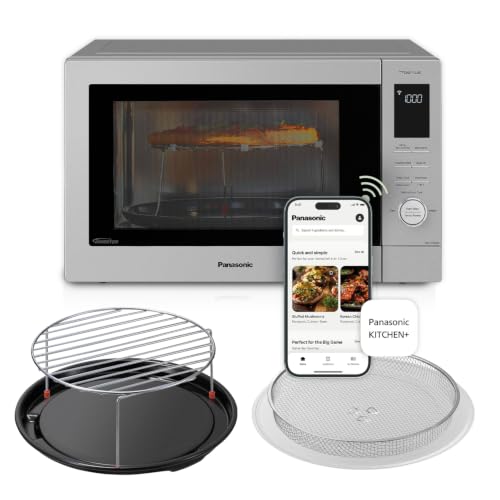
Panasonic HomeChef 4-in-1 NN-CD87KS
Inverter circuitry supplies continuous reduced power instead of pulsing full power on and off, so leftovers heat through rather than scorching at the rim. Broiling joins convection and air fry inside a 1.2 cubic foot cavity. Genius sensor cooking reads steam and sets time automatically.
Pros
- Inverter power reheats and defrosts evenly
- 1.2 cubic feet holds a dinner plate with room
- Sensor cooking removes timing guesswork
Cons
- Air fry crisping trails a dedicated basket unit
- Nested menu system takes a week to learn

Breville Combi Wave 3 in 1 BMO870BSS
Highest microwave output here at 1100 watts, delivered through inverter circuitry with power smoothing that levels the hot and cold spots typical of reheating. A physical dial replaces menu diving for time and power. Convection and air fry both run at genuinely high temperatures inside 1.1 cubic feet.
Pros
- 1100 watts, the strongest microwave output here
- Power smoothing evens out reheating
- Dial control is faster than button menus
Cons
- Occupies substantial counter width
- Costs more than any other pick in this ranking

GE 3-in-1 Microwave Oven with Air Fry JES1109RRSS
Footprint is the point, fitting convection and air fry into a cabinet where counter space is the binding constraint. Microwave power reaches 1050 watts across 1.0 cubic foot. Controls stay deliberately plain, which suits apartments, dorms and second kitchens.
Pros
- Smallest external footprint in this ranking
- 1050 watts despite the compact cavity
- No learning curve on the control panel
Cons
- Air fry basket holds a single portion
- Cramped for casserole dishes
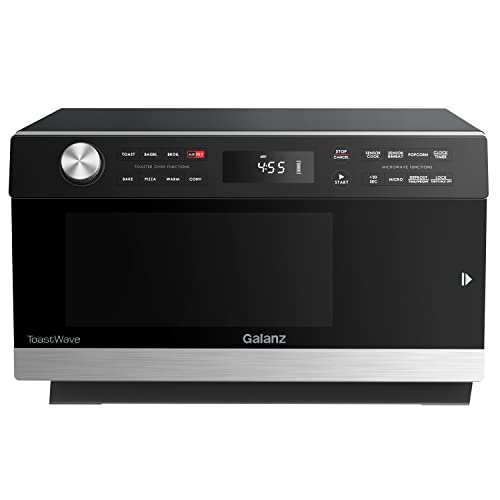
Galanz GSWWA16S1SA10 ToastWave
At 1.6 cubic feet this is the largest cavity in the ranking, with a toast function added to microwave, convection and air fry. That fourth mode genuinely removes a toaster oven from the counter. Inverter power at 1000 watts keeps reheating smooth across the bigger space.
Pros
- 1.6 cubic feet, largest cavity here
- Toast mode replaces a separate toaster oven
- Inverter output smooths reheating
Cons
- Toasting is less even than a dedicated toaster
- External width demands real counter space

Sharp SMC1585BS Convection Microwave
Convection baking is the strongest here, which is the mode most combination units handle worst. A stainless steel cavity of 1.5 cubic feet wipes down after greasy cooks and takes small sheet trays. Microwave output sits lower at 900 watts, so reheating runs a little slower.
Pros
- Most even convection baking in this group
- Stainless cavity cleans easily after air frying
- 1.5 cubic feet takes a small sheet tray
Cons
- 900 watts is the lowest microwave output here
- Air fry sits behind convection in priority

Toshiba ML-EC42P(SS)
Entry point for the category, with 1.5 cubic feet of cavity and 1000 watts of microwave power. Mode buttons carry printed labels rather than hiding inside menus. An air fry basket and convection rack ship in the box, so no extra accessories are needed.
Pros
- 1.5 cubic feet at the lowest cost here
- Printed mode buttons need no menu diving
- Basket and rack included in the box
Cons
- Crisps more gently than the ML2-EC10SA
- Wide exterior for the counter space it earns
Side by side
| # | Model | Functions | Best for | Score | Price |
|---|---|---|---|---|---|
| 1 | Toshiba ML2-EC10SA(BS) | Microwave, convection, air fry | Best overall | 9.4 | Check price |
| 2 | Panasonic HomeChef 4-in-1 NN-CD87KS | Microwave, convection, broil, air fry | Best for even reheating | 9.2 | Check price |
| 3 | Breville Combi Wave 3 in 1 BMO870BSS | Microwave, convection, air fry | Best premium | 9.0 | Check price |
| 4 | GE 3-in-1 Microwave Oven with Air Fry JES1109RRSS | Microwave, convection, air fry | Best for small kitchens | 8.7 | Check price |
| 5 | Galanz GSWWA16S1SA10 ToastWave | Microwave, convection, air fry, toast | Best for large households | 8.5 | Check price |
| 6 | Sharp SMC1585BS Convection Microwave | Microwave, convection, air fry, grill | Best for baking | 8.2 | Check price |
| 7 | Toshiba ML-EC42P(SS) | Microwave, convection, air fry | Best budget | 8.0 | Check price |
Good to know
Does an air fryer microwave really crisp food?
Yes, though less aggressively than a basket air fryer, because a larger cavity spreads airflow. Models with an elevated rack, such as the Toshiba ML2-EC10SA, crisp noticeably better than those running convection alone.
Can I use metal racks inside these units?
Only in convection and air fry modes, and only the racks supplied by the manufacturer. Never run metal during microwave operation. Each manual lists which accessory belongs to which mode.
What is inverter microwave power?
Steady reduced output rather than full power cycling on and off. It produces more even reheating and gentler defrosting. Panasonic NN-CD87KS, Breville Combi Wave and Galanz ToastWave all use it.
Can a combination microwave replace a full oven?
For a tray of vegetables, a modest bake or a portion of chicken, yes. Large roasts, multiple sheet pans and holiday cooking still need a full oven. Many owners run one as a second oven during busy meals.
How much counter space do these need?
More than a plain microwave, since the convection fan and heating element add depth. Measure width, depth and height plus rear and side ventilation clearance. GE JES1109RRSS is the most compact option here.
Are they harder to clean than a regular microwave?
Slightly, because air frying throws grease that plain microwaving does not. A stainless cavity like the Sharp SMC1585BS wipes down faster than a painted one. Wash racks after each air fry session to avoid smoke next time.
Which is better, a combination unit or two separate appliances?
Separate machines perform better at each job. A combination unit wins on counter space and a single control panel. Small kitchens generally favor combining, larger kitchens favor separating.
Do air fryer microwaves need preheating?
Convection and air fry modes do, usually a few minutes. Microwave mode does not. Preheat is the main adjustment when moving from a standalone air fryer, which reaches temperature faster in a smaller cavity.
Which air fryer microwave is best for a small apartment?
GE JES1109RRSS, thanks to the tightest footprint here alongside 1050 watts and simple controls. Toshiba ML2-EC10SA is the next step up if crisping quality matters more than width.
Toshiba ML2-EC10SA vs Panasonic NN-CD87KS: which should I buy?
Pick the Toshiba if crisping is the priority, since its raised air fry rack circulates air under food. Pick the Panasonic if reheating leftovers is the daily job, because inverter power heats through evenly.
Our take
Toshiba ML2-EC10SA strikes the best balance in this category, delivering real crisping alongside 1000 watts of microwave power without swallowing the counter. Panasonic NN-CD87KS is the pick when evenly reheated leftovers matter more than browning. Breville Combi Wave earns its premium through 1100 watt inverter output and a dial you can operate without reading the manual.


