Alcohol Markers That Blend Without Streaking
Copic Sketch Markers set the blending benchmark, with replaceable nibs and refill ink that keep one barrel working for years. Ohuhu Honolulu 48-Color gives beginners a broad palette and a zip case. Prismacolor Premier Double-Ended sits between them, laying rich pigment through fine and chisel tips.
Copic Sketch Markers blend better than anything else here and refill instead of dying. Ohuhu Honolulu 48-Color is the beginner set that teaches gradients cheaply. Prismacolor Premier Double-Ended bridges the two with strong pigment and reliable flow.
Marker sets look alike in a photo, yet ink load, nib softness and colour spacing decide whether gradients come out smooth or streaky. Budget barrels often run dry unevenly across a set. We compared nib types, published refill and replacement nib support, palette structure, and what long term owners report about flow consistency and drying out.
What to look for
What makes alcohol markers blend? Alcohol carries the dye and evaporates fast. While two layers are still wet, the solvent redissolves the dye underneath and the colours merge. Speed therefore matters more than technique at first. Work light to dark, keep the leading edge damp, and move on before the first pass dries. A colourless blender pushes pigment outward to soften an edge or lift a highlight after the fact.
Are refillable alcohol markers worth it? For anyone drawing weekly, yes. Copic Sketch and Ciao take refill ink and replacement nibs, so one barrel survives years of use and only the consumables get replaced. Disposable sets such as Ohuhu and Bianyo make more sense for occasional colouring or for testing whether the medium suits you. Count how many hours a month you draw, then decide which cost model fits.
Which nib shape suits your work? Brush nibs flex under pressure, giving a stroke that widens and tapers, which is what illustration and manga work rely on. Chisel ends cover flat areas quickly and give a crisp straight edge on their corner. Fine bullet tips handle outlines and small detail. Dual tip markers combine two of these in one barrel, and every set here does so, which is why single nib markers have largely disappeared.
What paper works best with alcohol markers? Alcohol ink soaks through ordinary printer and sketch paper within seconds. Dedicated marker paper is smooth and lightly sized, so ink sits near the surface where it can still be blended. Bleedproof pads add a barrier layer that stops ink reaching the next sheet. Slip scrap paper underneath whatever you use, and expect heavier cardstock to soak up more ink per stroke.
Our top picks

Copic Sketch Markers
Dual brush and chisel nibs carry a heavy ink load, which is why colours melt into each other instead of leaving a hard edge. Both the nibs and the ink are replaceable, so a well used barrel gets rebuilt rather than binned. Copic sells more than 350 colours as open stock, letting you buy the three or four greys a project actually needs.
Pros
- Blends more cleanly than anything else here
- Refills and spare nibs extend barrel life for years
- Huge open stock range for targeted buying
Cons
- Highest cost per marker in this group
- Mostly sold singly rather than in large sets

Ohuhu Honolulu 48-Color Alcohol Markers
Forty eight dual tip markers arrive in a zippered case that doubles as a stand, which keeps colours in order on a small desk. Blending holds up far better than the outlay suggests, especially within the same colour family. Barrels are sealed, so plan on replacing rather than refilling.
Pros
- Forty eight colours for a modest outlay
- Blends smoothly within a colour family
- Zip case stores and displays the set
Cons
- No refill system
- Nibs cannot be swapped when they fray

Prismacolor Premier Double-Ended Art Markers
Fine and chisel ends pair well: one for outlines and detail, the other for filling flat areas fast. Pigment strength runs high, so a single pass covers without patchiness on marker paper. Colour consistency across the range makes building gradients predictable, which is why illustrators keep returning to it.
Pros
- Dense pigment covers in one pass
- Predictable colour steps for gradients
- Ink flow stays even across the set
Cons
- Barrels are disposable
- Fine tip frays under heavy pressure

Arteza EverBlend Art Markers
A soft brush end forgives inconsistent pressure, which is exactly what a beginner needs while learning to layer. Every barrel carries a printed colour number and swatch, so rebuilding a gradient later takes seconds. Chisel and fine detail work sits on the second tip.
Pros
- Forgiving brush nib for new users
- Numbered barrels make colours easy to match
- Sensible spread of tones in the starter sets
Cons
- Fewer colour families than professional ranges
- Not refillable once a barrel runs dry
Copic Ciao Markers
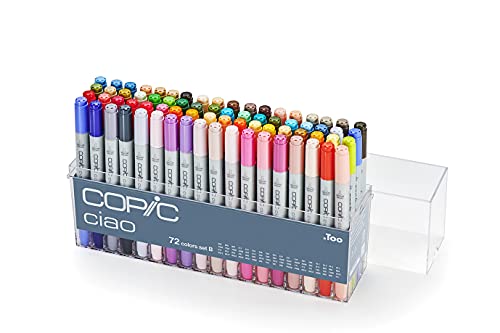
Same Copic ink and same replaceable nibs, wrapped in a slimmer round barrel that costs less. Reduced ink capacity is the trade, which suits a sketchbook bag rather than a studio bench. Around 180 colours are offered, fewer than the Sketch line but enough for portrait and manga work.
Pros
- Copic ink and refills at a lower entry point
- Slim round barrel packs easily
- Nibs swap out like the Sketch range
Cons
- Smaller palette than Copic Sketch
- Holds less ink between refills

Winsor and Newton Promarker Set
Fine bullet and broad chisel tips suit design work where clean edges matter more than painterly blending. Ink dries quickly, so overlaying a line onto a filled area does not lift the colour underneath. Curated ranges group greys, skin tones and brights, which speeds up choosing a palette for a brief.
Pros
- Crisp edges for line and fill work
- Quick drying ink resists lifting
- Curated sets simplify palette building
Cons
- Barrels cannot be refilled
- Total colour count trails Copic

Bianyo Classic Alcohol Markers
Large palettes at the lowest outlay here make this a practice set rather than a finished art set. Fine and broad tips cover both outlining and filling. Flow varies between individual barrels, so swatch the set before relying on a specific tone.
Pros
- Cheapest way to try alcohol markers
- Wide palette for colouring and practice
- Fine tip handles outlines adequately
Cons
- Blending leaves visible edges
- Ink flow differs from barrel to barrel
How they stack up
| # | Model | Tips | Best for | Score | Price |
|---|---|---|---|---|---|
| 1 | Copic Sketch Markers | Brush and chisel | Best overall | 9.4 | Check price |
| 2 | Ohuhu Honolulu 48-Color Alcohol Markers | Brush and chisel | Best value | 9.2 | Check price |
| 3 | Prismacolor Premier Double-Ended Art Markers | Fine and chisel | Best for blending | 9.0 | Check price |
| 4 | Arteza EverBlend Art Markers | Brush and fine | Best for beginners | 8.8 | Check price |
| 5 | Copic Ciao Markers | Brush and chisel | Best for portability | 8.6 | Check price |
| 6 | Winsor and Newton Promarker Set | Fine and broad | Best for illustration | 8.3 | Check price |
| 7 | Bianyo Classic Alcohol Markers | Fine and broad | Best budget | 8.0 | Check price |
Frequently asked questions
What makes alcohol markers blend so well?
Alcohol based ink redissolves the layer beneath while both are wet, letting the colours run together. Work quickly, keep the edge damp, and layer light tones before dark ones for the smoothest gradient.
Are Copic markers worth the price?
For frequent artists, yes. Refill ink and replaceable nibs mean one barrel lasts for years, so the higher entry cost spreads out. Occasional colourists rarely reach the point where refilling pays off.
Which alcohol markers are best for beginners?
Ohuhu Honolulu 48-Color and Arteza EverBlend both teach blending without a large outlay. Each gives a broad palette and dual tips, so technique can develop before committing to a professional range.
Do alcohol markers bleed through paper?
Almost always on standard paper. Use marker or bleedproof paper for finished work, and slide a scrap sheet underneath whatever you draw on to protect the page below.
Can cheap alcohol markers be refilled?
Most budget barrels are sealed and cannot. Refilling requires a system that sells matching ink and nibs, which among these sets means Copic Sketch or Copic Ciao.
What paper works best with alcohol markers?
Smooth, lightly sized marker paper. It keeps ink near the surface so it stays workable, and limits the feathering that soft sketch paper produces. Heavier cardstock takes more ink per stroke.
How do I stop alcohol markers drying out?
Store them flat with caps pressed on until they click, and keep them out of direct sun and warm rooms. Horizontal storage also keeps both nibs charged with ink.
Do I need a colorless blender?
Not to start, though it earns its place quickly. A blender softens hard edges, pushes colour outward and lifts small highlights. Several sets here include one in the box.
Copic Sketch vs Copic Ciao: which should I buy?
Sketch holds more ink, offers a far larger palette and has an oval barrel that resists rolling. Ciao uses identical ink and nibs in a slimmer, cheaper body. Choose Ciao for travel and Sketch for studio work.
How many alcohol markers do I actually need?
Around twenty four well chosen colours covers most illustration, provided the set includes three or four greys and a light, mid and dark version of each hue you use. Gradients depend on close tonal steps, not on total count.
Our pick
Artists who blend regularly will get years from Copic Sketch Markers, since refills and replacement nibs turn each barrel into a long term tool. Start with the Ohuhu Honolulu 48-Color Set to learn gradients without a large outlay. Prismacolor Premier Double-Ended markers sit in between, offering dense pigment and dependable flow without a refill system.