Top Auto-Ranging Multimeters for Accurate Circuit Testing
The Klein Tools MM400 stands out as the top pick for most users, offering a great balance of accuracy, safety, and affordability. It is ideal for electricians and DIYers who need a reliable meter for everyday circuit testing. Its main advantage is the built-in low impedance (LoZ) mode that prevents ghost voltage readings. The main limitation is that it lacks a true RMS feature, which may affect accuracy when measuring non-linear loads.
Auto-ranging multimeters simplify electrical testing by automatically selecting the correct measurement range. This feature is crucial for efficient circuit testing, as it reduces the risk of incorrect readings and speeds up the process.
When choosing a circuit tester, consider key factors like accuracy, safety ratings, and additional functions such as True RMS and low impedance (LoZ) mode. Our roundup helps you navigate the options to find the best tool for your needs.
The top picks, ranked

Klein Tools MM400
The Klein Tools MM400 is a versatile auto-ranging multimeter that measures AC/DC voltage, resistance, continuity, frequency, capacitance, and temperature. It features a low impedance (LoZ) mode to eliminate ghost voltages, ensuring accurate readings. The large backlit display and built-in kickstand make it easy to use in various settings.
Pros
- Low impedance mode prevents false readings
- Measures temperature and capacitance
- Durable build with backlit display
Cons
- No True RMS for non-linear loads
- Lacks a magnetic hanger

Fluke 117
The Fluke 117 is a true RMS multimeter designed for professional use. It includes a low impedance mode to prevent ghost voltage, and its AutoVolt function automatically selects AC or DC voltage. The large white LED backlit display is easy to read, and the meter is built to withstand drops from up to 3 meters.
Pros
- True RMS for accurate readings on non-linear loads
- AutoVolt function simplifies voltage testing
- Rugged design with long battery life
Cons
- Higher price point
- No capacitance or frequency measurement

AstroAI DM6000AR
The AstroAI DM6000AR is an affordable auto-ranging multimeter that offers a wide range of functions including AC/DC voltage, current, resistance, capacitance, frequency, and temperature. It features a large backlit LCD and a built-in flashlight for working in dark areas. The meter is CAT III 600V rated for safety.
Pros
- Very affordable
- Includes many measurement functions
- Backlit display and flashlight
Cons
- Lacks True RMS
- No low impedance mode
INNOVA 3320
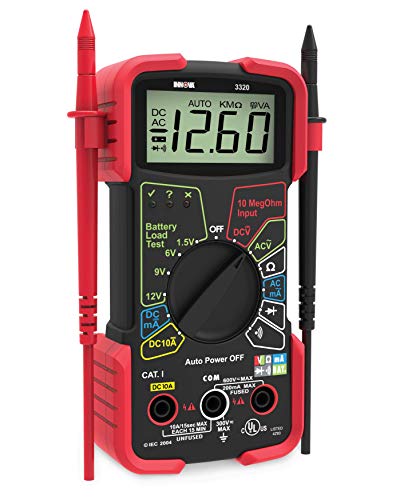
The INNOVA 3320 is a straightforward auto-ranging multimeter that is perfect for checking batteries, outlets, and basic household electrical issues. It features a large digital display and is equipped with a continuity buzzer. This meter is ideal for beginners due to its simple operation.
Pros
- Very user-friendly
- Low cost
- Compact and lightweight
Cons
- Limited features
- No backlight
Mastech MS8268
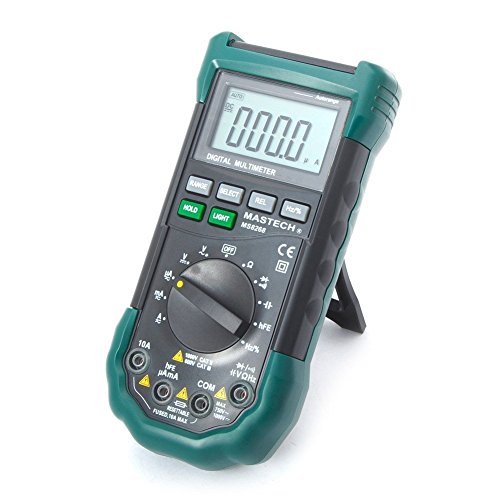
The Mastech MS8268 is a professional-grade auto-ranging multimeter with a wide range of functions, including true RMS, capacitance, frequency, and temperature. It has a large dual display that shows multiple readings simultaneously. The meter is designed with safety in mind, featuring overload protection and a CAT III rating.
Pros
- True RMS for accurate measurements
- Dual display for simultaneous readings
- High safety rating
Cons
- Slightly bulky
- No low impedance mode

Extech EX330
The Extech EX330 is an auto-ranging multimeter that includes a non-contact voltage (NCV) detector, making it easy to check for live wires without making contact. It measures AC/DC voltage, resistance, capacitance, and frequency. The meter features a backlit display and a built-in work light.
Pros
- Non-contact voltage detection
- Built-in work light
- Includes capacitance and frequency
Cons
- No True RMS
- No low impedance mode
KAIWEETS HT118A
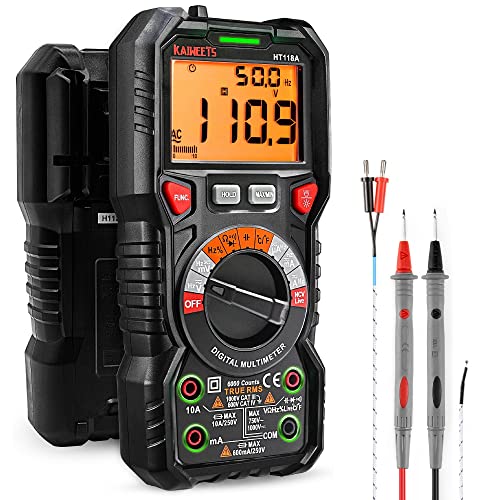
The KAIWEETS HT118A is an auto-ranging multimeter that offers a range of advanced features including True RMS, smart data hold, and a bright backlight. It has a rugged, double-molded housing that withstands drops and a built-in flashlight. The meter is CAT III 1000V rated, providing excellent safety.
Pros
- True RMS for accuracy
- Flashlight and backlit display
- Sturdy build with high safety rating
Cons
- No low impedance mode
- Slightly higher price for the features
How to pick the right one
Side by side
| # | Model | AC Voltage | Best for | Score | Price |
|---|---|---|---|---|---|
| 1 | Klein Tools MM400 | 600V | Best overall for electricians and DIYers | 9.4 | Check price |
| 2 | Fluke 117 | 600V | Best for professional electricians | 9.2 | Check price |
| 3 | AstroAI DM6000AR | 750V | Best budget-friendly option | 9.0 | Check price |
| 4 | INNOVA 3320 | 600V | Best for simple household checks | 8.5 | Check price |
| 5 | Mastech MS8268 | 750V | Best for comprehensive features | 8.8 | Check price |
| 6 | Extech EX330 | 600V | Best for non-contact voltage detection | 8.6 | Check price |
| 7 | KAIWEETS HT118A | 750V | Best for smart features and durability | 8.7 | Check price |
Good to know
What does auto-ranging mean on a multimeter?
Auto-ranging means the multimeter automatically selects the correct measurement range when you choose a function. You don’t need to manually set the range, making measurements faster and reducing the chance of errors.
Is True RMS necessary for circuit testing?
True RMS is important when measuring non-linear loads like those from electronic devices, as it provides accurate readings. For basic sine wave AC circuits, a standard average-responding meter may be sufficient.
What is low impedance (LoZ) mode and why is it useful?
LoZ mode lowers the input impedance of the meter, which drains residual voltage from circuits and prevents ghost readings. This is helpful when testing wires that may be disconnected but still show voltage due to capacitive coupling.
Can I use an auto-ranging multimeter on live circuits?
Yes, but you must follow safety precautions. Ensure the meter is rated for the voltage you are testing (e.g., CAT III for residential) and use the proper function and range. Always wear personal protective equipment.
What is the difference between CAT III and CAT IV ratings?
CAT III is for distribution level circuits like fixed installations and industrial equipment. CAT IV is for utility level connections like outdoor meters. Higher CAT ratings handle higher transient voltages, so CAT IV is safer for utility connections.
How often should I calibrate my multimeter?
For professional use, calibration is recommended annually or according to your quality standards. For hobbyists, calibration every few years is acceptable, but check the manufacturer’s guidelines.
Can these multimeters measure current?
Most auto-ranging multimeters can measure both AC and DC current, but the maximum current is often limited to 10A. For higher currents, you may need a clamp meter. Check the specifications of each model.
What is the advantage of a backlit display?
A backlit display improves visibility in low-light conditions, which is common when working in electrical panels or dark areas. It is a useful feature for safety and convenience.
Do these meters come with test leads?
Yes, all the multimeters in our roundup include a pair of test leads. Some also come with additional probes like alligator clips or temperature probes, as specified in the product description.
How do I choose between an analog and digital multimeter?
Digital multimeters with auto-ranging are more accurate and easier to read than analog ones. They offer more features and are safer for modern electronics. Analog meters are largely obsolete for professional use.
Our pick
For most electricians and DIYers, the Klein Tools MM400 is the clear winner due to its low impedance mode, robust build, and reasonable price. If you require True RMS for non-linear loads, the Fluke 117 is the best investment. Budget users should consider the AstroAI DM6000AR, which delivers solid performance at a fraction of the cost. Avoid models without LoZ if you work on circuits with ghost voltage issues.