How to Stock a Feeding Kit for Baby’s First Bites
Dr. Brown’s Natural Flow Anti-Colic Options+ Bottle Set covers the bottle stage with a vent you can remove later. ezpz Mini Mat suctions flat to a high chair tray at weaning. Boon Grass Countertop Drying Rack keeps nipples, valves and bottles off the worktop.
Building a feeding kit from scratch takes three items before anything else. Dr. Brown’s Natural Flow Anti-Colic Options+ Bottle Set handles the feeds, the ezpz Mini Mat handles thrown plates, and the Boon Grass Countertop Drying Rack handles the parts that pile up beside the sink.
Registry lists run long, and most of what sits on them stops being used within a fortnight. Survivors share three traits: few parts, honest dishwasher compatibility and a design that still works once a baby moves onto solids. We compared published material specifications, part counts and stated cleaning methods, then weighed those against what owners report keeping in rotation past six months.
What to look for
What baby feeding accessories do you actually need? Four categories carry most of the load: bottles, a drying rack, something to contain mess and a first utensil. Bottles and a rack earn their place from the first week. Bibs and plates wait for solids. Warmers, formula dispensers and food processors solve problems many families never have, so buy those once the need shows up rather than in advance.
How do you check materials and cleaning claims? Look for explicit statements rather than implied ones. BPA free, PVC free and phthalate free should appear in the listing text, not only in the packaging photography. Check whether the manufacturer says top rack dishwasher, full dishwasher or hand wash only, because those differ meaningfully. Silicone and glass tolerate boiling and steam sterilising. Printed designs on bibs and plates fade in hot cycles even when the item itself is rated safe.
Which feeding accessories suit each stage? Bottles and a drying rack matter from day one. Suction mats and flat pre spoons become relevant around six months, when solids begin. Sleeved bibs earn their place slightly later, once a baby feeds themselves and food travels further. Open cups and cutlery sets follow after that. Buying a whole year at once means storing things for months and discovering your baby skips half of them.
Will a suction plate stick to your high chair tray? Suction works on smooth, non porous surfaces only. Glass tables and moulded plastic high chair trays hold well. Textured plastic, mesh trays and untreated wood do not, whatever the technique. Wipe both surfaces dry, then press from the centre outward to push the air out. Check your own tray before ordering, because no amount of pressing fixes the wrong surface.
Our top picks
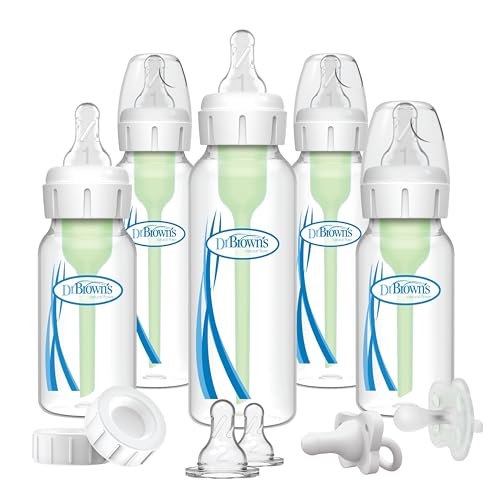
Dr. Brown’s Natural Flow Anti-Colic Options+ Bottle Set
An internal vent draws air to the base of the bottle instead of through the milk. Lift that vent out when your baby no longer needs it and the system becomes an ordinary bottle with fewer parts. Nipple flow levels run from preemie upward and sell separately as spares.
Pros
- Vent lifts out as your baby grows
- Spare nipples and parts are easy to find
- Fits standard warmers and sterilisers
Cons
- More parts than one piece bottles
- Vent tube needs a narrow brush

ezpz Mini Mat
Placemat and plate are moulded as one piece of silicone, leaving no rim for a baby to grip and launch. Its whole base suctions to a smooth tray or table, and a corner tab releases it when the meal ends. Nothing disassembles, so it goes straight into the dishwasher.
Pros
- One piece design, nothing to lose
- Full base suction resists a toddler pull
- Three sections help with portioning
Cons
- Will not grip textured or mesh trays
- Tomato and turmeric leave stains
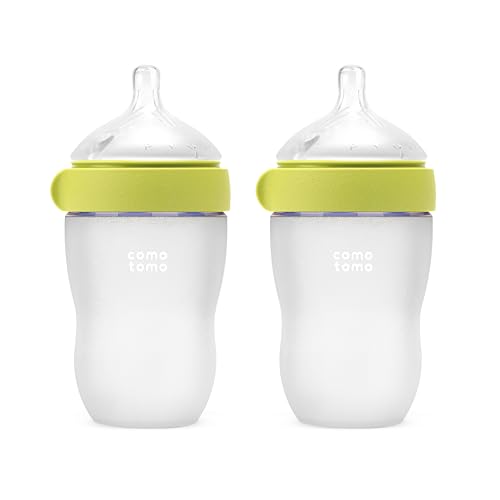
Comotomo Baby Bottle
Soft silicone body, a very wide opening and three parts in total. Your hand reaches inside to wash it, which removes the bottle brush from the routine entirely. Squeezable sides suit babies moving between breast and bottle, though the wide base misses many warmers.
Pros
- Cleans by hand without a brush
- Three parts to wash and rebuild
- Soft body is easy for a baby to hold
Cons
- Tips more readily than rigid bottles
- Does not fit every warmer or holder

Boon Grass Countertop Drying Rack
Flexible spikes rise from a shallow tray, so bottles, nipples, valves and vent tubes all push onto whichever spike suits their shape. Footprint stays smaller than a folding tree rack beside a sink. Lift the tray out to pour collected water away.
Pros
- Holds small parts as well as bottles
- Small footprint beside a sink
- Tray lifts out to empty
Cons
- Fills up with a full day of bottles
- Spikes need occasional deep cleaning

Bumkins Sleeved Bib
Neck bibs stop covering the right areas the moment a baby starts feeding themselves. Sleeves and a full torso panel catch porridge on the forearms, where a lot of it lands. Waterproof polyester wipes down or goes in the machine, and the fabric stays light enough that babies keep it on.
Pros
- Covers arms as well as the chest
- Light enough to be tolerated
- Machine washable, not hand rinse only
Cons
- Rear fastening fights a squirming baby
- Sleeves stay damp longer after washing

Munchkin High Capacity Bottle Drying Rack
Choose this one when bottles get washed in a single evening batch rather than after every feed. Pegs move and lift out, so wide neck bottles, pump parts and sippy cups all find a slot. An angled tray drains toward a spout instead of pooling water underneath.
Pros
- Holds a full day of bottles and pump parts
- Pegs rearrange for awkward shapes
- Angled tray drains rather than pools
Cons
- Takes substantial counter space
- Looks cluttered next to compact racks

NumNum Pre-Spoon GOOtensils
No bowl sits on the head of these utensils, so food clings to a flat surface and reaches the mouth from any angle. That removes the aiming step which makes conventional first spoons frustrating. Two stages come in the set, moving from flat to shallow grooves as coordination improves.
Pros
- Removes the aiming problem entirely
- Two stages track early progress
- Soft edges suit teething gums
Cons
- Carries less food than a spoon
- Outgrown once scooping starts
Side by side
| # | Model | Material | Best for | Score | Price |
|---|---|---|---|---|---|
| 1 | Dr. Brown’s Natural Flow Anti-Colic Options+ Bottle Set | BPA free polypropylene, glass version available | Best overall | 9.4 | Check price |
| 2 | ezpz Mini Mat | Food grade silicone, one piece | Best for weaning | 9.2 | Check price |
| 3 | Comotomo Baby Bottle | Food grade silicone body | Best silicone bottle | 9.0 | Check price |
| 4 | Boon Grass Countertop Drying Rack | Flexible spike mat over drainage tray | Best for small kitchens | 8.8 | Check price |
| 5 | Bumkins Sleeved Bib | Waterproof polyester, PVC free | Best bib for self feeding | 8.6 | Check price |
| 6 | Munchkin High Capacity Bottle Drying Rack | High, multiple bottles and parts | Best for batch washing | 8.3 | Check price |
| 7 | NumNum Pre-Spoon GOOtensils | Food grade silicone with rigid core | Best first utensil | 8.0 | Check price |
Frequently asked questions
How many bottles do you need?
Four to six covers a day if you wash after each feed, or eight to ten if you prefer one evening batch. Start with two or three of a single system to confirm your baby accepts the nipple, since unopened extras are easier to return.
Is food grade silicone safe for babies?
Food grade and medical grade silicone are widely used in feeding products and stay stable through dishwashing, sterilising and boiling. Look for those exact terms in the listing. Replace any silicone item that turns sticky, cracked or discoloured.
Do you need to sterilise bottles every time?
Guidance varies by country and by the age of the baby, so follow your health visitor or paediatrician. Thorough washing in hot soapy water or a dishwasher is the baseline everywhere, with sterilising advised more strictly for young infants.
When can a baby start using utensils?
Many babies begin exploring self feeding around six months, alongside first solids. Flat pre spoon designs suit that earliest phase because they need no aiming. Timing differs between children, so raise it with your health visitor or paediatrician.
Can bottle parts go in the dishwasher?
Most bottles state top rack dishwasher safe, though the specific product listing is what counts. Put vents, valves and small rings in a closed basket so they cannot fall through. Hot cycles shorten nipple life, so many parents wash those by hand.
What is the difference between a drying rack and a steriliser?
A rack holds washed items so air circulates around them. A steriliser uses steam or ultraviolet light to kill remaining microorganisms. They do different jobs, and most families use both: sterilise when advised, then air dry on a rack.
How do you get stains out of silicone bibs and mats?
Tomato, carrot and turmeric stains are cosmetic rather than a hygiene problem. A paste of bicarbonate of soda and water left on the mark often lifts most of it, as does a few hours in direct sunlight after washing. Avoid abrasive scourers, which scratch the surface and trap future stains.
Which bibs work best for baby led weaning?
Self feeding sends food onto the forearms and sleeves, so sleeved coverall bibs beat neck bibs at that stage. Silicone bibs with a catch pocket work for spoon fed meals but leave arms exposed. Many families keep both types in rotation.
Do you need a bottle warmer?
No. A jug of hot water warms a bottle in a few minutes and costs nothing. Warmers earn their place for families doing several night feeds, where waiting by a kettle at three in the morning wears thin. Never warm milk in a microwave, which heats unevenly.
Final word
Dr. Brown’s Natural Flow Anti-Colic Options+ Bottle Set is the safest first purchase, because removing the vent later means the system grows with your baby instead of being outgrown. Add the ezpz Mini Mat when solids start, pick a Boon Grass or Munchkin rack to suit your counter space, and bring in a Bumkins Sleeved Bib once self feeding turns every meal into a clean up.


