Baby Jumpers That Keep Little Legs Busy and Safe
Fisher-Price Rainforest Jumperoo leads on stability, with a wide freestanding base and three height settings. Graco Bumper Jumper clamps into a door frame and frees the floor entirely. Skip Hop Explore and More converts into a toddler play table once the jumping stage ends.
Fisher-Price Rainforest Jumperoo suits most homes with a spare corner for a freestanding frame. Where floor space is tight, Graco Bumper Jumper does the same job inside a door frame. Skip Hop Explore and More claims more room but keeps earning it as a play table later.
Jumper shopping turns on safety and space rather than features. Feet must reach the floor flat, so adjustment range matters more than toy count, and clamp models depend entirely on your door mouldings. We compared stated weight and height limits, number of height settings, set-up footprints and frame materials. Consistent owner feedback about wobble, carpet grip and storage decided the close calls.
Before you buy
What to look for in a baby jumper Readiness comes first. Most jumpers are rated for babies who hold their head steady unassisted, generally somewhere between four and six months. Stated weight limits commonly land near twenty five pounds, and use should stop once a baby walks. Beyond that, judge frames on adjustment range, base width and whether toys sit within arm’s reach. Space is the final filter, since a freestanding frame claims its corner every day.
How should the jumper seat height be set? Feet rest flat on the floor with a slight bend at the knee. Pushing off with the whole foot is the goal; tiptoe contact means the seat sits too high. More settings buy more months before a growth spurt ends the fit. Owners report this one adjustment causes most setup mistakes. Recheck it every few weeks, because babies gain length fast in the first year.
Doorway jumper vs freestanding frame: which suits your home? Door frames decide this. Clamp models need a solid moulding to grip, and they block a doorway for as long as the baby is bouncing. Freestanding frames ignore your architecture, sit steadily on carpet, and can be placed where you can see them from the kitchen. Measure the moulding and the free floor area before choosing. Renters and small flats usually land on doorway designs; a house with a spare corner does better with a frame.
How long should a baby use a jumper each day? Short sessions are the standard guidance, commonly framed as fifteen to twenty minutes at a time. Long stretches in any supportive seat eat into the floor time that builds core strength. Treat a jumper as a safe pause while you cook or shower, not a place to park a morning. Level floors only, always within sight, never on a raised surface. Bouncing also does not teach walking, which comes from crawling, cruising and supported standing.
The top picks, ranked

Fisher-Price Rainforest Jumperoo
Three height settings and a rotating seat let a baby reach every toy station unaided. Lights and music fire in response to bouncing, which holds attention longer than static toys. Owners report the wide base stays planted on carpet, though it does claim a permanent corner of the room.
Pros
- Wide base resists tipping during hard bouncing
- Rotating seat puts every toy in reach
- Height adjusts through several months of growth
Cons
- Needs a dedicated patch of floor
- Awkward to carry between rooms
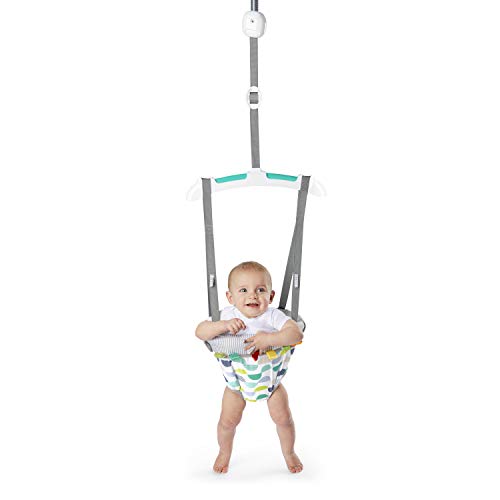
Graco Bumper Jumper
Clamping to a door frame frees the floor completely, which counts in a small living room. A padded bumper rings the frame so enthusiastic bouncing does not knock hands against wood. Owners report the clamp wants a solid moulding, so check the frame before ordering.
Pros
- Uses no floor space at all
- Packs into a bag for trips to grandparents
- Bumper keeps hands off the door frame
Cons
- Only fits frames with firm moulding
- Blocks the doorway while in use
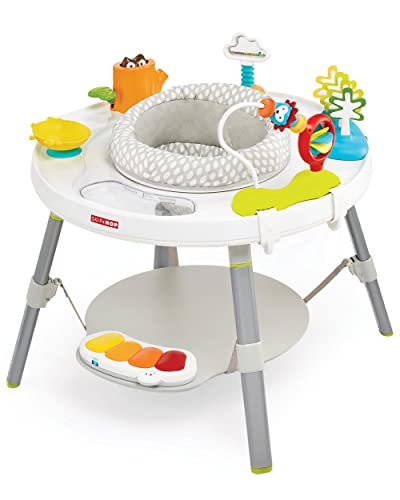
Skip Hop Explore and More Baby’s View 3 Stage Activity Center
Three stages carry this from jumper to activity centre to toddler play table. A clear panel in the base lets babies watch their own feet, which stretches attention past what static toys manage. Wipe clean trays replace fabric, so a snack spill needs a cloth rather than a wash cycle.
Pros
- Converts into a play table for toddlers
- Foot window holds attention longer
- Trays wipe down after snacks
Cons
- Larger footprint than a doorway model
- Conversion parts need somewhere to live

Baby Einstein Neptune’s Ocean Discovery Jumper
Sensory variety is the pitch: a piano station, spinning toys and audio in several languages. Full seat rotation and multiple frame heights cover the usual growth window. Its seat pad lifts out for the washing machine, which jumpers with sewn-in fabric cannot match.
Pros
- Broad spread of sensory stations
- Seat pad comes out for machine washing
- Seat spins to reach each toy
Cons
- Sound loops grate on adults
- Wide frame crowds a small room

Evenflo ExerSaucer Jump and Learn Jumper
A broad, low frame keeps the centre of gravity down, so hard bouncing produces less wobble. Toys sit on a tray within arm’s reach and pull off for cleaning. Owners report it holds position on carpet, where lighter frames tend to creep across the room.
Pros
- Steady under energetic bouncing
- Holds position on carpet and hard floors
- Toys detach for washing
Cons
- Bulkier to store than folding rivals
- Fewer electronic features than premium frames
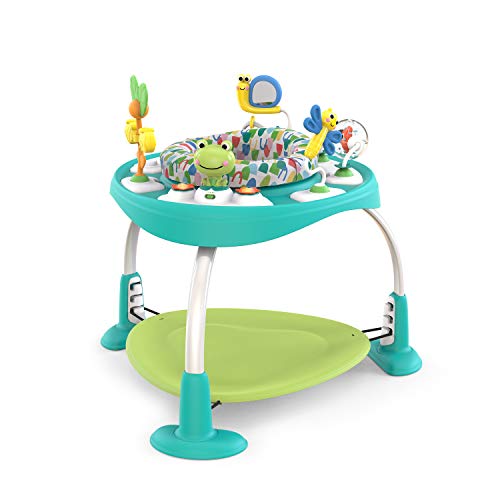
Bright Starts Bounce Bounce Baby 2 in 1 Activity Jumper
Folding flat is the point, because a jumper cannot sit in the middle of a shared living room all day. Two modes cover bouncing first and stationary play afterwards. Owners report it weighs less than most freestanding frames, so moving it between rooms is a one person job.
Pros
- Folds flat between sessions
- Light enough to shift room to room
- Two modes stretch its useful life
Cons
- Moves more than heavier frames under a strong bouncer
- Fewer height settings than rivals

Jolly Jumper Exerciser
Simplest design here: a fabric seat on a spring, clamped to a door frame or hung from a stand sold separately. Skipping the plastic activity centre leaves nothing to store and nothing to look at in the living room. Owners report a livelier bounce than padded frames, so height setting and supervision matter more.
Pros
- Stores in a drawer
- No electronics or batteries to manage
- Springier bounce that many babies prefer
Cons
- Freestanding stand sold separately
- Needs careful height setting and close supervision
The lineup, side by side
| # | Model | Type | Best for | Score | Price |
|---|---|---|---|---|---|
| 1 | Fisher-Price Rainforest Jumperoo | Freestanding stationary jumper | Best overall | 9.4 | Check price |
| 2 | Graco Bumper Jumper | Doorway jumper with clamp | Best value | 9.2 | Check price |
| 3 | Skip Hop Explore and More Baby’s View 3 Stage Activity Center | Jumper, activity centre and play table | Best convertible design | 9.0 | Check price |
| 4 | Baby Einstein Neptune’s Ocean Discovery Jumper | Freestanding jumper | Best for engagement | 8.8 | Check price |
| 5 | Evenflo ExerSaucer Jump and Learn Jumper | Freestanding jumper | Best for stability | 8.6 | Check price |
| 6 | Bright Starts Bounce Bounce Baby 2 in 1 Activity Jumper | Freestanding, folds flat | Best for small spaces | 8.3 | Check price |
| 7 | Jolly Jumper Exerciser | Spring suspended doorway jumper | Best minimal design | 8.0 | Check price |
Common questions
What age can a baby start using a jumper?
Once head control is steady without support, which usually arrives between four and six months. Use ends at the stated weight limit or when walking begins. Follow the figures printed by the manufacturer rather than age alone.
How long can a baby stay in a jumper?
Roughly fifteen to twenty minutes per session is the common recommendation, with floor and tummy time around it. Several short turns beat one long stretch.
Are doorway jumpers safe?
Yes, when the clamp grips a solid frame, the height is set so feet reach the floor, and an adult stays in the room. Check the clamp before every session and skip frames with loose or narrow mouldings.
Do baby jumpers help babies learn to walk?
No. Walking develops through floor play, crawling and cruising along furniture. Treat a jumper as short entertainment rather than developmental equipment.
How do you know the seat height is right?
Look at the feet. Flat contact with a slight knee bend is correct; tiptoes mean the seat is too high, and bent hips mean it sits too low.
Which is better, a stationary jumper or a doorway jumper?
Stationary frames are steadier and work in any room. Doorway models save floor space and pack away. Your home usually decides this more than the product does.
Can you use a baby jumper on carpet?
Freestanding frames work fine on carpet, though the bounce feels softer and heavier bases stay put better. Doorway models still need feet reaching the floor comfortably.
What is the weight limit on most baby jumpers?
Around twenty five pounds is typical, with some activity centres allowing more in their converted modes. Exceeding the figure affects how steady the frame stays.
Which baby jumper works best in a small apartment?
Graco Bumper Jumper uses no floor at all, and Bright Starts Bounce Bounce Baby folds flat between sessions. Jolly Jumper Exerciser packs smaller still.
When should you stop using a baby jumper?
Once a baby walks unaided, exceeds the weight limit, or can climb out of the seat. Some babies also lose interest well before that point.
The verdict
Fisher-Price Rainforest Jumperoo is the pick for most homes, pairing a planted base with three height settings and toys that hold interest. Where floor space is the constraint, Graco Bumper Jumper buys the same twenty minutes inside a door frame. Skip Hop Explore and More takes more room and repays it by becoming a toddler play table.


