A Good Battery Tester Tells You Before the Device Dies
ANCEL’s BA101 suits most drivers, reporting state of health, cranking strength and alternator output on one screen with no app involved. Autel’s BT506 goes further with a colour touchscreen and full electrical system analysis. TOPDON’s BT100 keeps the same three tests in a pocket sized handheld.
ANCEL’s BA101 answers the question most drivers actually have: is the battery failing, or is the alternator? Deeper diagnostic work suits the Autel BT506 and its adjustable test parameters. TOPDON’s BT100 covers the same core tests in a smaller, simpler package.
Testers diverge more than the listings suggest. Some measure conductance and estimate cold cranking amps against the battery’s rating, while others read voltage and stop there. Chemistry support varies too, and an AGM battery tested on a flooded setting returns a number you cannot trust. Picks below were ranked on published CCA ranges, supported voltages and chemistries, whether cranking and charging tests are included, and what owners report about repeatable readings.
The top picks, ranked

ANCEL BA101
BA101 runs three tests on a 12V system: battery health, cranking voltage during start, and charging output with the engine running. Results land as a percentage and a plain verdict rather than raw numbers needing interpretation. Flooded, AGM and gel chemistries are all selectable, which covers everything on a modern driveway.
Pros
- States health as a percentage, not a raw figure
- Separates battery faults from charging faults
- Selectable chemistry keeps AGM readings honest
Cons
- No 6V or 24V coverage
- Results cannot be exported or logged

Autel BT506
BT506 puts battery and electrical system analysis behind a colour touchscreen, with test parameters you can adjust rather than accept. Coverage spans 6V and 12V, so classic cars and motorcycles fall inside its range. Reports appear as detailed on screen breakdowns, which suits anyone diagnosing a parasitic drain rather than confirming a dud battery.
Pros
- Analyses the wider electrical system, not just the battery
- Touchscreen shows detailed breakdowns at a glance
- Test parameters adjust to the vehicle
Cons
- Depth of features overwhelms occasional users
- Screen and menus need charging and care

TOPDON BT100
BT100 delivers the same three core tests as far larger units in a body that fits a glovebox. Menus are short, so a reading takes under a minute from clamping on. Coverage stops at 12V, which is no limitation for a household running ordinary cars.
Pros
- Full cranking and charging tests in a small body
- Short menus mean fast repeat checks
- Draws power from the battery, so no cells to replace
Cons
- Monochrome display shows less detail
- 12V only, so no motorcycle six volt work
FOXWELL BT705
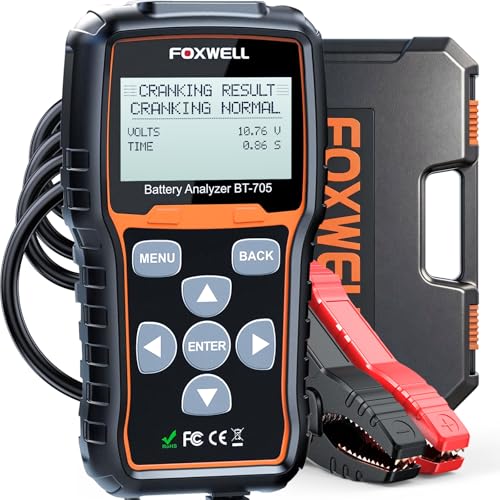
BT705 spans 12V and 24V, which brings light trucks and commercial vehicles into range alongside cars. Flooded, AGM and gel chemistries are each selectable, and modern stop start cars almost always need the AGM setting. Results print through a supported printer, useful when a workshop hands evidence to a customer.
Pros
- 24V coverage handles trucks and dual battery setups
- Chemistry selection matches modern stop start cars
- Printed results document a warranty claim
Cons
- Bigger than a glovebox handheld
- Printing needs a separate supported printer

KONNWEI KW208
KW208 covers battery, cranking and charging tests across roughly 100 to 2000 CCA, matching far more elaborate units on function. Its backlit screen stays readable under a bonnet at dusk. Housing and menu design show where the corners were cut, though the readings themselves hold up for DIY use.
Pros
- Complete test set at the entry level
- Backlit screen readable in a dark engine bay
- Wide CCA range covers cars and light trucks
Cons
- Plastic housing feels light in the hand
- Menu wording is clumsy in places

Schumacher BT-100
Schumacher’s BT-100 applies a real load and shows the result on a colour coded needle gauge. Nothing needs charging, pairing or configuring, which is why it survives in workshop drawers. Both 6V and 12V batteries are covered, making it useful for classic cars and garden machinery.
Pros
- Applies an actual load rather than estimating
- No internal battery, menus or setup
- Covers 6V batteries most digital units ignore
Cons
- Needle gauge gives no numeric health figure
- Load testing heats up and needs a rest between checks
OTOFIX BT1 Lite
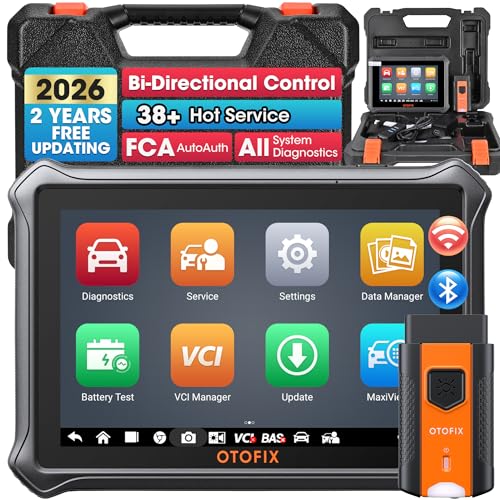
BT1 Lite pairs to a phone app that stores each test, so battery decline shows as a trend rather than a one off number. Coverage spans 6V and 12V with cranking and charging analysis included. Firmware updates arrive through the same app, which keeps the unit current as vehicles change.
Pros
- Saved reports show decline across seasons
- Cranking and charging tests included
- Firmware updates extend vehicle coverage
Cons
- A dead phone leaves the tester half useful
- Setup takes longer than a standalone handheld
Before you buy
What does a car battery tester actually measure? Three separate readings matter, and cheap tools give you only the first. Voltage shows the resting state of charge, which is why a failing battery can still read normal on a multimeter. State of health estimates remaining capacity by measuring internal conductance and comparing it against the battery’s rated cold cranking amps. Cranking voltage records how far the battery sags while the starter turns, which exposes weakness nothing else catches. Charging output then checks whether the alternator holds proper voltage under load. Running all three separates three very different repair bills: a battery needing a charge, a battery needing replacement, and a charging system at fault.
Which CCA range and battery type do you need? Your battery’s cold cranking amp rating is printed on its label, and the tester must cover that figure to compare against it. A range topping out around 2000 CCA covers cars, SUVs and light trucks comfortably. Chemistry matters just as much. Stop start cars use AGM or EFB batteries that behave differently under test, and selecting flooded on an AGM battery returns misleading health numbers. Larger trucks and dual battery setups need 24V support, which only the FOXWELL BT705 provides here. Motorcycles and classic cars need 6V, covered by the Autel BT506, Schumacher BT-100 and OTOFIX BT1 Lite.
How do you read cranking and charging results? Cranking voltage is the number to watch first. A healthy 12V battery should stay above roughly 9.6 volts while the starter turns, and anything sagging lower is failing under load regardless of what it reads at rest. Charging output should sit somewhere around 13.5 to 14.7 volts with the engine running. Readings below that point at the alternator or its belt, while readings above suggest a regulator fault that will boil a battery dry. Test with the battery reasonably charged, since a flat battery skews health estimates low and produces a false failure.
Is a simple load tester or a connected analyzer better? Simple wins for occasional checks. Schumacher’s BT-100 gives a pass or fail in seconds with no charging, pairing or menus, which is exactly right for a tool used twice a year. Digital handhelds such as the ANCEL BA101 and TOPDON BT100 add numeric health figures and charging tests without complication. App linked units like the OTOFIX BT1 Lite earn their keep only if you actually log results, since the value comes from watching a battery decline across seasons. Workshops handing results to customers want the FOXWELL BT705 and its printed reports.
The lineup, side by side
| # | Model | Voltage | Best for | Score | Price |
|---|---|---|---|---|---|
| 1 | ANCEL BA101 | 12V systems | Best overall | 9.4 | Check price |
| 2 | Autel BT506 | 6V and 12V | Best for advanced diagnostics | 9.2 | Check price |
| 3 | TOPDON BT100 | 12V systems | Best value | 9.0 | Check price |
| 4 | FOXWELL BT705 | 12V and 24V | Best for AGM and mixed fleets | 8.7 | Check price |
| 5 | KONNWEI KW208 | 12V systems | Best budget analyzer | 8.5 | Check price |
| 6 | Schumacher BT-100 | 6V and 12V | Best simple load tester | 8.2 | Check price |
| 7 | OTOFIX BT1 Lite | 6V and 12V | Best for tracking battery health | 8.0 | Check price |
Frequently asked questions
How is a battery tester different from a multimeter?
A multimeter reports voltage at rest, which stays near normal on a battery about to fail. Testers estimate capacity through conductance, watch voltage sag during cranking, and check alternator output. That combination catches problems weeks before a no start morning.
Do you have to remove the battery to test it?
Usually not. Clamps attach to the terminals with the battery in place, and cranking and charging tests specifically require the engine to run. Heavy terminal corrosion is the exception, since it skews readings until cleaned.
What CCA rating should a battery tester support?
Match it to the figure printed on your battery label. A range reaching around 2000 CCA covers cars, SUVs and light trucks. Entering the wrong rating is the most common cause of a wrong verdict, so read the label rather than guessing.
Can these testers check AGM batteries?
Many can, but the setting must be selected. ANCEL BA101 and FOXWELL BT705 both list AGM and gel support explicitly. Testing an AGM battery on the flooded setting returns a health figure that means nothing.
Will a battery tester tell me if my alternator is bad?
The charging test indicates whether output holds steady under load, which points the finger accurately most of the time. Around 13.5 to 14.7 volts running is normal. A shop can confirm a suspected fault with a ripple test before you buy an alternator.
Can one tester handle 6V, 12V and 24V batteries?
No single pick here covers all three. FOXWELL BT705 adds 24V for trucks. Autel BT506, Schumacher BT-100 and OTOFIX BT1 Lite cover 6V for motorcycles and classic cars. Check the voltage line before ordering.
How often should you test a car battery?
Before winter is the single most useful check, since cold thickens oil and weakens batteries at the same moment. Twice a year suits older batteries. Test immediately at the first slow crank rather than waiting to see if it repeats.
Are app connected battery testers worth it?
They pay off when you track several vehicles or want to watch a battery decline over years. Logged results turn guesswork into a trend line. For an occasional pass or fail, a standalone handheld involves less faff.
What voltage means a car battery is bad?
A rested 12V battery sitting around 12.6 volts is full, near 12.4 is roughly three quarters charged, and under 12.0 is significantly discharged. Sagging below about 9.6 volts during cranking indicates a failing battery even if the resting figure looks acceptable.
Can a battery pass a test and still fail?
Yes, particularly in cold weather, where capacity drops sharply below freezing. Intermittent internal faults also hide from a single test. Retesting after a cold night, and checking terminal and ground connections, catches most of these cases.
Final word
ANCEL’s BA101 is the tester most drivers should own, reporting health, cranking and charging clearly enough to act on without a manual. Step up to the Autel BT506 when the wider electrical system is under suspicion, or take the TOPDON BT100 for the same core tests in a smaller body. Whichever you pick, enter the CCA rating from the battery label and select the right chemistry, or the verdict is meaningless.