Bearing Puller Sets That Match Real Shop Jobs
OTC’s 4532 7-ton set leads for shop-wide versatility, pairing dual jaw reaches with a 7-ton forcing screw. Lisle’s 31330 reversible 2-jaw/3-jaw puller delivers strong value for passenger car work. ABN’s 3-Jaw Gear Puller Set fits tight budgets while keeping steel construction and acme-threaded screws for repeated use.
OTC’s 4532 covers the widest span of jobs from one case, Lisle’s 31330 balances price against 2-jaw and 3-jaw capability, and ABN’s 3-Jaw set handles occasional pulls at a lower cost.
Bearing pullers disappoint buyers when jaw spread or tonnage falls short of the actual job, so mismatched capacity is the most common failure point. We compared reach, rated capacity, and case quality across sets built for pulleys, hubs, gears, and axle bearings, weighing owner feedback on durability alongside listed specifications.
What to look for
How Do Bearing Puller Sets Remove Press-Fit Parts? A bearing puller grips a bearing, gear, or pulley from behind, then drives steady force through a center screw. Jaws hook the component’s edge on some designs, while a split ring clamps below it on others. Matching jaw type to the part being pulled prevents slipping and gouged shafts. Interchangeable jaws or splitters let one puller head cover several job sizes, which is why most automotive kits bundle more than one attachment.
2-Jaw vs 3-Jaw Pullers: Which Grip Fits the Job? Two-jaw pullers center more easily on round parts like pulleys and small bearings. Uneven flanges, such as those on flywheels, respond better to a three-jaw puller spreading load across three points. Reversible sets like the Lisle 31330 and Powerbuilt 648721 switch between both without buying two tools. Pick 2-jaw for a simple round pull, and reach for 3-jaw when a part resists centering.
How Much Tonnage and Reach Does a Puller Set Need? Capacity ratings between 3 and 7 tons show how much force a forcing screw can apply before the jaws risk bending. Jaw spread, measured in inches, sets the largest part the kit can straddle without extra attachments. Rust and loss between jobs become real risks for loose jaws and screws, so a blow-molded or molded plastic case adds real protection. Several budget sets skip a case, which trades organization for a lower cost.
Which Bearing Puller Suits Automotive, Small Engine, or Industrial Work? Passenger car alternators, pulleys, and small bearings typically need only 3 to 5 tons and a compact jaw spread. Truck wheel hubs, pinion bearings, and harmonic balancers call for 7-ton sets with a longer reach, such as the OTC 4532 or Powerbuilt 648721. Rear axle bearings pressed deep into a housing often favor a pneumatic or slide-hammer style kit, like the Neiko 20721A, over a standard screw-type puller. Shops running mixed fleets tend to keep both a mid-range reversible set and a heavier bar-type puller on hand.
The shortlist, ranked

OTC 4532 7-Ton Multi-Purpose Bearing and Puller Set
OTC built the 4532 around an H-bar puller block paired with two jaw sets spanning 5 to 9 inches. Short and long forcing screws deliver up to 7 tons without a tool swap. Owners report the blow-molded case keeps every jaw and screw organized on a service truck.
Pros
- Two jaw sets cover a 5 to 9 inch spread
- 7-ton screw pulls stubborn hubs free
- Blow-molded case keeps parts organized
Cons
- Bulkier than a single-purpose splitter
- H-bar block needs open clearance to set up

Lisle 31330 2 or 3 Jaw Reversible and Adjustable 5 Ton Puller
Lisle built the 31330 to flip between 2-jaw and 3-jaw configurations with no extra parts. A 5-ton screw and 3 to 5 inch reach cover most passenger car pulleys and small bearings. Owners report the reversible design replaces two separate pullers in one kit.
Pros
- Switches between 2-jaw and 3-jaw setups
- 5-ton rating handles most passenger car jobs
- Compact enough for a drawer, not a chest
Cons
- Ships without a storage case
- Reach falls short of bar-type pullers
ABN 3-Jaw Gear Puller Set, 3-Piece (3in, 4in, 6in)
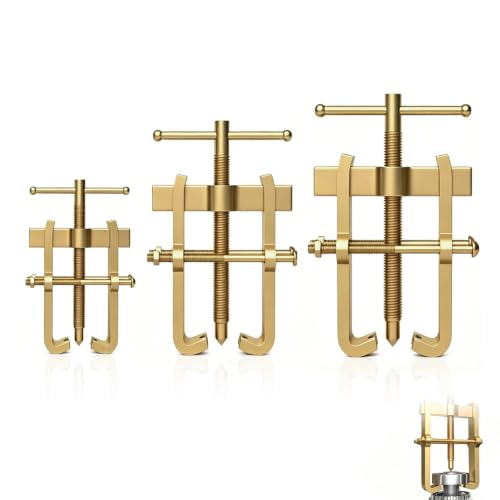
ABN bundles three jaw sizes, 3, 4, and 6 inch, so light bearing and pulley jobs get matched to the right tool. Cold-rolled, acme-threaded screws resist stripping under repeated use. Owners report it clears small engine and lawn equipment bearings without trouble.
Pros
- Three sizes cover most small pulleys
- Acme-threaded screws resist stripping
- Priced for occasional home use
Cons
- Capacity trails bar-type pullers
- No case included for storage

OTC 1183 Bearing Splitter Combo Set
Four bearing splitters plus a pulley attachment give the OTC 1183 a spread from 1/2 inch to 5-3/4 inch. Knife-edge jaws seat behind small pulleys and bearings that bar-type jaws can’t reach. Owners report it pairs well with an existing push-puller in tight clearance spots.
Pros
- Four splitter sizes handle small components
- Knife-edge jaws reach behind tight bearings
- Pulley attachment adds versatility
Cons
- Needs a separate puller to apply force
- Not a standalone pulling tool

Orion Motor Tech OMT Bearing Puller Set, 5-Ton Capacity
A 6-inch yoke and forcing screw anchor the Orion Motor Tech OMT set, rated to 5 tons. Included 2-inch and 3-inch separator jaws target wheel hub and pinion bearing removal on trucks and SUVs. Owners report the molded case keeps the yoke and extension screws from disappearing in a toolbox.
Pros
- 5-ton rating suits heavier hub jobs
- Two jaw sizes cover common bearing diameters
- Molded case keeps small parts together
Cons
- Yoke setup takes longer than simple 2-jaw pullers
- Extension screws misplace easily outside the case

Powerbuilt 648721 Gear Puller, 3-Way Reversible Jaw, 8 Inch Reach
An 8-inch reach and 3-way reversible jaw let the Powerbuilt 648721 switch between inside and outside pulls. Its steel yoke handles 7 tons, enough for press-fit pulleys that smaller pullers can’t budge. Owners report it reaches deep-set balancer bolts other pullers can’t clear.
Pros
- 8-inch reach clears deep harmonic balancers
- 7-ton capacity moves press-fit components
- Inside and outside pull options add flexibility
Cons
- No case included for storage
- Larger footprint needs more workspace

Neiko 20721A Pneumatic Rear Axle Bearing Puller Service Kit
Neiko swaps the usual forcing screw for a pneumatic slide-hammer on the 20721A, built for rear axle bearings seated deep in a housing. Three pieces nest into one case for quick transport between jobs. Owners report the air hammer action frees stuck bearings faster than a manual slide hammer.
Pros
- Pneumatic action speeds bearing removal
- Compact 3-piece kit travels well
- Molded case protects tools in transit
Cons
- Needs an air compressor to run
- Limited to rear axle style bearing removal
How they stack up
| # | Model | Jaw Spread | Best for | Score | Price |
|---|---|---|---|---|---|
| 1 | OTC 4532 7-Ton Multi-Purpose Bearing and Puller Set | 5 to 9 in. across two jaw sets | Best overall | 9.4 | Check price |
| 2 | Lisle 31330 2 or 3 Jaw Reversible and Adjustable 5 Ton Puller | 3 to 5 in. reach | Best value | 9.1 | Check price |
| 3 | ABN 3-Jaw Gear Puller Set, 3-Piece (3in, 4in, 6in) | 3, 4, and 6 in. pullers | Best budget | 8.8 | Check price |
| 4 | OTC 1183 Bearing Splitter Combo Set | 1/2 to 5-3/4 in., four splitters | Best for small bearings and pulleys | 8.6 | Check price |
| 5 | Orion Motor Tech OMT Bearing Puller Set, 5-Ton Capacity | 2 in. and 3 in. jaws | Best for automotive and heavy-duty hubs | 8.4 | Check price |
| 6 | Powerbuilt 648721 Gear Puller, 3-Way Reversible Jaw, 8 Inch Reach | 8 in. reach | Best for gear and harmonic balancer pulling | 8.2 | Check price |
| 7 | Neiko 20721A Pneumatic Rear Axle Bearing Puller Service Kit | N/A, collet-style expanding head | Best portable kit | 8.0 | Check price |
Frequently asked questions
What size bearing puller do I need?
Match jaw spread to the outer diameter of the bearing or pulley housing. Passenger car jobs usually fit a 3 to 6 inch spread, while truck hubs often need 7 inches or more.
2-jaw vs 3-jaw puller, which is better?
2-jaw pullers center faster on round pulleys and small bearings. Uneven flanges like flywheels grip more securely under a 3-jaw puller, so reversible sets cover both situations.
How many tons of pulling force do I need for wheel bearings?
Most wheel hub bearings release with 5 to 7 tons of force. Rusted or press-fit bearings on trucks sometimes require the higher end of that range.
Can a bearing puller damage the shaft?
Jaws that slip or seat at an angle can gouge a shaft. Splitters with knife-like edges, such as the OTC 1183, lower that risk in tight clearances.
Is a bearing separator the same as a bearing puller?
A bearing separator, or splitter, clamps behind a bearing so a separate puller or press can apply force. A puller applies that force itself through its own screw.
Do bearing puller sets work on harmonic balancers?
Yes, provided the set has enough reach and reversible jaws. The Powerbuilt 648721 and similar 3-way pullers are built for the deep-set bolts found on balancers.
What comes in a typical bearing puller kit?
Most kits include a puller head or yoke, a forcing screw, interchangeable jaws or splitters, and sometimes a case. Pneumatic kits swap the screw for an air hammer instead.
What’s the difference between a bearing puller and a gear puller?
Gear pullers and bearing pullers share the same basic jaw-and-screw design. Gear pullers often size up for larger, thicker components, while dedicated bearing pullers and splitters focus on tighter clearances behind small bearings.
How do I remove a rear axle bearing without damaging the housing?
A slide-hammer style kit, such as the Neiko 20721A, expands behind the bearing and uses hammer force instead of a screw. That approach avoids the sideways pressure a screw-type puller can put on a housing.
Are bearing puller sets worth buying instead of a shop press?
A press stays faster for shops pulling bearings daily, but a portable puller set costs less and travels to the vehicle. Occasional users and mobile mechanics tend to favor a puller set for that reason.
Our take
A reversible 2/3-jaw set like the Lisle 31330 covers most everyday pulls, and a multi-purpose kit like the OTC 4532 adds reach for bigger hubs. Heavier hub and balancer work justifies stepping up to a 7-ton set, while occasional small engine jobs rarely need more than the ABN 3-Jaw kit. Match tonnage and reach to the toughest job the set will face, not the easiest one.