Kids’ Microscopes Compared by Age, Power, and Ease of Use
AmScope’s M150C-I leads this list with true compound optics from 40x to 1000x and slides included. Budget-minded families do well with the Discovery Kids MINDBLOWN toy kit, and kids ready for more precision should try the My First Lab Duo-Scope.
AmScope’s M150C-I wins for most families, combining 40x-1000x compound optics with slides a child can use right away. Preschoolers and early elementary kids usually get more use out of a simpler toy-grade pick like the Discovery Kids MINDBLOWN kit.
A microscope that suits a five year old rarely suits a ten year old, which makes a single top pick hard to name. We compared magnification range, light source, build materials, and bundled accessories using manufacturer specifications and current Amazon listings.
Before you buy
What should you look for in a kids microscope? Match magnification to how the microscope gets used, since 40x to 1000x covers most classroom-style viewing without confusing a first-time user. LED lighting works better than a mirror here, since kids need steady light rather than an angle to adjust. Build material matters too. Plastic bodies crack sooner than metal-arm designs under daily handling.
Digital vs optical: which microscope type fits your kid? Optical models use a glass eyepiece and lenses, the same setup taught in school science labs. Digital picks like the Celestron Kids Handheld skip the eyepiece and put the image on a screen instead. Screen viewing suits kids who struggle to keep one eye shut while looking through a lens. Optical designs still reach higher magnification, since digital sensors lose detail past a few hundred times zoom.
What do the magnification numbers actually mean? A microscope’s power comes from combining the eyepiece and objective lens strength. Low settings around 40x work for whole insects or coins, while 400x starts to reveal cell structures in an onion skin or leaf. Only the AmScope M150C-I in this group reaches a true 1000x for viewing individual cells. Higher power also narrows the field of view, so most beginners start low and work up.
Which accessories are worth having on hand? Prepared slides let a child start viewing samples on day one, before learning to prepare their own. Blank slides and coverslips, included with the AmScope M150C-I, let older kids mount leaf or hair samples themselves. Specimen kits, like the brine shrimp eggs bundled with the National Geographic model, add a short hands-on biology project. A carrying case, such as the one packed with the Skybasic model, keeps loose slides from getting lost between uses.
The top picks, ranked
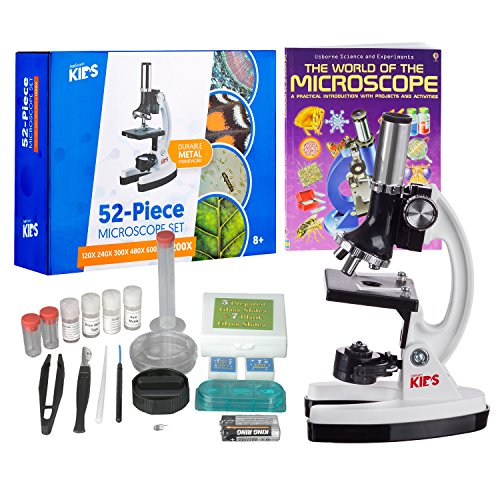
AmScope M150C-I Kids Beginner Compound Microscope
Three objective lenses take this compound microscope from 40x up to 1000x, enough range for real slide work rather than toy-level viewing. Metal gears drive the coarse and fine focus knobs, so repeated turning does not loosen the mechanism over time. The kit ships with prepared slides plus blank slides and coverslips for mounting new samples.
Pros
- Metal focus gears stay tight after months of daily use
- Three lenses cover a full 40x to 1000x range
- Blank slides let kids mount their own samples, not just view prepared ones
Cons
- Swapping objective lenses takes practice, so younger kids need help at first
- Setup takes longer than a toy microscope with fixed magnification

National Geographic Dual LED Student Microscope
Top and bottom LED lights let this microscope illuminate both see-through slides and solid objects like coins or leaves. Ten prepared slides, a brine shrimp hatchery kit, and a color filter wheel ship in the box. Magnification covers roughly 40x to 1000x across a set of swappable eyepieces.
Pros
- Dual lighting handles both transparent slides and solid specimens
- Brine shrimp kit turns the microscope into a short biology project
- Replacement parts are easy to find given the brand’s wide availability
Cons
- Plastic housing flexes more than metal-frame competitors
- Filter wheel is small and easy to lose in a toy bin

Discovery Kids #MINDBLOWN Toy Microscope STEM Kit
A simple twist dial replaces fine-focus knobs on this toy-grade microscope, cycling through three fixed magnification levels. A battery-powered LED lights the specimen tray automatically, with no manual adjustment needed. Preschool and early elementary kids get quick results here, trading precision for simplicity.
Pros
- Twist dial needs no fine-focus skill to operate
- Low cost makes early microscopy easy to try
- Lightweight body fits small hands comfortably
Cons
- Fixed 100x, 400x, and 900x steps limit real experimentation
- Image clarity trails true optical compound microscopes
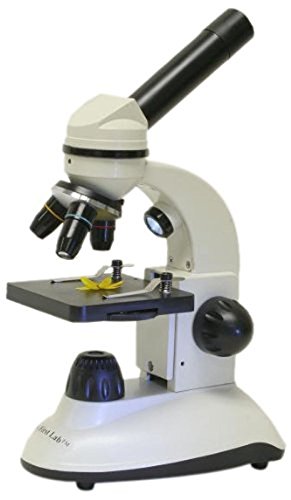
My First Lab Duo-Scope
A slide-free stage lets kids set an insect or leaf directly under the lens, no coverslip required. Fixed power steps reach up to 1000x, and a built-in mirror supplies light without batteries. An all-metal frame is built to survive classroom-style handling day after day.
Pros
- Slide-free stage works for bugs and leaves without prep
- Mirror illumination needs no batteries at all
- Metal frame holds up under repeated classroom use
Cons
- Turret steps skip finer magnification increments
- Bulkier to store than compact digital models
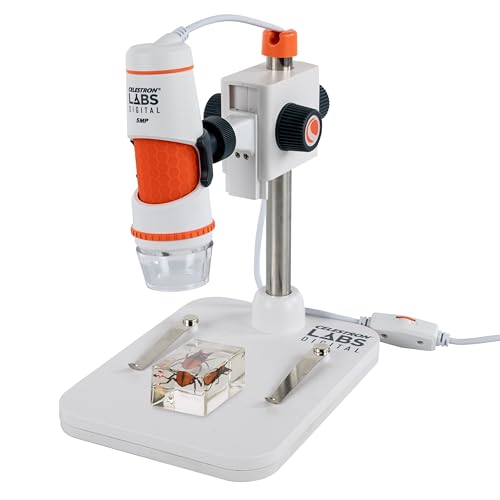
Celestron Kids Handheld Digital Microscope
A built-in sensor sends the image to a connected computer screen instead of an eyepiece, which helps kids who struggle to focus one eye. Bundled software captures still images and short video clips for later review. A ring LED lights the specimen at magnifications from roughly 20x to 200x.
Pros
- Screen viewing skips eyepiece focusing frustration entirely
- Saved captures build an ongoing specimen journal
- Several kids can watch one screen at the same time
Cons
- Needs a connected computer, so it is not standalone
- Top magnification falls short of compound optical models

Skybasic Kids Microscope
AA batteries power this compact model, so it works on a porch or in a car with no outlet nearby. Magnification spans 100x to 1200x, wider than most toy-grade units, through a small integrated LED. Ten prepared slides pack into a storage case that doubles as a carrying handle.
Pros
- Battery power removes the need for an outlet outdoors
- Carrying case keeps ten prepared slides from scattering
- 1200x top magnification beats most compact competitors
Cons
- Small focus knob is fiddly for younger fingers
- Batteries drain faster than mirror-lit alternatives
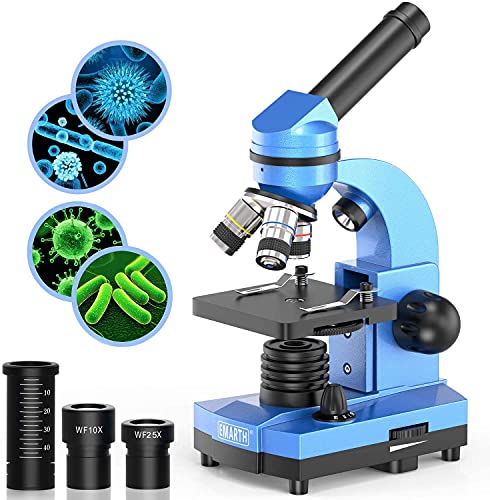
Emarth Kids Microscope
A metal arm and base replace the all-plastic build common at this price, so drops and rough handling do less damage. Dual LED lighting covers transparent slides and solid specimens alike. Ten slides plus a small specimen collection ship ready for immediate viewing.
Pros
- Metal arm and base resist drops better than plastic bodies
- Dual lighting covers both slides and solid objects
- Included specimen kit gives kids samples on day one
Cons
- Heavier than fully plastic compact models
- Eyepiece diopter adjustment offers limited range
Side by side
| # | Model | Magnification | Best for | Score | Price |
|---|---|---|---|---|---|
| 1 | AmScope M150C-I Kids Beginner Compound Microscope | 40x-1000x | Best overall | 9.4 | Check price |
| 2 | National Geographic Dual LED Student Microscope | 40x-1000x | Best value | 9.2 | Check price |
| 3 | Discovery Kids #MINDBLOWN Toy Microscope STEM Kit | 100x, 400x, 900x fixed steps | Best budget | 8.9 | Check price |
| 4 | My First Lab Duo-Scope | 100x, 400x, 1000x turret | Best for serious young scientists | 8.6 | Check price |
| 5 | Celestron Kids Handheld Digital Microscope | 20x-200x approximate | Best for digital screen viewing | 8.4 | Check price |
| 6 | Skybasic Kids Microscope | 100x-1200x | Best for portability | 8.2 | Check price |
| 7 | Emarth Kids Microscope | 100x-1200x | Best for rough handling and durability | 8.0 | Check price |
Questions worth asking
How much magnification does a kids microscope need?
Most beginners are covered by a 40x to 1000x range, spanning whole objects at low power and cell structures at the top end. Toy-grade models with fixed steps near 100x to 900x suit casual viewing rather than serious experiments.
Is a digital microscope better than an optical one for kids?
It depends on the kid. Digital picks like the Celestron Kids Handheld suit children who find eyepieces frustrating, since the image shows on a screen. Optical microscopes usually reach higher magnification and match what schools use.
What age is right for a real compound microscope versus a toy microscope?
Compound microscopes with glass lenses and focus knobs, such as the AmScope M150C-I, list a recommended age of 8 and up. Toy-grade models with fixed steps, like the Discovery Kids MINDBLOWN kit, work from around age 4.
Can young kids use a microscope without supervision?
Glass slides and coverslips call for supervision, since breakage and cuts are a real risk for younger children. Sealed specimen trays, like the one on the Discovery Kids kit, make independent use safer.
Do kids microscopes come with slides included?
Most kits in this range ship with prepared slides, and several, including the National Geographic and Emarth models, add specimen kits like brine shrimp eggs. Blank slides for making new samples appear mainly on higher-end sets like the AmScope M150C-I.
What is the difference between a toy microscope and a real microscope?
Toy microscopes use fixed magnification steps and simplified focusing, trading precision for ease of use. Real compound microscopes add adjustable focus knobs and interchangeable lenses, reaching true magnifications up to 1000x.
Which microscope works best for a 6 year old?
A 6 year old often does better with a model built for handling, such as the Emarth or Skybasic microscopes, both rated from age 6 with sturdier frames. Compound microscopes rated for age 8 and up can frustrate a younger child.
Are metal microscopes more durable than plastic ones?
Metal-frame models like the My First Lab Duo-Scope and Emarth microscope hold up better against drops and classroom-style handling. Plastic bodies cost less but crack sooner under rough use.
Can a microscope work without batteries or an outlet?
Yes. The My First Lab Duo-Scope includes a mirror that supplies light with no batteries at all, useful near a bright window.
What is the best beginner microscope for a serious young scientist?
The My First Lab Duo-Scope and AmScope M150C-I both push past toy-level magnification, with the AmScope reaching a full 1000x through three real objective lenses.
The verdict
AmScope’s M150C-I remains the strongest all-around pick for real magnification and included slides. Younger children tend to do better with a simpler toy-grade model like the Discovery Kids MINDBLOWN kit, while kids who dislike eyepieces may prefer the Celestron digital option. Match the pick to the child’s age and patience for fine focus, not just the top magnification number.


