Top Bench Power Supplies for Electronics Work
For most hobbyists and professionals, the KORAD KA3005P stands out as the top pick, offering precise regulation and a clear display at a reasonable cost. It handles up to 30V and 5A, making it versatile for a wide range of tasks. However, it lacks USB connectivity, which may be a drawback for those wanting remote control.
A bench power supply is a fundamental tool for anyone working with electronics, from repair technicians to hobbyists. It provides a stable, adjustable voltage and current to power circuits during testing and development.
Choosing the right model can be overwhelming with many options. We compared top sellers to highlight their strengths and limitations, helping you pick one that matches your typical projects.
The top picks, ranked

KORAD KA3005P
The KORAD KA3005P is a reliable linear power supply with precise voltage and current settings. It features a bright LED display and coarse/fine adjustments for fine tuning. Owners report stable output with low ripple, making it suitable for sensitive circuits.
Pros
- Accurate regulation
- Sturdy build
- Clear display
Cons
- No USB or remote control
- Fan noise at high load

TekPower TP3005D
The TekPower TP3005D provides basic adjustable voltage and current at an affordable price. It has simple analog controls and a digital readout. Users note it is adequate for basic tasks, but output ripple is higher than linear supplies.
Pros
- Inexpensive
- Compact
- Easy to use
Cons
- Higher ripple
- Less precise
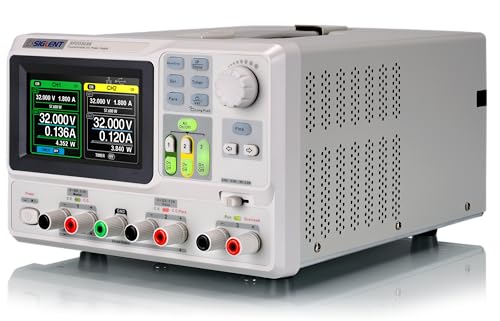
Siglent SPD3303X
The Siglent SPD3303X offers three outputs with a total of 220W, including a fixed 2.5V/3.3V/5V output. It features a high-resolution color display and programmable memory. Professionals appreciate its accuracy and low ripple.
Pros
- Multiple outputs
- High precision
- Programmable
Cons
- Expensive
- Large footprint
Eventek KPS1205D
The Eventek KPS1205D delivers up to 120V and 5A, making it suitable for high-voltage testing. It includes overload and reverse polarity protection. Users find the controls intuitive, though the fan can be loud.
Pros
- High voltage range
- Protection features
- Good value
Cons
- Noisy fan
- Basic interface

Rigol DP832
The Rigol DP832 is a high-performance triple output supply with exceptional accuracy and low temperature drift. It offers remote control via USB and LAN, and supports data logging. It is a favorite among engineers for design verification.
Pros
- Excellent stability
- Remote control
- Data logging
Cons
- High price
- Complex menu

Dcpower Supply 30V 10A
This unbranded but popular supply offers 30V and 10A, suitable for testing car audio or battery charging. It has a cooling fan and adjustable current limiting. Owners report it works well but lacks finesse in voltage adjustment.
Pros
- High current capacity
- Affordable
- Compact size
Cons
- Coarse voltage knob
- No memory presets

GW Instek GPD-3303S
The GW Instek GPD-3303S is a linear triple output supply with a reputation for durability. It provides clean, low ripple power and has a clear display. Users note it is heavier but worth it for bench stability.
Pros
- Rugged construction
- Low ripple
- Intuitive controls
Cons
- Bulky
- Higher cost
Compared at a glance
| # | Model | Voltage | Best for | Score | Price |
|---|---|---|---|---|---|
| 1 | KORAD KA3005P | 0-30V | General purpose electronics work | 9.4 | Check price |
| 2 | TekPower TP3005D | 0-30V | Budget conscious beginners | 8.8 | Check price |
| 3 | Siglent SPD3303X | 3 (two variable, one fixed) | Advanced users needing multiple outputs | 9.2 | Check price |
| 4 | Eventek KPS1205D | 0-120V | High current applications | 8.6 | Check price |
| 5 | Rigol DP832 | 3 | Precision work and data logging | 9.0 | Check price |
| 6 | Dcpower Supply 30V 10A | 0-30V | Heavy duty power demands | 8.4 | Check price |
| 7 | GW Instek GPD-3303S | 3 | Reliability and long term use | 8.9 | Check price |
How to choose
Common questions
What is a bench power supply used for?
A bench power supply provides a stable and adjustable voltage and current to power electronic circuits during development, testing, and repair. It allows you to simulate different power conditions and protect sensitive components.
Linear vs switching power supply: which is better?
Linear supplies produce lower output ripple and noise, making them better for sensitive analog circuits. Switching supplies are more efficient, lighter, and often cheaper, but may have higher ripple. For audio or precision work, choose linear; for general digital, switching is fine.
How much voltage and current do I need?
Most hobbyist projects require up to 30V and 5A. If you work with high power devices like motors or car electronics, consider a model with 10A or more. For low power digital logic, 3A is often sufficient.
Can I use a bench power supply to charge batteries?
Yes, but you need to set the voltage and current limit correctly. Some supplies have constant current mode that is useful for charging. Always monitor the battery voltage to avoid overcharging.
What is constant current mode?
Constant current mode regulates the output current to a set value while allowing voltage to vary. This is useful for charging batteries or driving LEDs. The supply automatically adjusts voltage to maintain the set current.
Do I need a triple output supply?
A triple output supply provides two variable outputs and a fixed output, which is useful for circuits requiring both positive and negative supplies or a separate digital supply. It adds flexibility but increases cost and size.
How important is display resolution?
Higher resolution allows finer adjustments and more accurate readings. For most work, a display showing 0.1V and 0.01A is adequate. For precision work, look for models with 1mV and 0.1mA resolution.
Can I connect a bench power supply in series or parallel?
Some supplies support series or parallel operation to increase voltage or current. Not all models have this feature. Check the user manual. If you need higher voltage, a single high voltage unit is simpler.
What safety precautions should I take?
Always connect leads correctly, use appropriate current limits, and avoid short circuits. Ensure the supply is grounded. Do not touch live circuits. For high voltages, use proper insulation and safety protocols.
How do I choose between brands?
Consider your budget and the features you need. Reputable brands like KORAD, Siglent, and Rigol offer reliable performance and support. Read user reviews to gauge real-world behavior. Avoid no-name models if you need accuracy.
The verdict
For most electronics enthusiasts, the KORAD KA3005P is the smart choice because it balances price, performance, and reliability. If you need multiple outputs for complex circuits, the Siglent SPD3303X is worth the extra investment. For precision work, the Rigol DP832 provides outstanding stability but at a higher cost. Choose based on your specific needs, but you cannot go wrong with KORAD for everyday use.


