Choosing a Benchtop Sander for Wood, Metal, or Curves
The WEN 6502T combo sander suits most home shops that need belt and disc sanding in one footprint. Buyers who sand hardwood daily should look at the RIKON 50-121 for its dual dust ports, while curved parts call for the Delta 31-483 spindle sander instead.
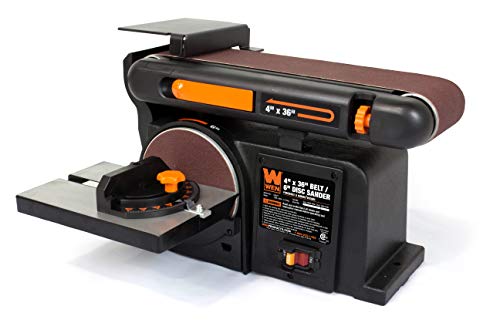
A combo sander that pairs a 4 x 36 inch belt with a 6 inch disc, the WEN 6502T handles both flat stock removal and edge shaping without doubling your bench footprint. Its 2.9 amp motor is fine for softwood but bogs down once hardwood enters the mix.
Shops choose a sander based on motor power, table tilt range, and dust port placement more than brand name. We compared published specs, belt and disc dimensions, and owner feedback on table flatness and vibration, since those issues surface more in daily use than on a spec sheet.
What matters most
What to look for in a benchtop sander Four basic types cover most shops: belt, disc, belt/disc combo, and oscillating spindle. Motor size ranges from 1/3 HP on light-duty models to 1/2 HP or more on cast iron combo units. Table tilt matters for beveled edges, and most disc or combo tables tilt 0 to 45 degrees while some belt tables reach 90. Dust ports run from a single outlet up to dual ports covering belt and disc separately. Cast iron resists warping better than stamped steel or aluminum under repeated pressure.
Belt sanders vs disc sanders vs combo machines Fast material removal is what belt sanders do best, making them the choice for flattening boards or squaring edges. Disc sanders trade speed for control, shaping curves and chamfers on smaller parts more precisely. Combo machines like the WEN 6502T and Grizzly G1014Z fold both jobs into one footprint when shop space runs tight. Concave curves that neither belt nor disc can reach fall to an oscillating spindle sander such as the Delta 31-483. Project mix, more than brand preference, should decide which category fits a given shop.
Matching motor power and table size to your shop Softwood and light hardwood sand fine on a 1/3 HP motor without stalling. Daily hardwood sanding, or long sessions under load, favor a 1/2 HP motor like the one in the RIKON 50-121. Table size sets the limit on how large a workpiece can lie flat against the belt or disc. Garage-shop hobbyists rarely need more than a 4 x 36 inch belt, while small production shops sanding batches benefit from larger tables and the added mass that cuts vibration.
Sanding metal, contours, and other edge cases Light metal deburring needs a table that resists deflection, which is why the Grizzly G1014Z’s cast iron frame outperforms lighter aluminum models here. Chair spindles, scroll cuts, and other curved parts call for an oscillating spindle sander rather than a flat belt or disc. Compact benches with little spare room suit a single-function unit like the WEN 6524 better than a bulkier combo machine. Occasional sanding jobs can skip cast iron entirely and still get acceptable results from a lighter stamped-table model.
The shortlist, ranked
WEN 6502T 4 x 36 Inch Belt and 6 Inch Disc Sander
One cast iron base carries both a 4 x 36 inch belt and a 6 inch disc, so flat stock removal and curved shaping share a single footprint. Each function runs independently off a 2.9 amp motor, and the belt table tilts a full 0 to 90 degrees for beveled edges. A miter gauge ships with it for angled work on the disc side.
Pros
- Belt and disc share one footprint, saving bench space
- Belt table tilts fully to 90 degrees for edge work
- Miter gauge included for angled disc sanding
Cons
- 2.9 amp motor bogs down in dense hardwood
- Single dust port serves only one function at a time

RIKON Power Tools 50-121 4 x 36 Belt/6 Disc Sander
Dual dust ports set the 50-121 apart, one mounted on the belt housing and one behind the disc, so both sides connect to a shop vacuum at once. A 1/2 HP motor drives a 4 x 36 inch belt and 6 inch disc on a cast iron base that resists flexing under pressure. Both tables tilt for beveled sanding.
Pros
- Dual dust ports capture debris from both belt and disc
- 1/2 HP motor handles hardwood without stalling
- Cast iron base reduces vibration during use
Cons
- Heavier than single-function sanders, harder to reposition
- Larger footprint than basic combo models

JET 708595K JSG-6DC Belt and Disc Sander
A 1 x 42 inch belt runs alongside a 6 inch disc on this machine, powered by a 1/3 HP motor built for repeated daily use. Its tilting table measures roughly 6 by 6 inches for angled disc work. Cast construction keeps the unit stable at sustained belt speeds.
Pros
- Longer 42 inch belt reduces splice wear over time
- Stable base suited to frequent daily sanding
- Compact disc table works well on small parts
Cons
- Smaller table limits support for larger workpieces
- 1 x 42 inch belts are less common than 4 x 36 sizes

Grizzly Industrial G1014Z 4 x 36 Belt/6 Disc Sander
Fully cast iron construction gives the G1014Z’s frame and table enough rigidity for light metal deburring alongside standard wood sanding. Its table tilts 0 to 45 degrees in both directions, and a 1/3 HP single-phase motor drives the 4 x 36 inch belt and 6 inch disc together.
Pros
- Cast iron table resists flexing during metal deburring
- Table tilts both directions for versatile bevel angles
- Solid base keeps vibration low at full speed
Cons
- Heavier cast iron build makes relocating it harder
- 1/3 HP motor still limits use to light metal work only

POWERTEC BD1400 Belt Disc Sander
A quick-release tension lever speeds up belt changes on the BD1400, which pairs a 4 x 36 inch belt with a 6 inch disc. Its cast iron table tilts to 45 degrees, and a 3.5 amp motor covers general woodworking tasks without extra frills.
Pros
- Quick-release lever makes belt swaps faster
- Cast iron table holds up to repeated bevel adjustments
- Combo design covers both flat and curved shaping
Cons
- 3.5 amp motor is modest for dense hardwood
- Fewer accessories included than premium combo models

WEN 6524 1 x 30 Inch Belt Sander
Small benches and detail work are the target for this single-function 1 x 30 inch belt sander. A 2.5 amp motor drives the belt, and the platen tilts from 0 to 90 degrees for vertical or angled sanding. At about 12 pounds, it stores easily on a shelf between projects.
Pros
- Small footprint fits benches with limited space
- Light weight makes it easy to store or move
- Platen tilt covers both flat and vertical sanding angles
Cons
- No disc sanding function included
- 1 x 30 inch belt is too narrow for wide flat stock
Delta Power Tools 31-483 Oscillating Bench Spindle Sander
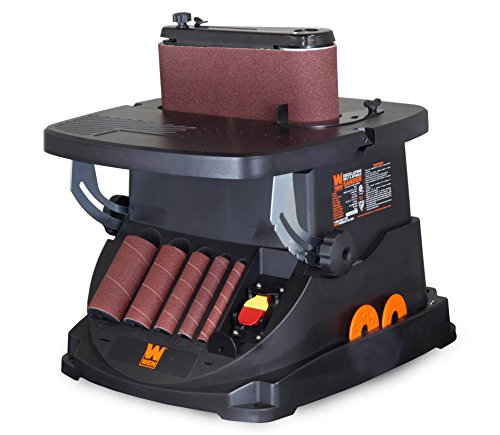
Concave curves and scroll cuts are where this oscillating spindle sander earns its keep, since it works nothing like a belt or disc machine. Five spindle sizes from 1/2 to 3 inches ship with it to match different curve radii. A 1/2 HP motor drives the oscillating stroke, and the table tilts 0 to 45 degrees.
Pros
- Reaches concave curves that belt and disc sanders cannot
- Five spindle sizes cover most curve radii out of the box
- Oscillating stroke reduces burn marks on edges
Cons
- Cannot flatten wide boards the way a belt sander can
- Swapping spindle sizes takes more time than changing a belt
Side by side
| # | Model | Motor | Best for | Score | Price |
|---|---|---|---|---|---|
| 1 | WEN 6502T 4 x 36 Inch Belt and 6 Inch Disc Sander | 2.9 amp | Best overall | 9.4 | Check price |
| 2 | RIKON Power Tools 50-121 4 x 36 Belt/6 Disc Sander | 1/2 HP | Best for dust collection | 9.2 | Check price |
| 3 | JET 708595K JSG-6DC Belt and Disc Sander | 1/3 HP, 115V | Best for heavy-duty shop use | 9.0 | Check price |
| 4 | Grizzly Industrial G1014Z 4 x 36 Belt/6 Disc Sander | 1/3 HP, single-phase | Best for metalworking | 8.8 | Check price |
| 5 | POWERTEC BD1400 Belt Disc Sander | 3.5 amp | Best value | 8.5 | Check price |
| 6 | WEN 6524 1 x 30 Inch Belt Sander | 2.5 amp | Best budget compact pick | 8.2 | Check price |
| 7 | Delta Power Tools 31-483 Oscillating Bench Spindle Sander | 1/2 HP, 3.5 amp | Best for curved edges and contours | 8.0 | Check price |
Frequently asked questions
What is the difference between a belt sander and a disc sander?
A continuous abrasive loop drives fast, flat material removal on a belt sander, while a disc sander spins a flat abrasive disc for shaping curves and angles. Combo machines like the WEN 6502T and Grizzly G1014Z include both in one unit.
How much HP do I need for a benchtop sander?
1/3 HP, found on the WEN 6502T and Grizzly G1014Z, covers most softwood and hobby-level hardwood sanding. Extended hardwood sessions call for a 1/2 HP motor like the RIKON 50-121’s.
Can a benchtop sander sand metal?
Light deburring on soft metals like aluminum works on a rigid cast iron model such as the Grizzly G1014Z. Stamped steel or aluminum tables flex too much for consistent metal work.
Is a 4×36 belt sander better than a 1×30 belt sander?
More surface area per pass makes a 4 x 36 inch belt better suited to general woodworking. A 1 x 30 inch belt, like the WEN 6524’s, saves bench space and suits detail sanding on small parts.
What is an oscillating spindle sander used for?
An abrasive drum moves up and down while it spins on an oscillating spindle sander, smoothing concave curves and scroll cuts. The Delta 31-483 ships with five spindle sizes from 1/2 to 3 inches for different curve radii.
Which benchtop sander is best for a small garage shop?
Tight benches suit the WEN 6524 1 x 30 belt sander since it skips the disc table entirely. Shops with a bit more room can add disc sanding through the WEN 6502T without a large footprint increase.
Do benchtop sanders need dust collection hookup?
Most benchtop sanders include at least one dust port sized for a shop vacuum hose. Running one without a vacuum or dust collector still works, but it leaves fine dust on the table and in the air.
Are cast iron sanding tables worth it?
Warping resistance and vibration damping are stronger on cast iron tables like those on the RIKON 50-121 and Grizzly G1014Z than on stamped steel. That extra mass matters most for daily sanding or larger stock.
Belt/disc combo sander vs single-function sander, which should I buy?
A combo unit like the WEN 6502T covers more project types in one footprint, useful when bench space is tight. Single-function sanders like the WEN 6524 cost less and suit buyers who only need one operation.
The verdict
Most home woodworkers get more use out of the WEN 6502T than any single-function machine, since it covers belt and disc sanding without doubling bench space. Shops running hardwood sanding sessions daily should step up to the RIKON 50-121 for its 1/2 HP motor and dual dust ports. Anyone shaping curved parts like chair spindles should skip belt and disc machines entirely and pick the Delta 31-483 oscillating spindle sander instead.