How Big Should a Betta Fish Tank Actually Be?
Fluval Spec V 5 Gallon Aquarium Kit leads on flow control, since its rear chamber nozzle dials the current down to a trickle. Marina LED Aquarium Kit 5 Gallon gives beginners every part except a heater. Choose Fluval Flex 9 Gallon for live plants.
Fluval Spec V 5 Gallon Aquarium Kit tops this list because its outflow nozzle turns down to a trickle. Beginners who want the whole setup in one box should look at Marina LED Aquarium Kit 5 Gallon. For live plants, Fluval Flex 9 Gallon adds volume and stronger light.
Betta gear gets sold on looks rather than water stability, which is why so much of it fails. Tanks under five gallons track room temperature overnight and build ammonia within days. Filters sized for the volume often push more current than a long finned fish can hold against. We compared listed volume, filter type and flow adjustment, lid design and heater clearance. Owner feedback about surface current and jumping settled the close calls.
The best picks, ranked

Fluval Spec V 5 Gallon Aquarium Kit
Three stage filtration hides in a rear chamber, and the output nozzle pivots to cut the current. That one feature solves the problem that spoils most small betta kits. Etched glass and aluminium trim also give the rear chamber somewhere tidy to hide a heater cable.
Pros
- Nozzle turns flow down to betta level
- Rear chamber conceals filter and heater
- Glass and trim outclass moulded plastic kits
Cons
- Heater is not included
- Open top leaves a jumping risk

Marina LED Aquarium Kit 5 Gallon
One box covers the glass tank, a clip on power filter, LED lighting, a net, conditioner and food samples. Five gallons is the sensible floor for stable water chemistry. Owners report the stock outflow runs brisk for a betta, which a sponge over the outlet fixes in a minute.
Pros
- Everything but a heater arrives together
- Glass tank rather than moulded acrylic
- Replacement filter media is easy to find
Cons
- Outflow needs baffling for a betta
- Heater must be bought separately

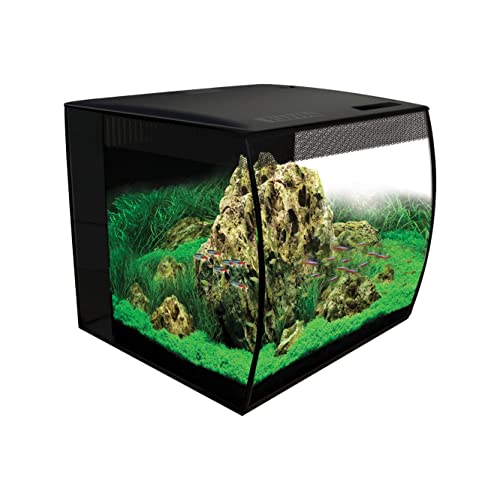
Fluval Flex 9 Gallon Aquarium Kit
Nine gallons and a multi colour LED put this kit within reach of anubias, java fern and cryptocoryne. Plants pull nitrate out of the water, so the tank stays cleaner between changes. Flow leaves an adjustable rear chamber output, and a remote handles the lighting modes.
Pros
- Volume holds parameters steady between changes
- Light drives low tech plants without extra kit
- Output adjusts low enough for long fins
Cons
- Curved front glass bends the view slightly
- Footprint needs more shelf depth than a 5 gallon
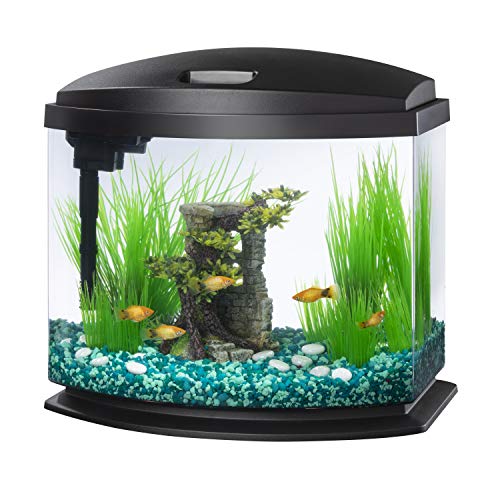
Aqueon LED MiniBow 5 Gallon Aquarium Kit
An enclosed hood, integrated LED and a slot in cartridge filter keep the learning curve short. That closed hood matters more than beginners expect, because bettas jump. Cartridges swap in seconds, though they cost more across a year than rinsable sponge and ceramic media.
Pros
- Enclosed hood blocks jumping
- Cartridge changes need no tools
- Spare parts stocked in most pet aisles
Cons
- Cartridge refills add ongoing cost
- Outflow still needs slowing for a betta

Koller Products AquaView 3 Gallon Aquarium Kit
Three gallons is the smallest volume worth considering, and only with disciplined weekly changes. An internal power filter and colour changing LEDs sit inside a sealed hood. Impact resistant plastic keeps the weight low, which helps if the tank moves between rooms or dorm desks.
Pros
- Cheapest complete setup on this list
- Sealed hood prevents jumping
- Light enough to carry filled halfway
Cons
- Small volume shifts temperature quickly
- Plastic scratches faster than glass

hygger Horizon 8 Gallon Glass Aquarium Kit
Eight gallons buys real swimming room and a far more forgiving margin for beginner mistakes. Low iron curved glass keeps colours accurate under the adjustable LED. Owners report the supplied pump pushes hard, so plan to dial it back or fit a baffle before the fish goes in.
Pros
- Volume keeps ammonia and heat stable
- Low iron glass shows true colour
- Room for plants and a few snails
Cons
- Pump flow needs reducing for a betta
- Heavier to relocate once filled

Tetra Crescent 5 Gallon Aquarium Kit
A crescent footprint tucks against a wall or monitor without taking the whole desk. Moulded acrylic weighs less than equivalent glass, so a bookshelf handles it comfortably. Feeding happens through a hatch in the LED hood, which means no lifting the light off every evening.
Pros
- Narrow footprint suits desks and shelves
- Acrylic body is light to reposition
- Feeding hatch avoids removing the hood
Cons
- Acrylic scratches under abrasive cleaning
- Curved panels distort the side view
How to pick the right one
What to look for in a betta tank Four things decide whether a betta tank works: volume, flow, heat and a lid. Volume buffers temperature swings and dilutes ammonia. Flow decides whether your fish rests or fights the current all day. Heat needs to hold near 78 to 80 degrees Fahrenheit, which means an adjustable heater in almost every case. A hood or glass lid stops the jump that ends a lot of betta keeping. Lighting, shape and looks come after those four.
How many gallons does a betta need? Five gallons is the practical floor. At that volume, a 25 percent weekly change holds nitrate down and temperature steady in between. One and two gallon bowls follow room temperature hour by hour, so the fish never settles. Eight to ten gallons is easier to keep healthy, not harder, since dilution does most of the work. Extra volume also leaves space for live plants and a nerite snail or two.
How to soften a filter that is too strong Bettas evolved in shallow, slow water and carry fins that catch current like a sail. Aim for gentle surface ripple with no visible push across the glass. Adjustable nozzles, as on both Fluval kits here, handle this with one twist. Clip on filters usually need help: slide a coarse sponge over the outlet, or clip a curved piece of plastic bottle under the lip. Air driven sponge filters are another quiet route, and they double as biological media.
Cycling, heaters and lids before the fish arrives Waste turns into ammonia, and a brand new tank has no bacteria to convert it. Run the filter for several weeks with a bottled ammonia source, testing until ammonia and nitrite both read zero and nitrate appears. Liquid test kits give clearer numbers than paper strips. Pick an adjustable heater rated for your volume, then add a separate thermometer, because built in thermostats drift. Keep the water level a couple of inches below the rim and cover any open top.
The lineup, side by side
| # | Model | Volume | Best for | Score | Price |
|---|---|---|---|---|---|
| 1 | Fluval Spec V 5 Gallon Aquarium Kit | 5 gallons | Best overall | 9.4 | Check price |
| 2 | Marina LED Aquarium Kit 5 Gallon | 5 gallons | Best value | 9.2 | Check price |
| 3 | Fluval Flex 9 Gallon Aquarium Kit | 9 gallons | Best for planted setups | 9.0 | Check price |
| 4 | Aqueon LED MiniBow 5 Gallon Aquarium Kit | 5 gallons | Best for beginners | 8.8 | Check price |
| 5 | Koller Products AquaView 3 Gallon Aquarium Kit | 3 gallons | Best budget | 8.6 | Check price |
| 6 | hygger Horizon 8 Gallon Glass Aquarium Kit | 8 gallons | Best for a larger single betta setup | 8.3 | Check price |
| 7 | Tetra Crescent 5 Gallon Aquarium Kit | 5 gallons | Best for a compact desk tank | 8.0 | Check price |
Good to know
What size tank does a betta need?
Five gallons is the practical minimum for stable water. Eight to ten gallons is easier to maintain, since a larger volume dilutes waste and resists temperature swings. Smaller containers change chemistry faster than a beginner can react.
Do betta tanks need a filter?
Yes, because the filter media houses the bacteria that convert ammonia. Flow is the part to control, not the filtration itself. An adjustable nozzle, a sponge over the outlet or an air driven sponge filter all keep the current low.
Does a betta need a heater?
Almost always. Bettas are tropical and want water around 78 to 80 degrees Fahrenheit. Most homes drop several degrees overnight, and that daily swing stresses the fish more than a steady cooler temperature would.
Is a 3 gallon tank big enough for a betta?
It can work with weekly changes, a heater and a gentle filter, as with the Koller AquaView. Margin for error is thin at that volume. Ammonia climbs faster and one skipped water change shows up quickly.
Can bettas live with other fish?
Not in five gallons, where there is no room to retreat. From eight gallons up, snails and shrimp usually work, and some keepers add small bottom dwellers. Avoid long finned or nippy species entirely.
How often should you change betta tank water?
Roughly 25 percent weekly in a cycled five gallon tank, using dechlorinated water matched to tank temperature. Smaller volumes need changes more often. Vacuum the substrate during the change rather than as a separate job.
Why does my betta jump out of the tank?
Jumping is natural behaviour, and poor water quality makes it more likely. Fit a hood or a glass lid, leave a couple of inches of air below the rim, and test ammonia if the habit is new.
Are live plants better than plastic ones?
Live plants consume nitrate and give the fish cover, so they help water quality as well as behaviour. Anubias and java fern grow under standard kit lighting. If you prefer artificial, choose silk over stiff plastic, which tears fins.
How do you cycle a new betta tank?
Set the tank up with the filter and heater running, then add an ammonia source and test every few days. Wait until ammonia and nitrite both read zero and nitrate registers. Bottled bacteria speeds this up but does not replace testing.
The bottom line
Fluval Spec V 5 Gallon Aquarium Kit is the tank we would set up for a single betta, since its adjustable nozzle fixes the flow problem before it starts. Marina LED Aquarium Kit 5 Gallon is the smarter first purchase once you baffle the outlet. Give Fluval Flex 9 Gallon the shelf space if live plants are part of the plan.