Which Bike Pump Actually Gets Tires to Full Pressure?
Topeak JoeBlow Sport III Floor Pump ranks first for its base mounted gauge and dual valve head. BV Bike Floor Pump reaches the same 160 psi ceiling with a twin head. Pro Bike Tool Mini Bike Pump handles roadside flats and bolts under a bottle cage.
Topeak JoeBlow Sport III Floor Pump is the one most riders should start with, thanks to a readable gauge and a head that fits either valve. BV Bike Floor Pump covers the same 160 psi range with fewer frills. Keep a Pro Bike Tool Mini Bike Pump on the frame for flats away from home.
Pumps go wrong in specific ways. A vague gauge leaves you guessing at sidewall pressure, a single format head strands you at a trailhead, and a narrow mini barrel can take three hundred strokes to seat a road tire. We compared published max pressure, head design, gauge placement and base construction across seven currently sold pumps, then weighed owner feedback about leaking chucks and long term seal wear.
The best picks, ranked

Topeak JoeBlow Sport III Floor Pump
Topeak mounts the analog gauge at the base, where it stays visible while you stand over the handle. A dual head clamps onto Presta and Schrader with no insert to reverse. Owners point to the wide steel base, which stays planted through fast strokes.
Pros
- Gauge stays readable mid stroke
- Dual head needs no swapping
- Wide base resists tipping
Cons
- Tall barrel takes shelf space
- More pump than casual riders need

BV Bike Floor Pump
BV pairs a twin valve head with a 160 psi ceiling, so road tires reach target pressure without extra hardware. Its gauge sits on top of the barrel rather than down at the floor. Owners report the plastic base flexes a little under hard strokes but keeps working.
Pros
- Twin head covers both valve types
- Reaches 160 psi for road tires
- Gauge sits close to eye level
Cons
- Reads coarsely below 40 psi
- Plastic base flexes under load

Lezyne Classic Floor Drive
Aluminium barrel, steel base and a wooden handle put this closer to a workshop tool than a household one. Its threaded chuck screws onto the valve stem, so nothing pops loose at 90 psi. A 220 psi rating leaves headroom well above any road tire.
Pros
- Metal barrel and base resist wear
- Threaded chuck seals without leaking
- Headroom to 220 psi
Cons
- Screwing the chuck on adds a step
- Heavy to carry between bikes

Pro Bike Tool Mini Bike Pump
Sized to sit under a bottle cage, this hand pump ships with a frame bracket and a short flexible hose. Hose flex keeps sideways load off a Presta stem while you work at the roadside. Reaching 100 psi takes patience, though that is plenty to ride home on.
Pros
- Mounts under a bottle cage
- Flexible hose protects the valve stem
- Reaches rideable road pressure
Cons
- Hundreds of strokes for a road tire
- No gauge on the body

Schwinn Air Center Plus Floor Pump
Schwinn keeps the design plain: tall barrel, moulded handle and a head that accepts both common valves. Each stroke moves a useful volume of air, so hybrid and kids tires fill in a hurry. A 120 psi ceiling suits everyday riding but stops short of race pressures.
Pros
- Stocked in most bike aisles
- Moulded handle spreads hand pressure
- Fills wide tires in few strokes
Cons
- Stops at 120 psi
- Gauge reading is approximate

Vibrelli Mini Bike Pump
Vibrelli bundles a glueless patch kit with the pump, covering both halves of a roadside flat. Its barrel still reaches 120 psi despite the compact body. Commuters get a frame clip plus a hose that switches valve types by reversing an internal insert.
Pros
- Patch kit ships in the box
- 120 psi from a pocket sized barrel
- Frame clip and hose included
Cons
- Narrow barrel means more strokes
- No gauge to confirm pressure
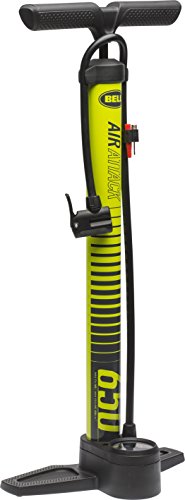
Bell Air Attack 650 Bike Pump
Bell fits an auto fit head that seats on Presta or Schrader with no lever to flip and no insert to reverse. New riders can inflate a tire without learning valve anatomy first. Output tops out near 100 psi, which covers hybrids, cruisers and kids bikes.
Pros
- Auto fit head needs no setup
- Simple enough for first time riders
- Light to move around the garage
Cons
- 100 psi limit rules out racing tires
- Lighter build than metal pumps
The lineup, side by side
| # | Model | Type | Best for | Score | Price |
|---|---|---|---|---|---|
| 1 | Topeak JoeBlow Sport III Floor Pump | Floor pump | Best overall | 9.4 | Check price |
| 2 | BV Bike Floor Pump | Floor pump | Best value | 9.2 | Check price |
| 3 | Lezyne Classic Floor Drive | Floor pump | Best for durability | 9.0 | Check price |
| 4 | Pro Bike Tool Mini Bike Pump | Mini hand pump | Best portable | 8.8 | Check price |
| 5 | Schwinn Air Center Plus Floor Pump | Floor pump | Best budget | 8.6 | Check price |
| 6 | Vibrelli Mini Bike Pump | Mini hand pump | Best for commuters | 8.3 | Check price |
| 7 | Bell Air Attack 650 Bike Pump | Floor pump | Best for beginners | 8.0 | Check price |
What matters most
Floor pump or mini pump: which do you need? Floor pumps stand on the ground and move far more air per stroke than anything handheld. Most carry a gauge, so you can hit a sidewall number instead of guessing. Mini pumps exist for one job, which is getting you home after a puncture. Owning both is the normal setup, with the floor pump in the garage and the mini pump clipped to the frame.
How do Presta and Schrader valve heads differ? Presta stems are narrow, threaded and closed by a small locking nut at the tip. Schrader stems match a car tire and appear on most mountain, kids and department store bikes. Dual heads accept both, either through two openings or a single auto fit seal. Older pumps still ship with one format only, so check the listing before you end up hunting for an adapter.
What psi do road, gravel and mountain tires need? Your tire sidewall prints a working range, and that beats any rule of thumb. Narrow 25mm road tires often sit between 80 and 100 psi. Gravel rubber around 40mm runs closer to 35 psi, while a 2.3 inch mountain tire may want under 25. Choose a pump rated above your highest target, because gauges read least accurately near their ceiling.
Best bike pump for commuters and roadside flats Commuters need repair gear that fits in a bag or bolts to the frame. A mini pump with a flexible hose protects the valve stem while you kneel on a kerb. Pair it with a patch kit or spare tube, since air alone cannot fix a torn tube. CO2 inflators work faster but give one shot per cartridge, which keeps a hand pump as the safer backup.
Frequently asked questions
What is the difference between Presta and Schrader valves?
Presta valves are slim, threaded and need the top nut loosened before air goes in. Schrader valves are wider and use a spring loaded pin, the same design as a car tire. Dual head pumps fit both without an adapter.
Do I need a floor pump or a mini pump?
Floor pumps inflate faster and show pressure on a gauge, which makes them the home tool. Mini pumps trade speed for size and live on the bike for emergencies. Riders who commute or ride far from home usually keep one of each.
How much air pressure does a bike tire need?
Check the range moulded into the sidewall and stay inside it. Wider tires run lower pressure, and rider weight shifts the target within that range. Underinflation invites pinch flats, while overinflation costs grip on rough surfaces.
Can a bike pump inflate sports balls and inflatables?
Many floor pumps store a needle and a cone nozzle in the base or handle. Those adapters cover footballs, basketballs and pool toys at low pressure. Mini pumps rarely include them, since the barrel is sized for tires.
Why does my pump leak air when I pull the head off?
A short hiss is air trapped in the hose escaping, not tire pressure. Continuous leaking while you pump means the chuck is not sealing on the stem. Reseat it square, open the Presta lock nut fully, or move to a threaded chuck that screws on.
Do mini bike pumps have a pressure gauge?
Most skip it to save length and weight, so you judge firmness by thumb. Carrying a pencil style gauge solves that for a few grams. Some mini pumps do include one, though small gauges read coarsely above 60 psi.
Which max pressure rating should I look for?
Pick a pump rated comfortably above your highest tire target. Road riders aiming for 100 psi are well served by a 160 psi pump. Mountain and gravel riders rarely need more than 120 psi on the label.
Are premium bike pumps worth it?
Higher end pumps add metal barrels, rebuildable seals and more accurate gauges. Those matter if you inflate several bikes a week or run tubeless tires that need a fast air surge. Occasional riders get years from a solid mid range floor pump.
How often should I check tire pressure?
Inner tubes lose pressure steadily, so road tires want a top up before most rides. Wider mountain and hybrid tires hold usable pressure for a week or two. Weekly checks are a reasonable habit for casual riding.
Our take
Topeak JoeBlow Sport III Floor Pump earns the top spot on gauge readability and a head that never needs swapping. BV Bike Floor Pump delivers the same 160 psi ceiling for riders who only want the essentials. Keep a Pro Bike Tool Mini Bike Pump on the frame so a puncture never ends the ride.