Indoor Bird Cages With Proper Bar Spacing and Room
The Prevue Hendryx F040 Flight Cage is our overall pick for its wide flight span and sensible bar spacing for small birds. The Hagen Vision Bird Cage is the easiest to keep clean, and the Yaheetech 69 Inch Rolling Bird Cage suits larger parrots that need height and a play top.
If you keep budgies, finches or canaries indoors, the Prevue Hendryx F040 Flight Cage gives them the horizontal space they actually need, while the Hagen Vision Bird Cage solves the daily cleaning problem and the Yaheetech 69 Inch Rolling Bird Cage suits bigger parrots.
Bird cages are harder to compare than they look because listings emphasise overall height, which includes the stand, while the number that matters is the clear horizontal span inside. We compared interior dimensions, bar spacing, door and tray design and what owners report about seed scatter and rust to rank the seven below.
Before you buy
Bar spacing is the safety specification Spacing that is too wide lets a small bird push its head through and become trapped, which is the most serious cage hazard there is. As a general guide, finches and canaries need roughly three eighths to half an inch, budgies and cockatiels around half an inch, and medium parrots three quarters to one inch. Never buy a cage with wide bars for a small bird on the reasoning that it has more space, and check the actual measurement rather than trusting a description like suitable for small birds.
Width beats height for most indoor birds Cage listings advertise total height because it sounds impressive, but small birds fly horizontally in short bursts and a tall narrow cage gives them nowhere to go. A flight cage like the Prevue Hendryx F040 trades height for span and is far better exercise for budgies and finches. Height matters more for climbing parrots, which use vertical space by clambering rather than flying. Measure the clear interior span and ignore the stand in the headline figure.
Cleaning design decides how you feel about the cage Seed scatter and droppings are the daily reality of indoor birds, and cage design changes the workload enormously. Deep moulded bases such as the Hagen Vision contain most debris, seed skirts catch a fair amount, and bare wire cages spread it across the room. Slide out trays that pull from the front without opening the cage are safer and quicker than trays you reach through a door. A grate above the tray keeps birds off the waste, which matters for health.
Check the finish and the latches Powder coated wrought iron is the standard for good cages, and the finish must be non toxic and well applied, because flaking coating is ingested by birds that chew bars. Galvanised wire is not appropriate for parrots that chew. Latches are the other detail worth inspecting: cockatiels and small parrots learn to open simple slide catches within days, so look for latches that need two actions or accept fitting a bird safe clip.
The shortlist, ranked

Prevue Hendryx F040 Flight Cage
A wide rectangular flight cage that prioritises horizontal distance over height, which is what small birds actually use when they fly. The bar spacing suits budgies, finches and canaries, and the rolling stand lifts it to a comfortable height for daily care. Owners report it is the cage that finally lets a pair of budgies fly rather than hop.
Pros
- Horizontal layout allows genuine short flights
- Bar spacing correct for finches and budgies
- Rolling stand makes daily care easier
Cons
- Bar spacing is too narrow for larger parrots
- Assembly takes time and two people

Hagen Vision Bird Cage Model L01
A cage built around a deep moulded plastic base that contains seed scatter and droppings instead of spreading them across the floor, which is the single biggest daily annoyance of keeping birds indoors. The debris guard and removable tray make cleaning a two minute job. Owners report a dramatic reduction in vacuuming compared with wire based cages.
Pros
- Deep base contains almost all seed scatter
- Very quick to clean out fully
- Plastic base will not rust or corrode
Cons
- Less overall flight space than a flight cage
- Plastic base scratches over time
Yaheetech 69 Inch Rolling Bird Cage with Play Top
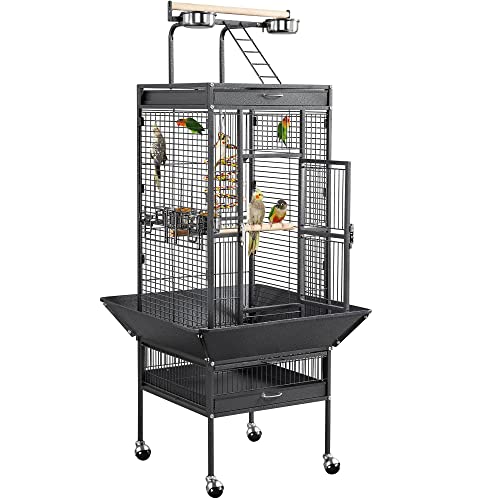
A tall wrought iron cage on castors with an open play top, giving a larger parrot somewhere to sit outside the cage without leaving the area. The wider bar spacing and heavier gauge wire suit birds that chew and climb. Owners report it is solid for the price, with the play top being the feature that gets used most.
Pros
- Play top gives out of cage time in one place
- Heavier gauge wire resists chewing
- Castors make repositioning simple
Cons
- Bar spacing is unsafe for very small birds
- Large footprint dominates a room

Prevue Hendryx Wrought Iron Select Bird Cage
A heavier wrought iron cage with a durable powder coated finish, built to a standard that holds up to a determined parrot rather than a budgie. The seed skirt around the base catches a good deal of scatter. Owners report the finish resists chipping far better than budget cages, which matters because flaking coating is a genuine hazard.
Pros
- Powder coat resists chipping and flaking
- Seed skirt cuts floor mess noticeably
- Solid enough for medium parrots that chew
Cons
- Heavy and difficult to move once built
- Costs more than similar sized budget cages

VIVOHOME 61 Inch Wrought Iron Bird Cage
A tall wrought iron cage with a play top and rolling stand at a noticeably lower cost than premium equivalents, aimed at owners of medium parrots and cockatiels. It comes with perches and feeding cups so it is usable straight away. Owners report good value overall, with the finish being the main compromise against pricier cages.
Pros
- Large cage at an accessible price
- Includes perches and cups to start
- Rolls easily for cleaning behind
Cons
- Finish is thinner than premium cages
- Door latches need checking for clever birds

A and E Cage Company Flight Bird Cage
A larger flight cage aimed at housing several small birds together, with a wide span and enough height for perches at multiple levels. The construction is heavier than typical retail flight cages. Owners report it works well as an indoor aviary for finches and budgie groups where a standard cage would be crowded.
Pros
- Genuinely suits several small birds
- Large doors reach the whole interior
- Sturdier than typical flight cages
Cons
- Takes up substantial floor space
- Heavier and harder to relocate

Yaheetech 30 Inch Portable Hanging Bird Cage
A compact cage suited to a single small bird, a temporary setup or a travel and vet visit cage rather than a permanent home. It is light enough to move room to room and cheap enough to keep as a spare. Owners report it does the job for its intended purpose but should not be a full time home for an active bird.
Pros
- Cheap and easy to move between rooms
- Useful as a hospital or travel cage
- Simple to clean given the small size
Cons
- Too small for full time housing of an active bird
- Light wire bends if handled roughly
How they compare
| # | Model | Interior span | Best for | Score | Price |
|---|---|---|---|---|---|
| 1 | Prevue Hendryx F040 Flight Cage | Wide rectangular flight layout | Best overall | 9.4 | Check price |
| 2 | Hagen Vision Bird Cage Model L01 | Deep moulded plastic with debris guard | Best for easy cleaning | 9.2 | Check price |
| 3 | Yaheetech 69 Inch Rolling Bird Cage with Play Top | Around 69 inches including stand | Best for large parrots | 9.0 | Check price |
| 4 | Prevue Hendryx Wrought Iron Select Bird Cage | Wrought iron with non toxic powder coat | Best build quality | 8.8 | Check price |
| 5 | VIVOHOME 61 Inch Wrought Iron Bird Cage | Around 61 inches with stand | Best value large cage | 8.6 | Check price |
| 6 | A and E Cage Company Flight Bird Cage | Wide flight cage for multiple birds | Best for multiple birds | 8.3 | Check price |
| 7 | Yaheetech 30 Inch Portable Hanging Bird Cage | Around 30 inches tall | Best budget | 8.0 | Check price |
Good to know
What size cage does a budgie need?
For a single budgie, aim for at least eighteen by eighteen by eighteen inches, and considerably more span if possible. A flight cage is much better, since budgies fly rather than climb. For a pair, treat that as the absolute minimum and go wider, prioritising horizontal distance over height.
Where should I put a bird cage indoors?
Against a wall rather than in the middle of a room, so the bird has a secure side, in a family area rather than isolation, and away from kitchens, draughts and direct sun. Kitchen fumes, particularly from overheated non stick cookware, are dangerous to birds and this is the single most important placement rule.
How often should an indoor cage be cleaned?
Change paper or tray liner daily, wash food and water dishes daily, wipe perches and grate weekly, and do a full wash of the cage monthly. Cages with deep bases such as the Hagen Vision make the daily part far quicker, which is the main reason they are worth considering.
Is a round cage bad for birds?
Most keepers avoid them. Round cages give less usable flight space for their footprint and offer no corner for a bird to retreat into, which some birds find unsettling. Rectangular cages with a wide span are the better choice for the same floor area.
Do I need a cage cover at night?
Many birds settle better with a cover, which signals sleep time and blocks household light. Use a breathable fabric and leave part of one side open for airflow. Introduce it gradually, since some birds find sudden full darkness stressful.
How do I stop seed getting everywhere?
Choose a cage with a deep base or a seed skirt, use seed catchers or an acrylic guard around the lower section, and place the cage on a washable mat. Feeding pelleted diets and using covered feeder cups also reduce scatter noticeably compared with open seed dishes.
Can two birds share one cage?
Some species pair well, particularly budgies and finches of compatible types, provided the cage is large enough that both can move without conflict. Introduce birds gradually and watch for aggression at feeding stations. Provide two of everything, since competition over a single food dish is a common cause of trouble.
Are wrought iron cages safe for parrots?
Yes, when finished with a non toxic powder coat, which is the standard on cages such as the Prevue Hendryx Wrought Iron Select. Avoid galvanised wire and any cage where the coating chips or flakes, since parrots chew bars and ingest what comes loose.
Final word
The Prevue Hendryx F040 Flight Cage is the cage to buy for budgies, finches and canaries, because horizontal span is what small birds actually use. The Hagen Vision Bird Cage is worth choosing if daily mess is what puts you off keeping birds indoors, and the Yaheetech 69 Inch Rolling Bird Cage is the practical option once you move up to a medium parrot.