Which Boat Battery Switch Matches Your Wiring Setup
Perko 8501DP suits most gasoline boats with a 250-amp OFF/1/2/BOTH design used across the industry for decades. Blue Sea Systems 8080 isolates the starting battery from a house bank at 300 amps. Guest 2304A covers diesel cranking loads at 600 amps continuous.
Wiring a boat’s electrical system starts at the battery switch, not the breaker panel. Amp rating, terminal size, and switch position have to match the engine and accessory load, not just the price tag on the shelf.
We compared continuous and momentary amp ratings, terminal stud size, ignition protection, and mounting style across seven current listings. Owner feedback on corrosion resistance and knob durability broke ties between switches rated within a few amps of each other.
The top picks, ranked

Perko 8501DP Medium Duty Battery Selector Switch
Four positions, OFF, 1, 2, and BOTH, cover nearly every gasoline boat wiring layout. A 250-amp continuous rating handles outboards up to roughly 300 horsepower, backed by a 360-amp momentary spike allowance. Copper contacts and brass terminals sit inside a polycarbonate case rated for 6 to 50 volt DC systems.
Pros
- Four-position layout suits most gasoline boats
- Ignition protection allows safe below-deck mounting
- Long track record of reliable field use
Cons
- 250A ceiling limits larger diesel setups
- 360A momentary spike trails heavy-duty rivals

Blue Sea Systems 8080 Dual Circuit Plus Battery Switch
A 300-amp On/Off switch isolates the starting battery, while a separate 100-amp ignition-protected breaker manages the house bank. Emergency cross-connect lets one bank jump the other without extra cabling. Two independent circuits stop house electronics from draining the start battery overnight.
Pros
- Keeps house electronics off the starting battery
- Built-in cross-connect doubles as a jump-start option
- 100A breaker adds circuit protection the basic switch skips
Cons
- Wiring is more involved than a single selector switch
- Panel footprint needs more helm space
Guest 2304A Heavy-Duty Diesel Power Battery Switch
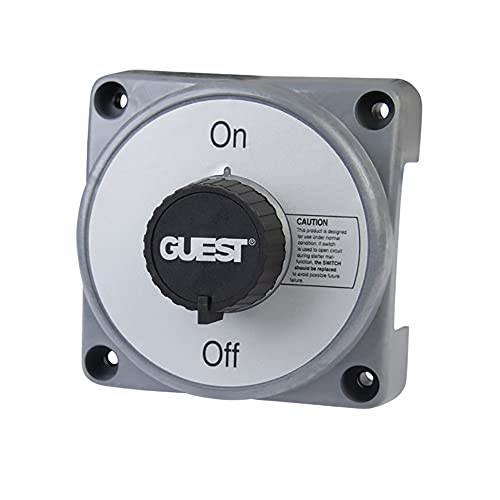
Diesel starters and stacked accessory loads pull more current than a medium-duty switch tolerates. This On/Off switch handles 600 amps continuous and 1000 amps momentary, well above typical gasoline-rated hardware. Guest houses it in sealed polycarbonate built for engine-room mounting.
Pros
- Handles diesel cranking loads other switches cannot
- Sealed housing tolerates engine-room humidity
- 1000A momentary rating absorbs heavy accessory spikes
Cons
- No 1/2/BOTH selector positions, On/Off only
- Amp rating is overkill for small gasoline outboards

BEP Marine 701-S Mini Battery Selector Switch
At 2.75 by 2.75 by 3 inches, this ranks among the smallest four-position switches sold for boats. OFF, 1, BOTH, and 2 still cover dual battery selection despite the reduced size. Three 5/16-inch tin-plated copper studs match the corrosion resistance of larger switches.
Pros
- Smallest footprint among 4-position switches
- 1000A cranking rating covers most outboard starts
- Mounts recessed or flush on the surface
Cons
- 200A continuous trails full-size switches
- Small knob is harder to grip with wet gloves

Blue Sea Systems 6006 m-Series Mini On-Off Battery Switch
One battery, one load group, one On/Off switch. Rated 300 amps continuous and 1500 amps cranking, it outperforms its 2-7/8-inch size on paper. UL Listed and ignition protected, it works as a master disconnect for boats that skip a second bank entirely.
Pros
- High cranking rating in a small case
- UL Listed and ignition protected
- Wiring stays simple on single-battery boats
Cons
- No 1/2/BOTH positions for a second bank
- Not a fit for dual battery setups

Guest 2111A-17 Universal Mount Marine Battery Selector Switch
230 amps continuous and 345 amps momentary cover a typical single-outboard boat without the price of heavy-duty hardware. Universal mounting fits existing panel cutouts left by other brands. A red knob on a polycarbonate case stays visible and corrosion resistant at the helm.
Pros
- Lower amp tier keeps cost down
- Universal mount simplifies replacement jobs
- Four positions match pricier switches
Cons
- 230A ceiling rules out larger diesel engines
- Momentary rating trails heavy-duty models
Sea-Dog 422766 Heavy-Duty Battery Switch
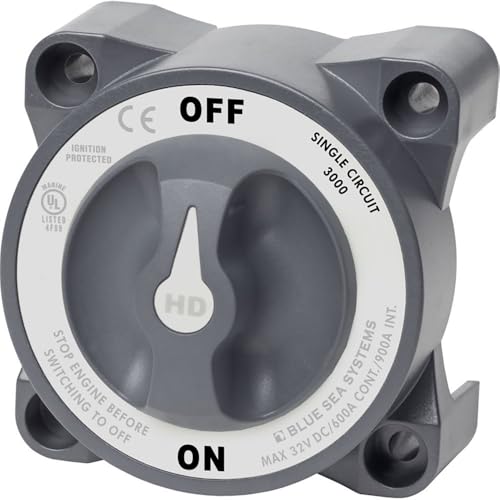
380 amps continuous and 2000 amps cranking undercut premium heavy-duty switches. Surface or rear-panel mounting fits most helm layouts, and the housing carries an ignition-protected rating safe for gasoline engines. Sea-Dog positions it between mid-range and premium switch lines.
Pros
- 2000A cranking rating beats many pricier switches
- Ignition protection suits gasoline engines
- Surface or rear-panel mounting fits more helms
Cons
- Fit and finish trail Blue Sea and Perko
- Fewer accessory mounting options than name-brand rivals
What matters most
What to look for in a boat battery switch Amp rating comes first: continuous rating covers normal running current, and cranking or momentary rating covers the brief spike an engine draws at startup. Terminal stud size has to match your existing cable lugs, usually 5/16-inch or 3/8-inch on marine switches. Ignition protection matters for any switch mounted near a gasoline engine or fuel vapor. Mounting style, surface, recessed, or panel cutout, decides whether an old switch can be swapped without cutting new holes.
How much amperage does your engine and bank setup need A single outboard under 150 horsepower rarely exceeds 250 amps continuous, which fits switches like the Perko 8501DP. Twin engines, diesel starters, or stacked accessory loads push past 300 amps and call for switches like the Guest 2304A at 600 amps. Undersized switches overheat at the terminals long before anything trips, since most are simple mechanical contacts without a breaker. Match the switch to the highest expected draw, not the average one.
Which switch fits dual battery bank wiring Dual bank setups separate the engine-starting battery from a house bank running electronics, pumps, and lighting. Blue Sea Systems 8080 handles this with two independent circuits instead of one shared selector. A 100-amp breaker on the house side adds protection a basic 4-position switch skips entirely. Boats with trolling motors, livewells, or long overnight anchoring benefit most from that separation.
Best switches for small boats, single batteries, and diesel engines Small center consoles and jon boats often lack room for a full-size 4-position switch, which is where BEP Marine 701-S fits at 2.75 inches square. Single-battery boats need only an On/Off switch like the Blue Sea Systems 6006, since there is no second bank to select. Diesel starters briefly pull far more current than a gasoline outboard, flipping the amp math the other direction. Guest 2304A and similar extra-duty switches exist specifically for that higher diesel draw.
Side by side
| # | Model | Positions | Best for | Score | Price |
|---|---|---|---|---|---|
| 1 | Perko 8501DP Medium Duty Battery Selector Switch | OFF / 1 / 2 / BOTH | Best overall | 9.4 | Check price |
| 2 | Blue Sea Systems 8080 Dual Circuit Plus Battery Switch | Dual circuit, isolated start and house | Best for dual battery banks | 9.2 | Check price |
| 3 | Guest 2304A Heavy-Duty Diesel Power Battery Switch | On/Off, extra duty | Best for high amperage and diesel engines | 9.0 | Check price |
| 4 | BEP Marine 701-S Mini Battery Selector Switch | OFF / 1 / BOTH / 2 | Best for small boats and tight helm spaces | 8.8 | Check price |
| 5 | Blue Sea Systems 6006 m-Series Mini On-Off Battery Switch | On / Off, single circuit | Best for single-battery on/off isolation | 8.6 | Check price |
| 6 | Guest 2111A-17 Universal Mount Marine Battery Selector Switch | OFF / 1 / 2 / BOTH | Best value | 8.3 | Check price |
| 7 | Sea-Dog 422766 Heavy-Duty Battery Switch | OFF / 1 / 2 / BOTH | Best budget for heavy-duty use | 8.0 | Check price |
Good to know
What size battery switch do I need for my boat?
Match continuous amp rating to your highest expected load, not the average. Single outboards under 150 horsepower typically need 250 amps continuous or more. Twin engines, diesel starters, or heavy electronics push that requirement toward 300 to 600 amps.
What does OFF/1/2/BOTH mean on a boat battery switch?
OFF disconnects every battery from the system. Positions 1 and 2 each isolate a single battery bank on its own. BOTH parallels the two banks together, mainly for emergency jump-starting.
Can I leave a boat battery switch on BOTH while running?
Running on BOTH ties the banks together, so a short or a dead battery can drain both at once. Most owners cruise on one bank, switch periodically, and reserve BOTH for starting trouble.
Is a 4-position switch better than a simple on/off switch?
It depends on how many batteries the boat carries. A 4-position OFF/1/2/BOTH switch suits dual battery boats. A single battery boat gains nothing from the extra positions and works fine with a simpler switch like the Blue Sea Systems 6006.
How do you wire a battery switch for two battery banks?
Run heavy cable from each battery’s positive terminal to its own switch position, then a single output cable to the engine and house loads. Blue Sea Systems 8080 simplifies this further by keeping start and house circuits on separate paths from the beginning.
Are boat battery switches waterproof?
Most are ignition protected and built with sealed polycarbonate housings, which resist spray and humidity rather than full submersion. Guest 2304A and Sea-Dog 422766 both use sealed housings rated for engine-room and helm mounting.
What is the difference between continuous and cranking amp ratings?
Continuous amps describe current the switch handles indefinitely without overheating. Cranking or momentary amps describe a brief spike, usually a few seconds during engine start. A switch can carry 250 amps continuous while briefly tolerating 360 amps or more at startup.
Do diesel engines need a different battery switch than gasoline engines?
Diesel starters draw more current during cranking than most gasoline outboards. Extra-duty switches like the Guest 2304A, rated 600 amps continuous, cover that higher diesel draw. A standard 250-amp switch can overheat under repeated diesel starting cycles.
What is the best battery switch for a small boat?
The BEP Marine 701-S fits tight helms at 2.75 inches square while still offering four selector positions. Smaller boats rarely need the amp headroom of a full-size diesel-rated switch.
Perko or Blue Sea, which brand is better for a battery switch?
Perko’s 8501DP suits single-selector gasoline boats with a proven 4-position design. Blue Sea Systems leans toward dual-circuit setups like the 8080, which keeps start and house loads on separate paths. The better brand depends on whether the boat runs one shared selector or two isolated circuits.
Our take
Perko 8501DP remains the dependable default for boats running two batteries through a single selector. Blue Sea Systems 8080 earns its higher price on boats that need starting and house circuits kept fully separate. For diesel engines or genuinely small helms, match the switch to that specific load instead of defaulting to the biggest name on the shelf.