Bodyboards for Beach Days, From Beginner to Advanced
The Morey Mach 7 Bodyboard leads for all round performance and a core stiff enough for real waves. The THURSO SURF Quill 42 Inch Bodyboard is the value pick with a durable slick bottom. The Wavestorm Bodyboard is the budget choice for casual beach days.
The Morey Mach 7 Bodyboard is the one that keeps working as you improve, the THURSO SURF Quill 42 Inch Bodyboard covers most riders with a tougher slick bottom for less, and the Wavestorm Bodyboard is enough for a family beach day.
Bodyboards are easy to buy badly because the sizing charts vary between brands and the core material, which decides almost everything about how a board rides, is often buried in the listing. We compared core type from expanded polystyrene through polypropylene, slick bottom material, whether a stringer is fitted, how board length maps to rider height and weight, and the quality of the included leash across the seven boards below.
What we recommend

Morey Mach 7 Bodyboard
Morey is the name the sport was built on and the Mach 7 is the model most riders end up on, with a core stiff enough to hold a line in real surf and a shape that still forgives a beginner. The crescent tail gives control on a wave face without punishing a rider who is still learning to angle. It is the board you keep as you improve.
Pros
- Stiff core holds its line in real surf
- Forgiving enough for improving riders
- Holds resale value and long term durability
Cons
- Costs more than casual beach boards
- Stiff core feels less lively in very small waves
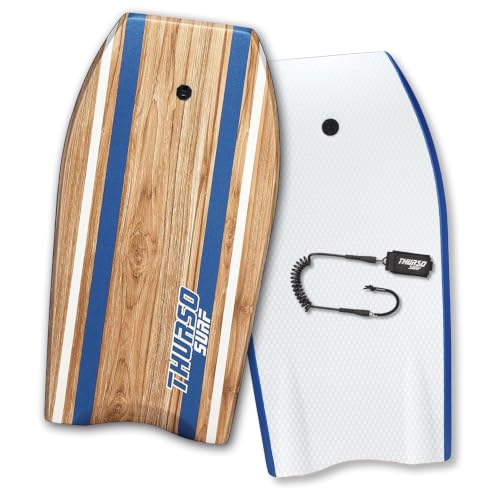
THURSO SURF Quill 42 Inch Bodyboard
The high density polyethylene slick bottom resists the scuffing that shore break dishes out, which is the main way cheap boards die. Twin stringers add stiffness so the board does not fold under a heavier rider. Owners report the included leash is better than the throwaway ones bundled with most boards at this level.
Pros
- Tough slick bottom survives shore break
- Twin stringers stop the board folding
- Includes a usable leash rather than a token one
Cons
- Single length limits rider fit
- Polystyrene core is less responsive than polypropylene

Wavestorm Bodyboard
The board to buy when the question is whether the family will use it more than twice a summer. It floats well, it is soft on knees and elbows in a tumble, and it is cheap enough to leave in a garage over winter without worrying. Serious wave riding is not what it is for.
Pros
- Low outlay for a whole family
- Soft construction is gentle in a wipeout
- Plenty of float for beginners
Cons
- Soft core flexes too much for real waves
- Not built for a full season of heavy use

BZ Advantage Bodyboard
BZ builds this for riders who are past the learning stage and want speed down the line and response off the bottom turn. The core is stiffer than most and the rails are shaped for holding a high line. That precision is wasted on a rider still learning to catch waves, and it is less forgiving in the process.
Pros
- Genuinely fast down the line
- Rails hold an edge on steeper faces
- Built for regular hard use
Cons
- Too stiff and demanding for beginners
- Limited value in small mushy waves

Own the Wave 33 Inch Bodyboard
Sized properly for a child rather than being an adult board scaled down badly, which matters because an oversized board is genuinely hard for a small rider to control. The construction is straightforward with a slick bottom and a wrist leash. Adults will find it far too small to be useful.
Pros
- Correctly sized for younger riders
- Light enough for a child to carry
- Includes a wrist leash sized for kids
Cons
- Far too small for teenagers or adults
- Basic core will not suit progression

South Bay Board Co. Bodyboard
A wide, buoyant shape that catches waves easily, which is the thing beginners struggle with most. Extra float means you plane sooner and get more rides per session, and more rides is how anyone improves. Experienced riders will find the same width slows the board on a steeper face.
Pros
- Catches waves easily thanks to extra float
- Wide template is stable under a beginner
- Coiled leash included in the box
Cons
- Width slows the board on steep faces
- Not a board you keep as you progress

BPS Storm Bodyboard
Light enough to carry a long way down a beach or check into a flight without a fight, which sounds trivial until you have hauled a heavy board a mile. The construction is decent for the outlay with a slick bottom and stringer. Very light boards give up some drive in bigger surf, which is the trade.
Pros
- Light to carry over distance and to travel with
- Stringer adds useful stiffness for the weight
- Reasonable build quality for the outlay
Cons
- Light construction loses drive in bigger surf
- Less durable than heavier performance boards
How they stack up
| # | Model | Core | Best for | Score | Price |
|---|---|---|---|---|---|
| 1 | Morey Mach 7 Bodyboard | Polypropylene | Best overall | 9.4 | Check price |
| 2 | THURSO SURF Quill 42 Inch Bodyboard | Expanded polystyrene with stringers | Best value | 9.2 | Check price |
| 3 | Wavestorm Bodyboard | Soft foam | Best budget | 9.0 | Check price |
| 4 | BZ Advantage Bodyboard | Performance polypropylene | Best for performance | 8.8 | Check price |
| 5 | Own the Wave 33 Inch Bodyboard | 33 inches | Best for kids | 8.6 | Check price |
| 6 | South Bay Board Co. Bodyboard | High float foam with stringer | Best for beginners | 8.3 | Check price |
| 7 | BPS Storm Bodyboard | Lightweight polystyrene with stringer | Best for travel | 8.0 | Check price |
What to look for
Core material decides how the board rides Expanded polystyrene is light and buoyant, which suits beginners and warm water, but it flexes and loses stiffness over time. Polypropylene is stiffer, more responsive and holds its shape far longer, which is why performance boards use it. Extruded polystyrene sits between the two. If you ride regularly in real waves, a polypropylene core is the upgrade that changes the most, and in cold water it stays stiff where cheaper cores go soft.
Sizing to rider height and weight The usual guide is that a board stood on its tail should reach somewhere around your navel, with heavier riders sizing up for float and lighter riders sizing down for control. Weight matters as much as height, since an under-buoyant board ploughs instead of planing and an oversized board is hard to turn. Brand charts differ, so check the specific chart rather than assuming a length transfers between makers.
Slick bottoms, stringers and durability The slick is the hard plastic layer on the underside, and high density polyethylene resists shore break scuffing far better than the cheaper surlyn-style alternatives. A stringer is a rod running through the core that stops the board folding under load, and for anyone above about seventy kilograms it is worth insisting on. Boards without a stringer develop a permanent bend that ruins how they ride.
Leashes, fins and looking after the board A wrist or bicep leash keeps the board with you after a wipeout and prevents it becoming a hazard to other beach users. Swim fins are close to essential once you move past whitewater, since they let you catch waves earlier and control the board on the face. Afterwards, rinse the board in fresh water and never leave it in a hot car or in direct sun, since heat delaminates the slick from the core faster than anything else.
Questions worth asking
What size bodyboard do I need?
As a starting point, the board should reach roughly your navel when stood on its tail. Adjust up for heavier riders who need more float and down for lighter riders who want easier turning, and always check the specific brand chart.
What core material should I choose?
Polystyrene cores are light, buoyant and cheap, which suits beginners and warm water. Polypropylene is stiffer and more responsive and holds its shape far longer, making it the choice for regular riding and colder water.
Do I need swim fins for bodyboarding?
In whitewater, no. Once you want to catch unbroken waves and control the board on the face, fins become close to essential because they let you match the wave speed and paddle into it earlier.
What is a stringer and do I need one?
A stringer is a reinforcing rod running through the core to stop the board flexing and folding. Riders above roughly seventy kilograms should treat it as necessary, since an unstringered board can take a permanent bend.
Can adults use a bodyboard, or is it a kids toy?
Bodyboarding is a full adult sport with its own competitive scene. Adult riders just need adult sizing and a stiffer core, since child-sized boards will not float or control properly under an adult.
How do I stop my bodyboard getting damaged?
Rinse it in fresh water after every session, keep it out of direct sun and never leave it in a hot car. Heat is what separates the slick bottom from the core, and it does more damage than the waves ever will.
What is the difference between a crescent and a bat tail?
A crescent tail wraps around the hips for more control and hold, favoured for prone riding. A bat tail is wider and looser, which suits drop knee riding and lighter riders. Crescent is the safer default for most people.
Is a leash necessary?
Yes. A leash keeps the board attached after a wipeout, which saves a long swim and stops a loose board hitting someone else in the water. Wrist leashes are standard for prone riding, bicep leashes for drop knee.
The bottom line
The Morey Mach 7 Bodyboard is the pick for anyone who intends to ride more than a handful of times, with a core stiff enough for real waves and a shape that does not punish you while you learn. The THURSO SURF Quill 42 Inch Bodyboard gets you most of the way there with a slick bottom that survives shore break. For a family beach day, the Wavestorm Bodyboard is all the board you need.

