Buffing Pads Compared: Cutting Foam vs Microfiber vs Wool
The Chemical Guys Hex-Logic Buffing Pad Kit is the overall pick because it spans cutting through finishing in one set. Lake Country CCS Smart Pads deliver the most consistent foam quality between pads, and Meguiar’s Soft Buff DA Foam discs are the easiest starting point for beginners.
Correction through finishing in a single purchase makes the Chemical Guys Hex-Logic Buffing Pad Kit the most useful pick overall. Detailers chasing repeatable results lean toward Lake Country CCS Smart Pads, while first time polishers get the gentlest start from Meguiar’s Soft Buff DA Foam discs.
Colour coding on buffing pads looks standardised but is entirely brand specific, so a black pad from one maker finishes while a black pad from another cuts. We compared seven currently sold pad ranges on foam density and cell structure, cut level, diameter options and backing plate fit, then weighed those specs against what owners report about pad life, edge tearing and heat build up on long panels.
What to look for
Why pad colour means less than the cut level printed on the label Pad colours are not standardised across brands, so learning that orange means cutting will actively mislead you the moment you switch manufacturers. Read the stated cut level in the product description instead. Working order stays the same regardless of brand: a cutting pad with compound to remove defects, a polishing pad to refine what cutting left behind, and a soft finishing pad for jewelling or applying a glaze.
How to match pad size to your backing plate and panels A pad should overhang the backing plate by roughly half an inch, no more. Too much overhang lets the unsupported edge flex, generate heat and tear. Larger pads cover a bonnet faster, but smaller three inch pads let you correct pillars, mirrors and tight areas around door handles where a six inch pad can’t sit flat.
Foam vs microfiber vs wool: which solves which problem Foam is the general purpose choice, covering everything from heavy correction to final finishing depending on density. Microfiber cuts much faster on a dual action polisher, letting these machines tackle defects that used to require a rotary, but it always needs a refining pass afterward. Wool remains the traditional heavy cutting option on rotary machines and generates the most heat, demanding the most care.
Pad care that actually extends usable life A pad clogged with spent compound stops cutting and starts smearing, so clean it against a brush or with compressed air after every panel. Wash pads in warm water with a dedicated pad cleaner, squeeze rather than wring them to protect the foam structure, and air dry face up. Pads washed promptly last several times longer than ones left to dry with compound still in them, according to owner reports.
The top picks, ranked

Chemical Guys Hex-Logic Buffing Pad Kit
A hex pattern face holds product and channels heat away, which is the main reason these pads stay usable across a whole panel instead of glazing over. Cutting, polishing and finishing densities ship together in the kit, so a correction never stalls waiting on another order. Foam forgiveness for slightly wrong pressure suits people still learning machine polishing, according to owner reports.
Pros
- One kit covers the full correction process
- Hex face channels heat and holds product
- Forgiving foam density suits newer users
Cons
- Edges fray sooner than premium single pads
- Colour coding differs from other brands, causing confusion

Lake Country CCS Smart Pads
A collapsed cell structure dimples the pad face so polish meters out gradually instead of soaking in on the first pass. Density stays noticeably consistent between individual pads, which matters when repeating a result across a whole car. Many detailers default to this range because it holds its shape through repeated washing.
Pros
- Dimpled face meters polish rather than absorbing it
- Density stays very consistent between pads
- Size range includes spot correction pads
Cons
- Sold individually rather than as a starter kit
- Colour system takes time to memorise

Meguiar’s Soft Buff DA Foam Polishing Disc
Dual action polishers get a purpose built match here, with a thinner profile that transfers machine motion to the paint more directly and generates less heat. A tapered edge reduces the chance of catching a body line. Working on your own car with a starter DA polisher, this is the least intimidating pad on the list.
Pros
- Heat build up stays low on dual action machines
- Tapered edge is safer around body lines
- Wide stocking makes replacements easy
Cons
- Thin foam gives less cushioning on curves
- Not aggressive enough for heavy defect removal

Griot’s Garage BOSS Foam Pads
Thinner foam and a rounded edge keep rotational energy at the paint rather than turning into heat inside the BOSS pad. Long door panels, where the same area gets worked for a while, show the real benefit of that design. Colour matching to the BOSS polish range simplifies pairing for anyone already using it.
Pros
- Runs cooler over long working sections
- Rounded edge follows curved panels well
- Simple two grade system is hard to get wrong
Cons
- Fewer grades than rival systems
- Best results assume the matching polish line
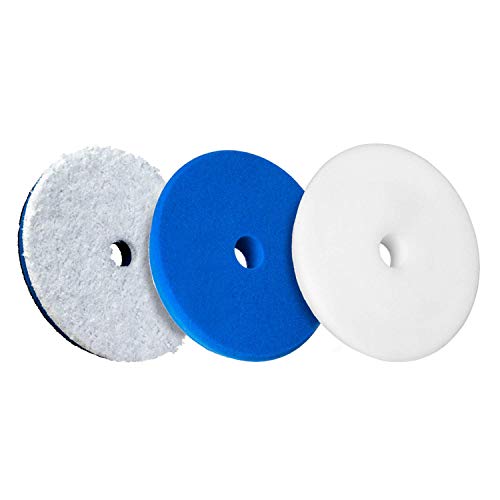
Adam’s Polishes Microfiber Cutting Pad
Microfiber cuts considerably faster than foam on a dual action machine, which is how deeper sanding marks and heavy swirls come out without moving to a rotary polisher. A foam polishing step still has to follow, since microfiber alone leaves a hazier finish. Compressed air or a brush needs to clear the fibres frequently, because a loaded pad stops cutting and starts hazing.
Pros
- Removes heavy defects faster than foam
- Extends what a dual action polisher can achieve
- Holds compound well across a section
Cons
- A foam refining step is always needed afterward
- Loads up quickly and must be cleaned often

RUPES D-A Coarse Blue Foam Pad
Long throw random orbital machines can stall a standard pad against the paint, and this RUPES pad is built around that mechanic specifically. Foam engineering keeps rotation going under pressure, which is the whole point of a long throw polisher. Matching the pad to the throw makes a bigger difference than most people expect on a large orbit machine.
Pros
- Maintains rotation on long throw machines
- Cut stays even across the pad face
- Durable through repeated cleaning
Cons
- Overkill on short throw entry level polishers
- Limited grade options in this line

SPTA 5 Inch Buffing and Polishing Pad Kit
Cutting, polishing and finishing plus a backing plate all ship in this large multi pack, aimed at people who want to try machine polishing without committing to premium pads. Quality varies more than with named brands, but enough pads in the box means the weak ones can be retired without regret. A reasonable way to practise before buying better foam.
Pros
- Covers every stage in one purchase
- Includes a backing plate and adapter
- Enough pads included to practise without worry
Cons
- Foam density varies between pads in the same pack
- Usable life runs shorter than premium ranges
The lineup, side by side
| # | Model | Construction | Best for | Score | Price |
|---|---|---|---|---|---|
| 1 | Chemical Guys Hex-Logic Buffing Pad Kit | Hex faced open cell foam | Best overall | 9.4 | Check price |
| 2 | Lake Country CCS Smart Pads | CCS dimpled foam | Best value | 9.2 | Check price |
| 3 | Meguiar’s Soft Buff DA Foam Polishing Disc | Thin profile open cell foam | Best for beginners | 9.0 | Check price |
| 4 | Griot’s Garage BOSS Foam Pads | Thin foam with rounded edge | Best for long panels | 8.8 | Check price |
| 5 | Adam’s Polishes Microfiber Cutting Pad | Microfiber over foam interface | Best for heavy defect removal | 8.6 | Check price |
| 6 | RUPES D-A Coarse Blue Foam Pad | Coarse open cell foam | Best for long throw polishers | 8.3 | Check price |
| 7 | SPTA 5 Inch Buffing and Polishing Pad Kit | Mixed foam and wool | Best budget | 8.0 | Check price |
Common questions
What do buffing pad colours actually mean?
They mean whatever the manufacturer decided, and there is no industry standard. One brand’s black pad is a soft finishing pad while another’s is a cutting pad. Always read the stated cut level in the description, and label your own pads if you mix brands so you aren’t guessing halfway through a correction.
Do I need different pads for a dual action and a rotary polisher?
Yes, in practice. Dual action machines work best with thinner foam that transfers motion efficiently and resists heat, while rotary machines can drive thicker foam and wool. Long throw random orbital polishers add another wrinkle, since standard pads can stall under pressure and pads designed for that throw keep rotating.
How many buffing pads do I need for one car?
Plan on at least two pads per stage for a full car, since a single cutting pad saturates before you finish. Detailers commonly use three or four cutting pads on a heavily swirled vehicle, swapping to a clean pad as soon as cut noticeably drops rather than trying to clean one pad repeatedly.
Can buffing pads be washed and reused?
Yes, and they should be. Rinse in warm water with a dedicated pad cleaner or mild detergent, work the compound out with your fingers, then squeeze rather than wring so the foam structure isn’t torn. Air dry face up. Machine washing on a gentle cycle suits microfiber pads but shortens the life of foam.
How do I know when to throw a buffing pad away?
Retire a pad once the foam edge tears, the hook and loop backing starts separating from the foam, or the face hardens and glazes to the point that washing no longer restores its texture. A degraded pad hazes paint rather than correcting it, costing more time than a new pad would.
Is a microfiber pad safe on soft paint?
Fast cutting means it can also mar soft paint if left too long in one place or if the refining step gets skipped. Owners generally report better results starting with a foam polishing pad on soft clear coats, stepping up to microfiber only if defects won’t come out.
What size buffing pad should I start with?
A 5.5 inch pad on a 5 inch backing plate is the most versatile combination for a whole car, balancing coverage against control. Adding a set of three inch pads covers pillars, bumpers and areas around handles and badges, where a large pad can’t sit flat and will burn edges.
Do different pad sizes need different backing plates?
Usually yes. The backing plate should be roughly half an inch smaller in diameter than the pad face, so a set of three inch pads needs its own smaller plate. Running small pads on an oversized plate is a common cause of edge damage and vibration.
Foam vs microfiber buffing pads: which cuts faster?
Microfiber cuts noticeably faster than foam on a dual action polisher, which is why it handles heavier defects. Foam stays gentler and more controllable, and most corrections still finish with a foam polishing or finishing pad regardless of which pad started the job.
Final word
The Chemical Guys Hex-Logic Buffing Pad Kit remains the most sensible single purchase, delivering cutting, polishing and finishing grades in one box so a correction never stalls waiting on a delivery. Detailers chasing repeatable results should build a set of Lake Country CCS Smart Pads instead, since foam consistency between pads is that range’s real strength. First time polishers get the best start from Meguiar’s Soft Buff DA Foam discs, which run cool and forgive imperfect technique.


