Camera Backpacks Compared for Padding and Access
Lowepro ProTactic BP 450 AW II wins for four-side access and a genuinely supportive belt. Peak Design Everyday Backpack V2 30L covers hybrid shooters who also carry a laptop. K&F Concept Alpha Backpack 25L handles a budget mirrorless kit well.
Lowepro ProTactic BP 450 AW II handles a body, three lenses and a laptop without strain, making it the safest single pick. Peak Design Everyday Backpack V2 30L works almost as well for photographers who split time between camera gear and daily commuting.
Marketing capacity rarely matches usable padded volume, and a pack that swallows gear can still ride badly on a long walk. We compared published dimensions, divider systems, access panels and harness design, then weighed owner reports about durability and airport carry-on fit.
Our top picks

Lowepro ProTactic BP 450 AW II
Top, both sides and the full rear panel open independently, so a lens comes out without setting the pack down. MOLLE-style webbing on the exterior accepts accessory pouches for extra gear. Owners report a two-body setup plus a 70-200mm rides comfortably thanks to the removable hip belt.
Pros
- Reaches gear from four separate directions
- Modular exterior accepts accessory pouches
- Hip belt genuinely supports a heavy kit
Cons
- Weighs more than minimalist camera packs
- Boxy shape reads as obvious camera gear

Peak Design Everyday Backpack V2 30L
Origami FlexFold dividers reshape into whatever configuration a kit needs, from one body to a full lens lineup. Dual side flaps give quick access without a full unpack. MagLatch closure expands the top for overpacking days, and the bag passes as an ordinary backpack once the camera stays home.
Pros
- Dividers reshape to fit any kit
- Passes as a normal daily backpack
- Top closure expands for overpacking
Cons
- Waist belt offers minimal support for the size
- Divider arrangement takes practice to master
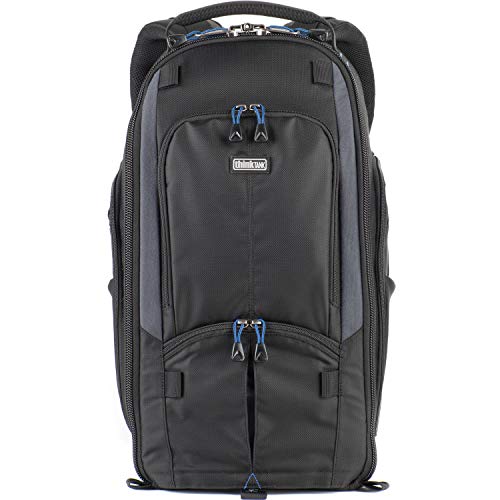
Think Tank Photo StreetWalker V2.0
A narrow footprint stays comfortable through crowds and on public transit. Rear panel access keeps the harness clean whenever the bag sits on the ground. Tripod pocket sits centered rather than off to one side, and the pack favors a single body with two or three lenses over a sprawling kit.
Pros
- Very slim profile through the shoulders
- Rear access keeps shoulder straps clean
- Light weight for its protection level
Cons
- Limited room for a full-size laptop
- Too small for two camera bodies
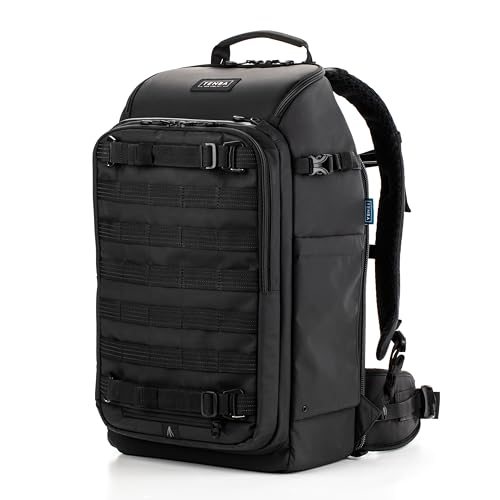
Tenba Axis v2 24L Backpack
A deep internal column holds a long lens attached to a body, ready to shoot on arrival. Harness design borrows from hiking packs, spreading weight across the hips. Fabric sheds drizzle well, and owners report the shape holds up when set on wet ground at a game or trailhead.
Pros
- Deep column fits an attached long lens
- Hiking-style harness spreads weight well
- Water-resistant fabric handles light rain
Cons
- Tall shape can feel top-heavy when full
- Fewer small organizer pockets than rivals

Manfrotto Advanced Befree Backpack III
A side compartment sized around Manfrotto’s own travel tripods swallows one without unbalancing the pack. Upper section stays free for a jacket and lunch, doubling as a day bag. Landscape photographers who always travel with support get the most from this layout.
Pros
- Best-in-class dedicated tripod compartment
- Upper section works for non-camera items
- Comfortable enough for day hikes
Cons
- Camera storage section runs modest
- Harness feels basic under heavier loads

Vanguard Alta Sky 51D
A large gear side and a personal side split this pack, with a removable divider for one big cavity when a super telephoto needs the room. Suspended harness design keeps air moving on hot days. It ranks among the roomiest packs here without stepping into hard case territory.
Pros
- Handles very large telephoto lenses
- Separate compartment for personal items
- Ventilated back panel stays cooler
Cons
- Large footprint struggles in tight cabins
- Empty weight runs high before packing

K&F Concept Alpha Backpack 25L
Padded dividers, a side-entry door, a tripod strap and a rain cover cover the basics competently. Materials run lighter duty than the premium packs above, though a mirrorless body and two lenses fit without issue. It works as a reasonable first camera backpack before carry preferences are set.
Pros
- Complete feature set for the price
- Light empty weight for easy carrying
- Rain cover included at purchase
Cons
- Zippers feel less refined than pricier packs
- Padding runs thinner than premium rivals
What to look for
How much padded volume do you actually need? Listed liters include laptop sleeves and lid pockets, so a 30 liter pack may offer only 15 liters of padded camera space. Lay out the body, lenses, flash and batteries carried on a typical week. Measure that stack against internal dimensions rather than headline capacity. Buying one size up is common, but a half-empty pack lets gear shift around.
Which camera backpack access style suits how you shoot? Rear panel access keeps the harness off wet ground and makes theft harder in a crowd, though it means removing the whole pack. Side access lets a bag swing around one shoulder for a lens swap in seconds. Top loading suits hiking with a single body. Event shooters gain the most from side or four-way access across a long day.
When does a hip belt matter on a camera backpack? Shoulder straps feel fine alone under roughly 12 pounds of gear. Above that weight, a load lifter and a real hip belt shift weight onto the pelvis and stop shoulder ache. Look for a padded belt that wraps past the hip bones rather than thin webbing. Back panel airflow channels matter too if shoots happen in heat.
Are camera backpacks waterproof and airline carry-on safe? Most camera backpacks use water-resistant fabric plus a stowed rain cover rather than a true waterproof shell, fine for showers but not sustained rain. Frequent flyers should check a pack against their usual airline cabin dimensions. Tall wildlife packs exceed common limits once fully loaded, which can force an unwanted gate check with fragile gear inside.
Side by side
| # | Model | Capacity | Best for | Score | Price |
|---|---|---|---|---|---|
| 1 | Lowepro ProTactic BP 450 AW II | About 25 liters | Best overall | 9.4 | Check price |
| 2 | Peak Design Everyday Backpack V2 30L | 30 liters | Best value | 9.2 | Check price |
| 3 | Think Tank Photo StreetWalker V2.0 | About 18 liters | Best for street and travel | 9.0 | Check price |
| 4 | Tenba Axis v2 24L Backpack | 24 liters | Best for long lens kits | 8.8 | Check price |
| 5 | Manfrotto Advanced Befree Backpack III | About 20 liters | Best for tripod carry | 8.6 | Check price |
| 6 | Vanguard Alta Sky 51D | About 30 liters | Best for wildlife gear | 8.3 | Check price |
| 7 | K&F Concept Alpha Backpack 25L | 25 liters | Best budget | 8.0 | Check price |
Frequently asked questions
How much camera gear fits in a 25 liter backpack?
A typical 25 liter pack holds one body with a lens attached, two or three additional lenses, a flash, batteries and a 15 inch laptop. Large telephoto lenses eat that space fast, pushing wildlife shooters toward 30 liters or a removable divider.
Is a camera backpack allowed as airline carry-on?
Packs in the 18 to 25 liter range usually fit standard cabin limits, while 30 liter and larger packs run borderline once loaded. Measure packed depth, since camera packs are thicker than normal backpacks and depth is what usually fails a sizer.
Do camera backpacks keep gear dry in rain?
Fabrics run water-resistant rather than waterproof, so light rain is fine but sustained downpours are not. Use the included rain cover where supplied, and keep spare batteries and memory cards in a sealed pouch inside.
Rear access or side access, which works better?
Rear access is more secure and keeps straps clean, while side access is faster to use. Travel and street photographers tend to prefer rear panels, while event and wedding shooters favor side doors for quick lens swaps.
Can a tripod fit on any camera backpack?
Nearly all include a side pocket with a compression strap or front straps. Full-size tripods ride better on a side pocket since weight stays close to your center of gravity, while travel tripods work fine on the front.
Are hard shell cases better than backpacks for camera gear?
Hard cases resist crushing and suit checked luggage or vehicle transport, but they run heavy and slow to open. A padded backpack works better for anything involving walking, and many photographers pair a hard case for transit with a backpack for the shoot itself.
How should camera backpack dividers be arranged?
Stand lenses upright with the widest at the bottom, place the body in the center where padding runs thickest, and leave no gap wider than a finger. Gear that can slide is gear that can knock, so tighten dividers even at the cost of a slightly awkward layout.
Do these packs fit both a laptop and a tablet?
Most carry either a 15 or 16 inch laptop, and several add a second slim slot for a tablet or documents. The slimmest models here take a 13 inch machine at most, worth checking if editing happens on the road.
Final word
Lowepro ProTactic BP 450 AW II remains the pick for most photographers, since four-way access and a proper hip belt cover heavy kits and long days alike. Hybrid shooters wanting one bag for camera and commute should choose the Peak Design Everyday Backpack V2 30L, while the K&F Concept Alpha Backpack 25L makes a sensible starting point for a smaller mirrorless setup.