How to Pick a Camping Hatchet That Holds Its Edge
Estwing’s Sportsman’s Axe wins overall for its single piece forged steel head that never loosens. Backpackers should choose the lighter Fiskars X7 Hatchet instead. Campers splitting fat rounds into kindling get more from the Gerber Gator Hatchet’s wider blade.
Estwing’s Sportsman’s Axe is the top pick for most campers, forged from one piece of steel so the head can’t work loose. Its main tradeoff is weight, since an all steel build runs heavier than composite alternatives. Backpackers counting ounces should look at the Fiskars X7 Hatchet, and anyone splitting fat rounds gets more from the Gerber Gator Hatchet’s wider bit.
Full tang steel, composite cores and traditional wood hafts each trade durability against weight in a different way. We compared steel type, handle construction, blade geometry and owner reports on edge retention across seven camping hatchets to rank them here.
How to pick the right one
What to look for in a camping hatchet Weight, handle material and blade geometry decide whether a hatchet suits backpacking or car camping. Estwing’s one piece forged design never loosens, while wood handles absorb shock better but need occasional care. Match the tool to whether you carry it for miles or leave it at a fixed site.
Full tang steel or wood handle: which holds up longer Full tang construction runs steel through the entire handle, removing the point where a head can separate from wood. Wood handles flex slightly during heavy chopping, which reduces hand fatigue over a long session. They can also be replaced individually if cracked, unlike a one piece forged head.
Splitting kindling or carving: match the blade shape to the job Wide, blunt profiles like the Gerber Gator’s push rounds apart more effectively when splitting kindling. Thinner geometry, like the Council Tool Wood-Craft’s, cuts more precisely for stakes or feather sticks. Few hatchets handle both tasks equally well, so pick the shape that fits your main use.
How to keep a camping hatchet sharp on the trail Carbon steel takes a finer edge than stainless but needs oiling after wet use to resist rust. Stainless and coated steels resist corrosion with less upkeep, trading away some sharpness. A pocket sharpener packed alongside any hatchet maintains cutting performance between trips.
What we recommend

Estwing Sportsman’s Axe
Estwing forges the head and handle from a single piece of steel, so there is no wedge to work loose over years of use. Rubber wraps the handle to cut down on shock during repeated swings. Owners report the edge holds up through extended trips with only occasional resharpening.
Pros
- Head can never separate from the handle
- Edge stays sharp across extended use
- Ships with a leather sheath for storage
Cons
- Heavier than composite handle alternatives
- All steel build transmits more shock than wood

Fiskars X7 Hatchet
Fiskars pairs a steel core with a fiberglass reinforced composite handle to cut weight without losing durability. Its hardened blade returns to a sharp edge quickly after use. Reviewers say it splits kindling with noticeably less effort than heavier all steel hatchets.
Pros
- Lighter than most all steel hatchets
- Composite handle resists moisture damage
- Blade resharpens to a fine edge easily
Cons
- Composite handle cannot be replaced like a wood haft
- Grip stiffens in freezing temperatures

Gerber Gator Hatchet
Gerber widens the blade profile beyond typical camping hatchets, so it pushes wood apart more effectively when splitting fat rounds. Its Gator grip stays secure even when wet from rain or dew. Campers at established sites favor it for processing firewood over general chopping.
Pros
- Wide bit splits thicker rounds effectively
- Grip stays secure in wet conditions
- Sheath includes a built in sharpener
Cons
- Shorter length limits chopping leverage
- Less suited to fine carving tasks

CRKT Chogan T-Hawk
CRKT gives this tomahawk style head a spiked poll opposite the blade, adding a tool for prying and breaking wood apart. Its hickory handle can be replaced individually if damaged instead of discarding the whole tool. Owners use the spike for splitting small kindling by baton striking.
Pros
- Spike poll adds prying and splitting utility
- Hickory handle is replaceable if it breaks
- Carbon steel takes a very sharp edge
Cons
- Carbon steel needs oiling to prevent rust
- Longer handle is less packable than compact hatchets

Husqvarna 13 Inch Hatchet
Husqvarna shapes this hickory handle with a traditional Scandinavian curve for better grip control during swings. Swedish forged steel holds an edge well between sharpenings. A cracked handle can be replaced here, unlike with a one piece forged design.
Pros
- Wood handle offers natural shock absorption
- Forged steel holds an edge well between sharpenings
- Handle is replaceable if damaged
Cons
- Wood needs occasional oiling to prevent drying out
- Less weather resistant than composite or all steel designs

SOG Camp Axe
SOG builds this compact full tang hatchet to pack easily while still handling basic camp chopping tasks. Its straight handle suits both overhand chopping and baton style splitting. Weekend campers treat it as a reliable budget option rather than a heavy use tool.
Pros
- Compact size packs easily into camping gear
- Reasonable price for a full tang build
- Includes a nylon sheath
Cons
- Shorter handle reduces chopping power on larger wood
- Edge dulls faster than premium carbon steel
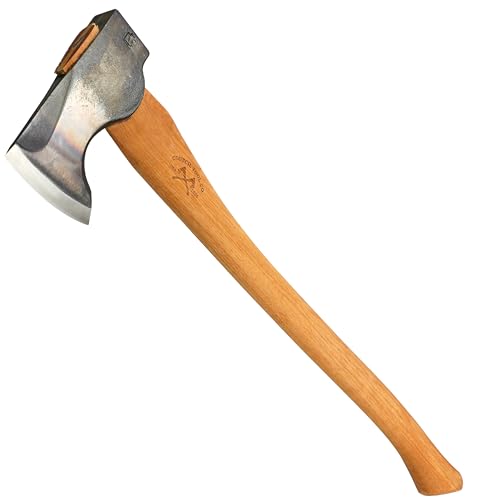
Council Tool Wood-Craft Pack Axe
Council Tool grinds a thinner blade geometry suited to fine carving and bushcraft tasks rather than straight splitting power. American hickory handles ship oiled from the factory to resist early cracking. Bushcraft focused owners favor this over blunter, splitting focused hatchets.
Pros
- Thin geometry suits detailed carving work
- Factory oiled hickory resists early cracking
- Carbon steel sharpens to a fine edge
Cons
- Thinner blade splits large rounds less efficiently
- Carbon steel needs regular oiling to prevent rust
How they stack up
| # | Model | Construction | Best for | Score | Price |
|---|---|---|---|---|---|
| 1 | Estwing Sportsman’s Axe | One piece forged steel | Best overall | 9.4 | Check price |
| 2 | Fiskars X7 Hatchet | Steel head, fiberglass reinforced composite handle | Best for lightweight packing | 9.1 | Check price |
| 3 | Gerber Gator Hatchet | Full tang steel | Best for splitting kindling | 8.9 | Check price |
| 4 | CRKT Chogan T-Hawk | 1055 carbon steel head | Best multi purpose design | 8.7 | Check price |
| 5 | Husqvarna 13 Inch Hatchet | Forged steel head | Best traditional wood handle | 8.5 | Check price |
| 6 | SOG Camp Axe | Full tang stainless steel | Best value | 8.3 | Check price |
| 7 | Council Tool Wood-Craft Pack Axe | 1060 carbon steel head | Best for bushcraft tasks | 8.0 | Check price |
Good to know
What is the difference between a hatchet and a camp axe?
A hatchet is shorter and lighter, built for one handed use on smaller wood and kindling. A camp axe uses a longer handle and heavier head for two handed chopping of larger logs.
How heavy should a camping hatchet be?
Most camping hatchets weigh between 1 and 2 pounds, balancing enough mass to split wood against staying light for packing. Backpackers usually favor the lighter end, while car campers can afford a heavier head.
Is carbon steel or stainless steel better for a hatchet?
Carbon steel sharpens to a finer edge and holds it longer under hard use but rusts without regular oiling. Stainless resists corrosion better with less maintenance but typically does not hold as sharp an edge as long.
Can a hatchet replace a full sized axe for camping?
For kindling and small to medium branches, yes, a hatchet handles most camp firewood needs. Felling trees or splitting large rounds still calls for a full sized axe with more leverage and mass.
How do I stop a hatchet head from loosening?
One piece forged designs like the Estwing avoid the problem entirely since there is no separate head. Wood handled hatchets should be checked periodically for a snug wedge fit and kept out of prolonged wet storage.
Which handle material lasts longest outdoors?
Composite and steel handles resist moisture and temperature swings better than wood over years of outdoor storage. Wood lasts a long time too if oiled periodically and stored dry, and it can be replaced individually if damaged.
Do camping hatchets come with a sheath?
Most models compared here include a sheath, typically leather or nylon, for safe transport and storage. Sheath quality and material still vary noticeably between budget and premium hatchets.
How often should a camping hatchet be sharpened?
Frequency depends on use, but a hatchet used regularly for splitting kindling typically needs touch up sharpening every few trips. A small camp sharpening stone or puck kept with your gear maintains the edge between trips.
Which hatchet is best for splitting kindling versus carving?
The Gerber Gator’s wide bit splits fat rounds into kindling more efficiently than slimmer designs. The Council Tool Wood-Craft’s thinner blade suits carving stakes and feather sticks instead.
Is a full tang hatchet worth the extra weight?
Full tang steel removes the failure point where a head can separate from a wooden handle, so it holds up better under hard, repeated use. Occasional users splitting light kindling may not need that extra durability.
Final word
Pick the Estwing Sportsman’s Axe if you want a hatchet that never develops a loose head no matter how hard you use it. Its one piece steel construction outlasts wedge and pin designs used elsewhere on this list. Backpackers who prioritize pack weight should choose the Fiskars X7 instead for its lighter composite build. Skip thin bushcraft blades like the Council Tool’s if splitting firewood is your main task, since a wider bit like the Gerber Gator’s works faster.