Camping Tents You Can Actually Pitch Inside the House
The Coleman Sundome 4-Person is our top pick for indoor use because it stands freely without stakes and fits most living rooms. The Night Cat Pop Up Tent sets up in seconds for sleepovers, and the Alvantor Bed Canopy Pop Up Tent turns a mattress into a private space.
If you want a real camping tent that works on a living room floor, the Coleman Sundome 4-Person is the pick, because its freestanding pole structure holds shape without a single stake. The Night Cat Pop Up Tent is faster for spontaneous sleepovers, and the Alvantor Bed Canopy Pop Up Tent is the better answer if the goal is privacy over a bed rather than a floor camp.
Choosing a tent for indoor use is trickier than it sounds, because most camping tents rely on staked guy lines to hold their shape and simply collapse on a hard floor. We compared listings on whether the pole structure is truly freestanding, the floor footprint against typical room sizes, peak height for sitting or kneeling inside, how the floor material behaves on carpet and wood, and how quickly each one packs away.
Our top picks

Coleman Sundome 4-Person Tent
The classic crossed pole dome holds its own shape, which is exactly what you need on a floor where stakes are not an option. A four person footprint fits most living rooms and gives enough peak height for children to stand and adults to kneel. Owners report it is also the easiest tent to practise pitching indoors before a first trip.
Pros
- Stands up without any stakes
- Large mesh panels keep air moving indoors
- Simple two pole pitch
Cons
- Needs a fair amount of clear floor
- Rainfly is unnecessary inside and adds bulk

Night Cat Pop Up Tent
This one springs into shape the moment it leaves the bag, which makes it the obvious pick for sleepovers where speed matters more than anything else. The hoop structure is self supporting, so it holds up on carpet or floorboards. Owners report folding it back down takes a little practice, and the instructions are worth keeping.
Pros
- Opens in seconds with no assembly
- Self supporting on any surface
- Light enough for a child to carry
Cons
- Folding it away takes practice
- Low peak height inside

Alvantor Bed Canopy Pop Up Tent
Designed specifically for indoor use, this sits over a mattress to create a private, draught reduced sleeping space in a shared room. Mesh panels keep it breathable rather than stuffy. Owners report it also helps light sleepers in rooms with early morning sun, and it folds flat when not needed.
Pros
- Purpose built for indoor use
- Creates privacy in a shared room
- Breathable mesh construction
Cons
- Only useful over a bed
- Frame can flex if leaned on

CORE 6 Person Dome Tent
A six person dome gives enough interior space for two air beds side by side, which suits a basement or large lounge camp out. The freestanding frame stands on its own and the mesh ceiling keeps the interior from getting stuffy indoors. Owners report the wall pockets and gear loft are genuinely useful for keeping torches and books tidy.
Pros
- Adults can stand inside
- Fits two air beds
- Plenty of interior storage
Cons
- Too large for a small living room
- Heavier to move once pitched

Wenzel Alpine 3 Person Tent
A three person dome with a modest footprint that clears most furniture, which makes it workable in a flat or a bedroom. The shock corded poles go together quickly and the shape is stable without staking. Owners report it is a sensible first tent because the pitch is simple enough for a child to learn.
Pros
- Fits smaller rooms
- Quick shock corded assembly
- Easy for beginners to pitch
Cons
- Low headroom for adults
- Basic fabric compared with premium tents
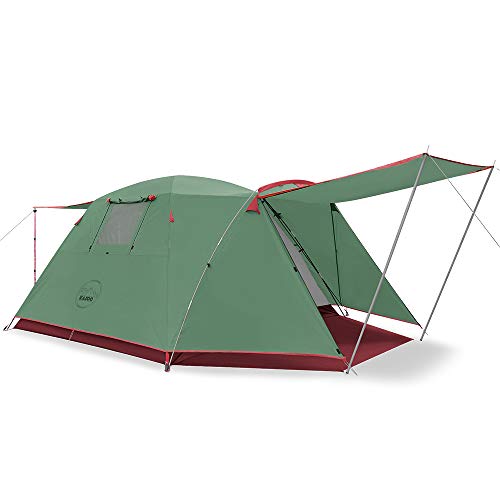
KAZOO Outdoor Camping Tent
Large mesh panels and two doors keep the interior from turning stuffy, which matters more indoors than out because there is no breeze to help. The aluminium pole set is lighter and stiffer than fibreglass. Owners report the double door layout makes it easier to get in and out without crawling over anyone.
Pros
- Excellent airflow for indoor use
- Light aluminium poles
- Two doors for easy access
Cons
- Narrow for three adults
- Fabric is thin against knocks

Coleman Skydome 2-Person Tent
The Skydome frame pitches faster than a traditional dome and gives more usable headroom for its size thanks to the steeper walls. A two person footprint tucks into a corner of most rooms. Owners report it is one of the simplest tents to pitch alone, which is handy when the setup happens with children helping.
Pros
- Very quick to pitch
- Steep walls add usable space
- Small footprint indoors
Cons
- Tight for two adults
- Low peak height
The lineup, side by side
| # | Model | Capacity | Best for | Score | Price |
|---|---|---|---|---|---|
| 1 | Coleman Sundome 4-Person Tent | 4 people | Best overall | 9.4 | Check price |
| 2 | Night Cat Pop Up Tent | 2 people | Best for quick setup | 9.2 | Check price |
| 3 | Alvantor Bed Canopy Pop Up Tent | Indoor beds and mattresses | Best for privacy over a bed | 9.0 | Check price |
| 4 | CORE 6 Person Dome Tent | 6 people | Best for larger rooms | 8.8 | Check price |
| 5 | Wenzel Alpine 3 Person Tent | 3 people | Best compact option | 8.6 | Check price |
| 6 | KAZOO Outdoor Camping Tent | 2 to 3 people | Best for ventilation | 8.3 | Check price |
| 7 | Coleman Skydome 2-Person Tent | 2 people | Best budget | 8.0 | Check price |
Before you buy
Freestanding is the only thing that matters indoors Outdoors, guy lines and stakes hold a tent taut. Indoors you have neither, so the pole structure alone has to hold the shape. Dome and hub style tents are freestanding by design and will stand happily on carpet or floorboards. Tunnel and ridge tents rely on tension from staked ends and will sag into a heap on a hard floor, no matter how good they are outside.
Measure the room before you choose a capacity Tent capacities describe how many sleeping bags fit shoulder to shoulder, not how much room the tent occupies. A four person dome typically needs a clear area around nine by seven feet plus space to walk around it. Measure the clear floor after furniture is pushed back, and remember that doors need to swing and that a tent under a ceiling light will get warm.
Think about ventilation and heat A tent traps warmth, which is welcome outdoors and stifling in a heated house. Choose a model with large mesh panels and leave the rainfly off entirely when pitching indoors, since it is the fly that blocks airflow. Two doors help more than one. If children will sleep in it overnight, leave a door partly unzipped so air keeps moving.
Protect the floor and the tent Tent floors are coated to resist ground moisture, not to grip polished wood, so a full tent can slide if someone pushes against it. A rug or a light groundsheet underneath adds friction and stops grit scratching the floor. Equally, check the tent floor for stones or dirt from previous trips before laying it out on a clean carpet.
Frequently asked questions
Can you really set up a camping tent indoors?
Yes, provided it is a freestanding dome or hub design that holds shape without stakes. Leave the rainfly off, clear enough floor space and it pitches exactly as it would on a campsite.
What size tent fits in an average living room?
A two to four person dome is usually the practical limit, needing roughly seven by five feet up to nine by seven feet of clear floor. Six person tents need a basement, garage or a very large room.
Do I need to use the rainfly indoors?
No, and you should not. The fly exists to shed rain and it blocks the mesh panels that keep the interior breathable. Leaving it off makes the tent cooler, lighter and quicker to pitch.
Will tent stakes damage my floor?
You should not use stakes indoors at all. A freestanding tent needs none, and if a tent will not stand without them, it is the wrong design for indoor use.
Is an indoor tent safe for children to sleep in?
It is, with sensible precautions. Keep it away from heaters and cables, leave a door unzipped for airflow, avoid any candles or open flame, and make sure the zips are easy for a child to open from inside.
Can I practise pitching a new tent indoors?
That is one of the best reasons to do it. Pitching in a warm, dry room lets you learn the pole sequence, check that every peg and guy line is in the bag, and find any manufacturing faults before a trip.
How do I stop a tent sliding on a wooden floor?
Put a rug or groundsheet underneath. The coated tent floor has very little grip on smooth timber, and a layer of textured material underneath stops it moving when someone leans on a wall.
How do I pack a pop up tent away again?
Pop up tents fold by twisting the hoops together in a specific order rather than by force. Keep the instruction card, and if it has been lost, most manufacturers publish a short folding video for the exact model.
The bottom line
The Coleman Sundome 4-Person is the tent we would pitch in a living room, because it is genuinely freestanding, roomy enough for a family camp out and simple to put up. For speed, the Night Cat Pop Up Tent is unbeatable, and the Alvantor Bed Canopy is the one to choose if privacy over a bed is the real goal.