Best Family Card Games Sorted by Age and Play Style
Exploding Kittens fits most family game nights, with rules kids learn in minutes and 15-minute rounds. Sleeping Queens works better for four-year-olds still learning turns. Families wanting speed and competition should try Dutch Blitz instead.
Exploding Kittens leads this list for family game nights with kids seven and up, pairing a simple draw-and-avoid mechanic with humor that keeps adults engaged too. Rounds finish in about 15 minutes, though the base deck loses variety after dozens of plays.
Age numbers printed on a box rarely predict whether a six-year-old can actually follow the rules at the table. We compared stated age ranges, round length, and owner feedback on how younger kids handled turn order and strategy.
Our top picks

Exploding Kittens Original Card Game
A draw pile hides exploding kitten cards, and players use defuse or skip cards to stay in the game. Rounds wrap up in about 15 minutes, which keeps restless seven-year-olds from losing focus. Cartoon-style art adds humor that lands with teens and adults at the same table.
Pros
- Rules click in under five minutes
- Short rounds match shorter attention spans
- Artwork and humor appeal across age groups
Cons
- Base 56-card deck feels repetitive after many sessions
- Eliminated players sit out until the round ends

Mattel UNO Card Game
Matching colors and numbers lets five-year-olds join in before they understand any real strategy. Draw Two and Reverse cards add enough twist to hold a ten-year-old’s interest. Up to ten players can join a single game, more than most card games allow.
Pros
- Color matching makes it accessible to young kids
- Scales up to 10 players for big groups
- Familiar rules cut down on teaching time
Cons
- Games stretch past 30 minutes with six or more players
- Action cards frustrate kids under six

Skip-Bo Card Game by Mattel
Each player races to clear a personal stockpile by building number sequences in a shared middle area. A 162-card deck, nearly triple the size of Exploding Kittens, keeps games running without constant reshuffling. Rounds typically last 30 to 45 minutes.
Pros
- Large deck cuts down on mid-game reshuffling
- Number sequencing builds early math skills
- Strong replay value for a low-cost deck
Cons
- Runs longer than quicker family games
- Younger kids often need help planning sequences

Sleeping Queens Card Game
A child originally designed this game, and the rules still suit four-year-olds today. King and knight cards add light strategy without overwhelming new players. Rounds move fast enough that losing one rarely ends interest in a rematch.
Pros
- Simple enough for preschool-age players
- Light strategy stays approachable for beginners
- Fast rounds encourage repeat play
Cons
- Offers little depth for older kids or adults
- Small cards can be hard for tiny hands to hold

Sushi Go! Party Card Game
Card drafting drives the game: players pick one card from a hand, then pass the rest around the table. The party edition scales to eight players, three more than the original Sushi Go supports. Colorful sushi-themed art helps visual learners track scoring combinations.
Pros
- Scales to eight players for larger groups
- Card drafting adds a light strategic layer
- Bright, illustrated cards suit visual learners
Cons
- Scoring combinations take a round or two to learn
- Party edition box is bulkier than standard card games
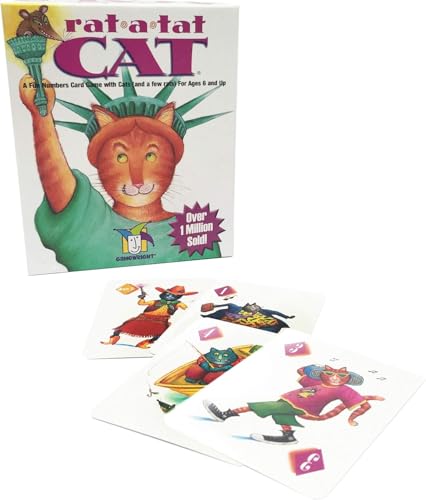
Rat-a-Tat Cat Card Game
Memorizing and swapping face-down cards keeps a player’s hand total as low as possible. That mechanic builds early memory skills and basic addition without feeling like a lesson. Short rounds fit inside a young child’s attention span.
Pros
- Builds memory and simple addition skills
- Short rounds suit young attention spans
- Compact box travels well for trips
Cons
- Holds less appeal for teens or adults
- Younger kids often need an adult to track scoring

Dutch Blitz Card Game
Every player plays simultaneously instead of waiting for a turn, racing to unload cards onto shared piles. That format creates a louder, more competitive game than turn-based options like UNO. Fast pattern recognition matters more here than patience.
Pros
- Simultaneous play keeps energy and pace high
- Quick rounds allow for fast rematches
- Rewards speed and pattern recognition
Cons
- Simultaneous format overwhelms kids under eight
- Caps out at four players per game
Compared at a glance
| # | Model | Age range | Best for | Score | Price |
|---|---|---|---|---|---|
| 1 | Exploding Kittens Original Card Game | 7 and up | Best overall | 9.3 | Check price |
| 2 | Mattel UNO Card Game | 5 and up | Best for young kids | 9.0 | Check price |
| 3 | Skip-Bo Card Game by Mattel | 7 and up | Best value | 8.7 | Check price |
| 4 | Sleeping Queens Card Game | 4 and up | Best for young children | 8.5 | Check price |
| 5 | Sushi Go! Party Card Game | 8 and up | Best for family game night | 8.3 | Check price |
| 6 | Rat-a-Tat Cat Card Game | 6 and up | Best for preschoolers | 8.1 | Check price |
| 7 | Dutch Blitz Card Game | 8 and up | Best for older kids and fast-paced play | 8.0 | Check price |
Before you buy
What to look for in a starter card game Match the recommended age on the box to your youngest regular player, not the oldest. A four-year-old struggles with a game rated for eight, even if the rules look simple in print. Round length matters just as much: a 45-minute game tests patience that a 15-minute one never does.
Turn-based games vs simultaneous play UNO and Skip-Bo give each player a clear turn, which suits kids who are still learning patience and impulse control. Dutch Blitz drops turns entirely, with everyone playing cards onto shared piles at once. That speed rewards quick hands but can overwhelm a child under eight.
Which games work best for the youngest players Sleeping Queens and Rat-a-Tat Cat scale down to ages four and six through simplified mechanics. Both let a preschooler play a full hand without an adult stepping in to manage it for them. Card size matters here too: smaller decks can slip out of young hands.
Best card games for mixed-age family game night Exploding Kittens and Sushi Go! Party balance short rules with enough humor or drafting strategy to hold an adult’s attention. Neither game bores the grown-ups at the table, a common complaint with games built purely for kids. Both also finish in under 30 minutes, useful on a weeknight.
Questions worth asking
What is the best first card game for a family with young kids
UNO and Sleeping Queens work well as a first game, since both rely on color, number, or simple matching rather than heavy strategy.
How long does a typical family card game round take
Most family card games run 15 to 30 minutes per round, short enough to fit into a weeknight without taking over the evening.
Are card games easier for kids than board games
Card games usually set up faster and run shorter than board games, which suits kids with limited attention spans.
Can adults actually enjoy games made for kids
Exploding Kittens and Sushi Go! Party were built with humor and light strategy that hold up for adults playing alongside children.
What age can kids start playing card games with real rules
Four-year-olds can manage simplified games like Sleeping Queens, while games with more strategy usually target seven and up.
How many card games should a starter collection include
Two or three games covering different styles, matching, turn-based, and simultaneous, give a family variety without decision fatigue.
Do card games help kids build math or memory skills
Rat-a-Tat Cat and Skip-Bo both use memory and number sequencing, building those skills through play rather than drills.
UNO vs Skip-Bo, which is better for family game night
UNO relies on color and number matching with action cards, while Skip-Bo focuses on building number sequences from a personal stockpile. UNO plays faster, Skip-Bo rewards planning.
Is Exploding Kittens appropriate for a seven-year-old
Yes. The publisher rates it for ages seven and up, and the draw-and-avoid mechanic is simple enough for that age to grasp in one sitting.
What is the best card game for a large group of kids
UNO supports up to 10 players and Sushi Go! Party supports up to 8, making both better choices than four-player games like Dutch Blitz for a big group.
The verdict
Exploding Kittens is the safer first purchase for most families, since its rules click fast and its age range covers seven-year-olds through adults. Parents of preschoolers should start with Sleeping Queens instead, since four-year-olds can play it without help. Families already comfortable with turn-based games can add Dutch Blitz once younger players stop needing to wait their turn.


