Extra Large Litter Boxes Give Big Cats Room to Turn
Petmate Giant Litter Pan offers the most usable floor length with the least fuss. Nature’s Miracle High Sided Litter Box adds tall walls for cats that spray upward. Modkat XL Litter Box controls tracking best through its top entry lid and reusable liner.
Petmate Giant Litter Pan answers the space problem directly for cats over 15 pounds. Nature’s Miracle High Sided Litter Box stops sideways spraying that shorter walls miss. Modkat XL controls litter tracking better than any open pan here.
Sizing a box for a large cat comes down to arithmetic that manufacturers rarely publish clearly. A pan should measure roughly one and a half times a cat’s body length, nose to tail base. We compared interior dimensions, wall heights, entry heights, liner options and material, then weighed that against what Maine Coon and Ragdoll owners report about aim and turning room.
Before you buy
How big should a litter box be for a large cat? Measure your cat from nose to the base of the tail, then multiply by 1.5. A 19 inch Maine Coon needs roughly 28 inches of interior length to turn comfortably, a size few retail boxes reach. Aim for at least 22 inches, and prioritize width over depth. Width lets a cat pivot; extra litter depth does not.
Why do wall height and entry height conflict? Tall walls stop spray, but low entries help stiff joints, so those two goals pull against each other. Boxes solve this with a dipped front, as seen on the Nature’s Miracle and Van Ness pans. Aim for roughly six inch entry height paired with nine to ten inch rear walls. Cats that stand fully upright to urinate need that taller rear wall or a removable shield like the IRIS design.
Which litter box controls tracking and odor best? Large cats carry more litter on their paws simply because their feet are bigger. Top entry designs such as the Modkat XL knock granules off during exit. Hooded boxes trap odor instead, though some cats refuse them outright. Stainless steel, as used by iPrimio, avoids the scratched plastic that holds smell after a year or two of scooping.
How many boxes do multi-cat households with large breeds need? Standard guidance calls for one box per cat plus one spare. Large breeds shift the math slightly, since a single oversized pan can serve where two small ones failed. Spread boxes across floors and rooms rather than lining them up together. Budget pans like the Van Ness CP7 make sensible secondary boxes once a premium primary is in place.
Our top picks

Petmate Giant Litter Pan
Interior length runs past 22 inches, giving a 20 pound cat room to squat without touching a wall. Polypropylene construction resists scratching, which slows odor buildup over time. Antimicrobial protection is built into the plastic itself rather than applied as a surface coating.
Pros
- Genuine turning room for cats over 15 pounds
- Smooth interior wipes clean without scrubbing
- Low front lip suits cats with stiff hips
Cons
- Six inch walls won’t stop determined sprayers
- No cover, so odor travels in small rooms

Nature’s Miracle High Sided Litter Box
Walls rise about 10 inches on three sides while the front dips lower, letting tall cats stand and spray without soaking the floor. A non stick surface treatment helps clumps release cleanly when scooping. Length runs generous enough for most long bodied breeds.
Pros
- Tall sides catch urine from cats that stand to go
- Lowered front keeps entry manageable
- Clumps release cleanly from the treated surface
Cons
- Deep walls make scooping far corners awkward
- Litter still tracks out through the open front
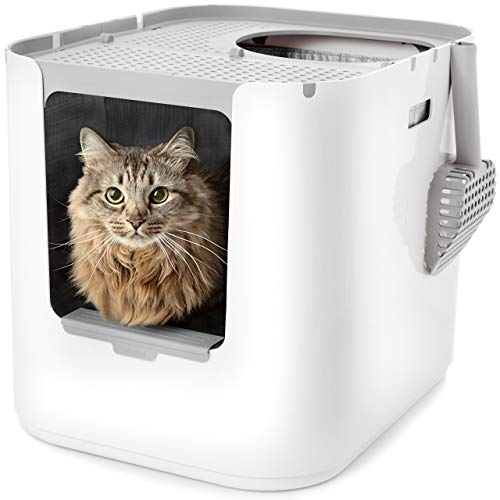
Modkat XL Litter Box
A hinged lid doubles as a walk off mat, knocking litter from paws before a cat reaches the floor. Interior width suits cats up to about 20 pounds, and a reusable liner replaces disposable bags. Swapping the lid panel converts the design to front entry.
Pros
- Lid surface knocks litter off paws on exit
- Reusable liner cuts plastic bag waste
- Convertible entry suits older or shorter cats
Cons
- Top entry doesn’t work for cats with joint pain
- Liner needs washing rather than tossing

iPrimio Extra Large Stainless Steel Litter Box
Stainless steel can’t absorb urine the way scratched plastic does, keeping long term odor lower. Rounded corners and a rolled rim make scraping out compacted litter simple. The surface stays cool and won’t warp, though metal rings louder when litter gets poured in.
Pros
- Metal won’t absorb odors over years of use
- No scratching means no bacteria trapping grooves
- Rolled rim protects paws and hands
Cons
- Narrower than the Petmate pan at 15.4 inches
- Litter hitting metal sounds noticeably louder
Van Ness CP7 Giant High Sides Cat Litter Pan
A giant footprint comes at a basic price, with high sides on three edges and a dipped entry. Recycled plastic construction keeps cost down but scratches more readily than the Petmate surface. This pan works well as a second or third box in a multi cat home.
Pros
- Large footprint for the lowest outlay here
- High rear wall blocks most backward spraying
- Light enough to empty and rinse one handed
Cons
- Surface scratches faster than smoother plastics
- Thin walls flex when carried full

IRIS USA Open Top Cat Litter Box with Shield and Scoop
A clip on shield raises effective wall height without fully enclosing the box, so nervous cats keep their sight lines. Removing the shield entirely works fine if a cat refuses it. A side clipped scoop stops the tool from disappearing behind furniture.
Pros
- Shield adds height without a full hood
- Open sight lines reduce ambush anxiety
- Scoop holder keeps cleaning tools at the box
Cons
- Shield clips can loosen with repeated removal
- Slightly shorter interior than the Petmate giant

Catit Jumbo Hooded Cat Litter Pan
A full hood with a swinging door contains odor and scattered litter well in apartments. Interior height clears large cats better than most hooded designs, though very tall breeds may still crouch. A carbon filter in the roof panel absorbs ammonia between cleanings.
Pros
- Hood keeps odor and litter contained in small rooms
- Carbon filter reduces ammonia smell between scoops
- Door panel removes for hesitant cats
Cons
- Some large cats refuse enclosed boxes entirely
- Filters are a recurring replacement cost
Compared at a glance
| # | Model | Exterior dimensions | Best for | Score | Price |
|---|---|---|---|---|---|
| 1 | Petmate Giant Litter Pan | About 22.5 by 18.5 by 6 inches | Best overall | 9.4 | Check price |
| 2 | Nature’s Miracle High Sided Litter Box | About 23 by 18.5 by 10 inches | Best for spraying cats | 9.2 | Check price |
| 3 | Modkat XL Litter Box | Suits cats up to about 20 pounds | Best for litter tracking | 9.0 | Check price |
| 4 | iPrimio Extra Large Stainless Steel Litter Box | About 23.5 by 15.4 by 6 inches | Best for odor resistance | 8.8 | Check price |
| 5 | Van Ness CP7 Giant High Sides Cat Litter Pan | About 23 by 17.5 by 9 inches | Best budget | 8.6 | Check price |
| 6 | IRIS USA Open Top Cat Litter Box with Shield and Scoop | About 22.4 by 16.5 by 8.5 inches | Best for splash control | 8.3 | Check price |
| 7 | Catit Jumbo Hooded Cat Litter Pan | About 22.8 by 18.3 by 16.5 inches | Best covered box | 8.0 | Check price |
Good to know
What size litter box do Maine Coons need?
Aim for 22 inches or more of interior length and at least 15 inches of width. Petmate Giant Litter Pan and Nature’s Miracle High Sided Litter Box both clear that mark. Some owners of adult Maine Coons use under bed storage totes instead.
Why does my large cat pee over the side of the box?
Cats that stand upright rather than squat can clear a six inch wall easily. High sided boxes with nine to ten inch rear walls fix that. A clip on shield, like the IRIS version, adds height to a box you already own.
Are top entry litter boxes good for big cats?
They control tracking well and suit large, agile cats. Modkat XL fits cats up to about 20 pounds. Avoid top entry for overweight cats, kittens or any cat with arthritis, since the jump becomes a barrier.
Is stainless steel better than plastic for litter boxes?
Stainless steel doesn’t scratch or absorb urine, so odor stays lower over the years. Plastic runs lighter, cheaper and quieter by comparison. iPrimio’s stainless pan suits long term use, while Petmate’s polypropylene giant works well for everyday practicality.
Should a large cat use a covered or open litter box?
Open boxes suit most cats since they preserve sight lines and escape routes. Covered boxes like the Catit Jumbo help in apartments where odor spreads easily. Try open first, since a refused hooded box often means accidents on the floor.
How deep should litter be in a large box?
Two to three inches of clumping litter is enough for most cats. Deeper layers waste litter and let clumps sink and stick to the base. Big pans simply need more litter by volume, since the floor area runs larger.
Can I use a storage tote as a litter box for a big cat?
Yes, and many owners of 20 pound cats already do. Cut a lowered entry on one long side and sand the edge smooth. Commercial giant pans skip that work and come with safe, rolled rims built in.
How often should an oversized litter box be emptied fully?
Scoop daily, and dump the full contents every two to three weeks with clumping litter. Larger surface area doesn’t extend that interval by much. Wash with unscented soap, since citrus and ammonia cleaners tend to deter cats.
Final word
Petmate Giant Litter Pan solves the core problem of floor space with a surface that stays easy to clean. Cats that stand and spray need the taller walls of the Nature’s Miracle High Sided Litter Box instead. Apartment owners fighting litter across the hallway should look at the Modkat XL and its walk off lid.


