How to Choose a Caulking Gun That Won’t Drip
Newborn 250 leads for everyday sealing with a smooth rod and instant pressure release. Dripless ETS2000 suits long sessions thanks to its ergonomic grip and higher thrust. Milwaukee’s M12 2441-20 removes hand fatigue entirely for anyone running several tubes a day.
Newborn 250 stays the overall pick for manual sealing, since its smooth rod and instant release solve most drip complaints. Dripless ETS2000 pulls ahead on comfort across long sessions, and Milwaukee’s M12 2441-20 removes hand fatigue for anyone working through several tubes in a day. Every gun here releases pressure cleanly at the end of a bead.
Guns that look interchangeable behave very differently once loaded. Rod type sets the tone: a toothed ratchet advances in visible steps and leaves an uneven bead, while a smooth rod flows continuously under friction. We compared thrust ratio, rod type, how fast pressure releases after a pull, grip shape and whether the frame accepts standard tubes, sausage packs or both.
Our top picks

Newborn 250 Drip-Free Smooth Rod Caulking Gun
Newborn 250 sets the bar most manual guns get measured against, pairing a smooth rod with a release lever that kills pressure the instant you let go. A 10 to 1 thrust ratio handles everything from thin acrylic caulk to heavier silicone without strain. The steel frame shrugs off years of jobsite use.
Pros
- Smooth rod lays down a genuinely even bead
- Release lever stops oozing the moment you let go
- Steel frame holds up under daily jobsite use
Cons
- Grip trails moulded rivals for comfort
- 10 to 1 ratio struggles with heavy adhesive

Dripless ETS2000 Ergo Caulk Gun
ETS2000 combines a 26 to 1 thrust ratio with a contoured grip that cuts hand strain across a full day of sealing. A cutter and puncture tool live inside the handle, so there is no separate hunt for a utility knife. Owners report its drip control ranks among the best of any manual gun.
Pros
- High 26 to 1 ratio makes heavy caulk easy to push
- Built in cutter and puncture tool save a step
- Contoured grip stays comfortable across long sessions
Cons
- Bulkier in hand than a basic frame gun
- Costs more than entry level manual guns

Milwaukee 2441-20 M12 Cordless Caulk Gun
Running on Milwaukee’s M12 battery platform, this gun sets flow rate with a variable speed dial for consistency no hand can match. Releasing the trigger retracts the plunger automatically to stop drips. It pushes both standard tubes and heavier sealants without stalling.
Pros
- Delivers a bead speed no manual gun can match
- Removes hand fatigue on long, repetitive runs
- Retracts the plunger automatically to cut drips
Cons
- Battery and charger sold separately
- Heavier and bulkier than a manual gun

DEWALT DCE560B 20V MAX Adhesive Gun
DCE560B targets construction adhesive rather than bathroom sealant, with enough force to push cold, thick material through a narrow nozzle. A variable trigger paired with a speed dial gives fine control over bead size. Owners say it speeds up subfloor and panel adhesive work considerably.
Pros
- Pushes cold, thick adhesive without stalling
- Dual speed control fine tunes bead size
- Shares batteries with the 20V MAX lineup
Cons
- Overkill for routine household caulking
- Sold as a bare tool without a battery

Albion Engineering B12S20 Manual Caulking Gun
Albion builds guns for professional sealant crews, and this manual model reflects that with heavy duty steel and a 12 to 1 thrust ratio for dense materials. It feels noticeably more solid in hand than consumer guns. Rod and plunger components are meant to be serviced, not replaced whole.
Pros
- Meets professional applicator build standards
- Worn components can be serviced rather than binned
- Pushes dense sealants without flexing
Cons
- Heavier than most consumer guns
- More gun than typical homeowners need
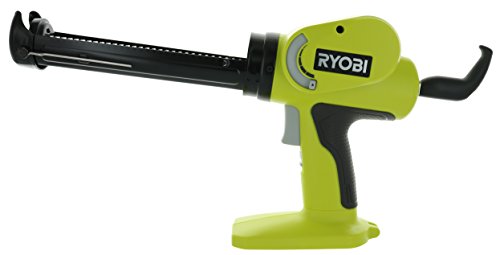
RYOBI P310G ONE+ Power Caulk and Adhesive Gun
For anyone already on RYOBI’s 18V ONE+ platform, this is the cheapest route into powered caulking. A six speed dial sets flow rate, and the plunger retracts on release to limit drips. Owners describe it as well suited to occasional household projects rather than daily professional use.
Pros
- Cheapest entry point into powered caulking
- Shares batteries with the ONE+ tool lineup
- Six speed dial covers thin and thick material
Cons
- Less refined than the Milwaukee M12 gun
- Long shape gets awkward in tight corners

Red Devil 3989 Extreme Duty Caulking Gun
Red Devil 3989 covers the essentials at a low price, with a smooth rod, a 12 to 1 thrust ratio and a built in cutter and puncture wire. It suits someone caulking a bathroom once a year rather than every week. Drip control stays basic but adequate for household jobs.
Pros
- Smooth rod at an entry level price
- Cutter and puncture wire built into the frame
- Handles occasional household jobs just fine
Cons
- Drip control trails the Newborn and Dripless
- Grip turns uncomfortable after several tubes
Side by side
| # | Model | Rod type | Best for | Score | Price |
|---|---|---|---|---|---|
| 1 | Newborn 250 Drip-Free Smooth Rod Caulking Gun | Smooth rod | Best overall | 9.4 | Check price |
| 2 | Dripless ETS2000 Ergo Caulk Gun | Smooth rod | Best for comfort | 9.2 | Check price |
| 3 | Milwaukee 2441-20 M12 Cordless Caulk Gun | M12 12V battery platform | Best cordless | 9.0 | Check price |
| 4 | DEWALT DCE560B 20V MAX Adhesive Gun | 20V MAX battery platform | Best for heavy adhesives | 8.7 | Check price |
| 5 | Albion Engineering B12S20 Manual Caulking Gun | Smooth rod | Best for professionals | 8.5 | Check price |
| 6 | RYOBI P310G ONE+ Power Caulk and Adhesive Gun | 18V ONE+ battery platform | Best value cordless | 8.2 | Check price |
| 7 | Red Devil 3989 Extreme Duty Caulking Gun | Smooth rod | Best budget | 8.0 | Check price |
How to pick the right one
Why does rod type matter more than price? A ratchet rod advances in discrete clicks, which shows up as a faint pulse in the bead and makes tight corners hard to control. A smooth rod moves under continuous friction instead, so flow stays even from start to finish. Every gun in this list uses a smooth rod for that reason. Fighting an uneven bead usually traces back to a ratchet mechanism rather than technique.
What thrust ratio do you actually need? Thrust ratio measures the mechanical advantage between your grip and the plunger. Around 10 to 1 suits household acrylic caulk and standard silicone comfortably. Ratios near 18 to 1 or higher turn thick construction adhesive and cold weather sealant from exhausting into manageable. A high ratio gun on thin caulk causes no harm, it just means squeezing more gently.
How do you stop a caulking gun from dripping? Pressure built up inside the tube keeps pushing material out after you release the trigger, unless the gun relieves it. Guns marketed as drip free retract the plunger slightly the instant you let go. Powered guns like the Milwaukee and RYOBI models do this automatically and precisely every time. This single feature explains most of the mess people blame on caulk itself.
Manual or cordless: which fits your workload? One or two tubes a year rarely justifies a battery platform, and a smooth rod manual gun like the Newborn 250 does the job well. Running several tubes in a session changes the math, since a cordless gun removes grip fatigue and keeps bead speed consistent. Already own an M12 or ONE+ battery? That tips the choice further toward cordless. Professional crews sealing daily often land on a heavy duty manual gun instead, since it needs no charging and survives rough handling.
Questions worth asking
What thrust ratio do I need for household caulking?
Around 10 to 1 handles standard acrylic and silicone caulk comfortably. Step up toward 18 to 1 or higher for construction adhesive or cold weather sealant, since both resist the plunger far more than ordinary caulk.
Why does my caulk keep oozing after I stop squeezing?
Pressure remains trapped in the tube once the trigger is released. Guns with an instant release lever, like the Newborn 250, retract the plunger to relieve it. On a basic gun without that feature, flip the release lever manually every time you pause.
Is a cordless caulking gun worth the extra cost?
For several tubes a session, yes, since the steady flow rate beats what any hand can manage and grip fatigue disappears entirely. For one or two tubes a year, a smooth rod manual gun like the Newborn 250 covers the job for less.
How do you cut a caulk nozzle correctly?
Cut at roughly forty five degrees, starting with a small opening near the tip, since a smaller hole gives finer control and can always be trimmed wider. Push a nail or the gun’s built in wire through afterward to break the inner foil seal fully.
Can a standard caulking gun handle sausage packs?
Standard frame guns take cartridge tubes only. Sausage packs need a dedicated barrel gun built for that shape, so check the product listing before buying if bulk sausage packs are part of your routine.
How do you clean a caulking gun after use?
Wipe the nozzle area and plunger face before the sealant cures, since silicone and polyurethane become far harder to remove once set. Cured material left on the rod is the most common reason a gun stops feeding smoothly.
What is the difference between caulk and sealant?
Caulk usually refers to paintable acrylic latex used for gaps and trim. Sealant typically means silicone or polyurethane that stays flexible and resists water, though it cannot be painted. Choose based on whether the joint moves and whether it needs paint.
How long does an opened tube of caulk last?
Once the seal breaks, the clock starts, though capping the nozzle tightly or pushing a screw into it extends usable life for a few weeks. Cured plugs inside the nozzle can usually be pulled out before use resumes.
Do cordless caulking guns need a special battery?
Milwaukee’s 2441-20 runs on the M12 platform, RYOBI’s P310G runs on 18V ONE+, and DEWALT’s DCE560B runs on 20V MAX. Buying into a brand’s existing cordless lineup usually means the battery and charger are already on hand.
Final word
Newborn 250 remains the manual caulking gun most people should own, since its smooth rod and instant release solve the two problems that cause messy beads. Anyone spending real hours sealing gains more from the Dripless ETS2000, thanks to its comfortable grip and higher thrust. Trades running multiple tubes a day recover the cost of the Milwaukee M12 cordless gun through consistency alone.

