How to Pick Clamps for Glue-Ups, Jigs and Site Work
Bessey’s K Body REVO KRE3512 tops this list because its parallel jaws hold panels square under up to 1500 pounds of force. Irwin’s QUICK-GRIP 1964758 covers fast one handed holding for less money, and the Jorgensen 3712-HD steel bar clamp pulls stubborn joinery closed at a traditional clamp price.
Panel glue-ups reward one clamp above all others here: the Bessey K Body REVO KRE3512, whose parallel jaws keep a tabletop flat while the glue sets. Irwin’s QUICK-GRIP 1964758 handles one handed positioning, and the Jorgensen 3712-HD adds serious screw driven force for doors and laminations. Those three cover nearly everything a bench sees.
Marketing for clamps talks about pounds of force, yet the real shop problems are tilting jaws, bowing bars and pads that dent soft timber. We compared published force ratings, jaw depth, bar sections and pad design, then weighed owner reports on racking and glue release. Rankings reflect how square each clamp leaves the work, not just how hard it squeezes.
The shortlist, ranked

Bessey K Body REVO KRE3512 Parallel Clamp
Cabinet shops standardise on this clamp because its wide composite jaws stay parallel under load, which keeps a glued panel flat instead of bowed. Removable pads shed dried glue in seconds, and the fixed jaw reverses to work as a spreader. Weight is the trade, since holding one overhead tires an arm quickly.
Pros
- Jaws stay square under heavy load
- Sits flat on a bench for panel work
- Reversible fixed jaw doubles as a spreader
Cons
- Heavy for overhead holding
- Costs more per clamp than bar styles
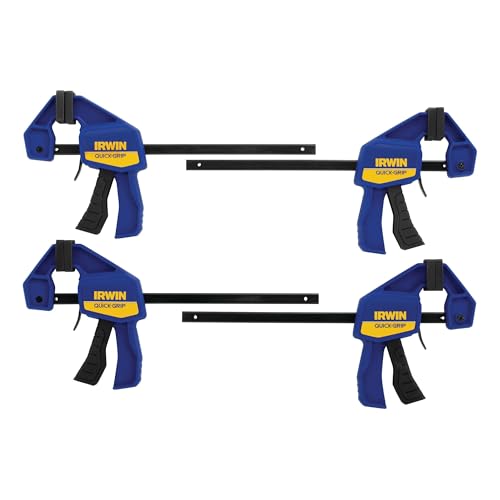
Irwin QUICK-GRIP 1964758 One-Handed Bar Clamp
A trigger action frees one hand to position the workpiece while the other squeezes the clamp closed, which is why these live in every shop drawer. Around 300 pounds of force suits jigs, stops and light assembly rather than pulling a tight joint together. Non marring resin pads protect finished surfaces without scrap blocks.
Pros
- Single hand operation frees the other hand
- Converts to a spreader
- Light enough for overhead holding
Cons
- Limited force for tight joints
- Bar can flex on long reaches

Jorgensen 3712-HD Steel Bar Clamp
Screw driven jaws on a heavy gauge steel bar deliver up to 1000 pounds, far beyond any trigger clamp. Owners report pulling door frames, bench laminations and stubborn gapped joints closed with these. Jaws can tilt under load, so pair them with cauls when flatness matters.
Pros
- High force for the money
- Deep throat reaches inside frames
- Simple, repairable design
Cons
- Jaws can tilt without cauls
- Bare steel can stain damp oak

Kreg KHC-PREMIUM Automaxx Face Clamp
Automaxx jaws set their own pressure as they close, so switching from a thin drawer side to a thick rail needs no knob turning. Large 3 inch pads hold two faces flush while a pocket screw drives, which is the whole job in face frame work. Reach is short by design, so it never replaces a bar clamp.
Pros
- No adjustment between different thicknesses
- Wide pads stop parts twisting
- Fastest option for face frames
Cons
- Short reach only
- Not a substitute for a bar clamp

Pony Jorgensen 50 Three Quarter Inch Pipe Clamp Fixture
Buy the cast iron fixtures, thread them onto any length of three quarter inch pipe, and you own long reach clamps for a fraction of parallel clamp money. Force runs up to 1200 pounds. Pipe flex is the limit, so keep pipes short and alternate clamps above and below a panel.
Pros
- Cheapest route to long clamps
- Pipes swap or extend for any job
- Very high force available
Cons
- Pipe bows on wide panels
- Steel pipe can mark damp timber
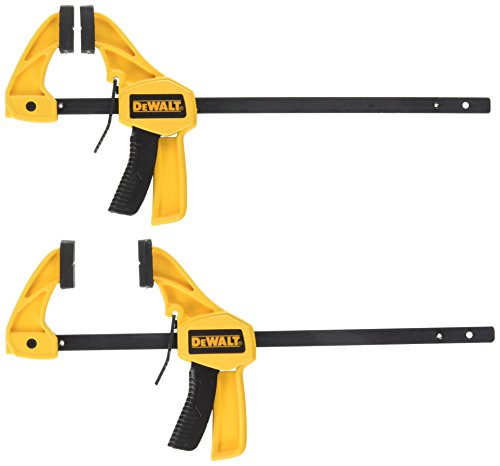
DEWALT DWHT83199 Medium Trigger Clamp
Site work mostly means holding a level, a straightedge or a temporary batten, and this rugged trigger clamp is built for exactly that. Its quick release lever works with gloves on, which matters outdoors more than extra pressure. An overmoulded handle shrugs off drops that would crack lighter clamps.
Pros
- Glove friendly release lever
- Tough enough for site abuse
- Converts to spreading
Cons
- Moderate force only
- Pads wear over time

Bessey GSCC2.512 Clutch Style Bar Clamp
Slide the clutch head down the bar until it meets the work and it locks instantly, so a run of clamps sets up in seconds. Up to 600 pounds of force sits between a trigger clamp and a full parallel clamp. General assembly, repairs and holding stock for sanding are its natural jobs.
Pros
- Very quick to position
- Good force for the size
- Compact on a storage rack
Cons
- Shallow throat
- Clutch needs a clean bar to bite
Before you buy
Which type of clamp do you actually need? Four styles cover almost all woodwork. Parallel clamps hold two flat jaws square to the bar, which stops a glued panel cupping, so they suit cabinet doors and tabletops. Bar and pipe clamps give more force for less money but let the jaws tilt, so add cauls. Trigger clamps are holding tools for jigs, stops and temporary work, not joint pullers.
How much clamping force is enough? Well fitted joints need surprisingly little pressure, and over squeezing starves a joint of glue. High force earns its keep when closing a slight gap, laminating a thick blank or bending springy stock. Based on specifications, 600 pounds covers ordinary furniture work. Reserve the 1000 to 1500 pound clamps for bench tops, doors and laminations.
What does throat depth change? Throat depth is the distance from the bar to the centre of the jaw, and it sets how far in from an edge pressure lands. Shallow throats leave the middle of a wide panel unsupported. Deeper throats reach past obstructions on frames and boxes. Edge gluing often works better with a shallow clamp and wide jaws.
How do you stop clamps staining or denting wood? Glue squeeze out reacting with bare steel leaves black stains on oak and other tannin rich timbers, so use composite pads or slip scrap between jaw and workpiece. A wipe of wax on the bars stops dried glue welding a head in place. Storage matters most of all. Hanging clamps on a rack prevents the dropped clamp bends that kill bars.
Compared at a glance
| # | Model | Capacity | Best for | Score | Price |
|---|---|---|---|---|---|
| 1 | Bessey K Body REVO KRE3512 Parallel Clamp | 12 in opening | Best overall | 9.4 | Check price |
| 2 | Irwin QUICK-GRIP 1964758 One-Handed Bar Clamp | 12 in and 6 in in the set | Best value | 9.2 | Check price |
| 3 | Jorgensen 3712-HD Steel Bar Clamp | 12 in opening | Best for heavy joinery | 9.0 | Check price |
| 4 | Kreg KHC-PREMIUM Automaxx Face Clamp | Up to 3 in | Best for pocket hole joints | 8.8 | Check price |
| 5 | Pony Jorgensen 50 Three Quarter Inch Pipe Clamp Fixture | Three quarter inch threaded pipe | Best budget | 8.6 | Check price |
| 6 | DEWALT DWHT83199 Medium Trigger Clamp | 12 in opening | Best for jobsite use | 8.3 | Check price |
| 7 | Bessey GSCC2.512 Clutch Style Bar Clamp | 12 in opening | Best for quick setup | 8.0 | Check price |
Common questions
How many clamps do I need for a glue up?
Four of one length covers most small projects, because glue-ups need pressure on both faces. Add pairs over time in one or two useful lengths rather than collecting odd sizes.
Are parallel clamps worth the extra cost?
For panels and casework, yes, because square jaws stop the assembly twisting while glue sets. Repairs, jigs and general holding work fine with cheaper bar or trigger clamps.
What size clamp should I buy first?
Twenty four to thirty six inches covers the widest range of furniture work. Longer clamps flex and are awkward to store. Shorter ones limit you to small assemblies.
Can pipe clamps be used on finished wood?
Yes, with protection. Place scrap blocks between jaw and surface, and keep the pipe off the panel. Steel touching damp, tannin rich timber leaves dark marks.
Why do panels come out cupped after clamping?
Pressure sitting below the centreline of the boards is the usual cause. Alternate clamps above and below the panel, or run cauls across the width to hold the surface flat.
Trigger clamps or bar clamps, which first?
Bar clamps first if you glue joints, because trigger clamps top out around 300 pounds and cannot pull a gap closed. Trigger clamps first if you mainly hold jigs, stops and straightedges.
What is a spreader clamp used for?
Reversing the fixed jaw turns many clamps into a spreader that pushes outward. Spreading separates glued parts, springs a joint open for repair, or holds a frame out to size.
How tight should clamps be on a glue joint?
Tighten until glue squeezes out evenly along the joint line, then stop. Cranking harder bows the panel and forces glue out of the joint, which weakens it.
How should clamps be stored?
Hang them by the bar on a rack or a French cleat so heads cannot fall. Standing clamps loose in a bucket bends bars and rounds screw threads, which is how most good clamps die.
The verdict
Furniture builders should invest in the Bessey K Body REVO KRE3512 first, because parallel jaws solve the squareness problem every other style works around. Add a pair of Irwin QUICK-GRIP 1964758 clamps for one handed holding, and stretch a tight budget with Pony Jorgensen 50 pipe fixtures cut to any length. Whatever you choose, buy in pairs, since one clamp rarely finishes a glue up.


