Combination Belt and Disc Sanders Sized for Wood or Metal
WEN’s 6502T is the strongest all-around combination sander, pairing a 4.3 amp motor with independent belt and disc switches. Grizzly’s G0764 suits high-volume shops thanks to its 12 inch disc and enclosed cabinet stand. Shop Fox’s W1855 delivers cast iron durability at a smaller 1 HP motor size for less.
WEN’s 6502T combination sander leads this group for home and small commercial shops. Independent switches keep the belt running while the disc sits idle, and a 4.3 amp motor drives both from one cast base. Its 6 inch disc is the main limitation, since it caps how wide a panel edge can be trued in a single pass.
Listings rarely state whether a motor is rated for continuous duty or intermittent use, which makes these machines hard to compare on power alone. We weighed motor size against belt and disc dimensions, checked table tilt range, and read owner feedback on dust control before matching each pick to a shop size and material mix.
How to choose
What a Combination Sander Adds to a Shop Two abrasive stations share one base in a combo sander, run by a single motor or a pair of motors switched independently. Stock removal and edge shaping happen on the belt, while the disc handles fine trimming against a miter gauge. Metalworkers use the same setup for deburring welds and rounding cut edges. Clearance on both sides matters, since material needs room to pass through each station.
How Belt Width and Disc Size Change the Job Wider stock passes through a 6 by 48 inch belt in fewer strokes than through a 1 by 30 inch belt, though the larger belt needs more floor space and usually a stronger motor. Disc diameter scales the same way. A 12 inch disc trues larger panel edges, and a 5 inch disc suits small parts and craft pieces. Match belt width to typical stock size instead of chasing the biggest number on the spec sheet.
Benchtop or Floor Standing: Which Fits the Space Benchtop combos such as the Grizzly G1015 weigh under 50 pounds and clamp onto an existing bench, which works well in garages and hobby rooms. Floor standing machines like the Grizzly G0764 sit on an enclosed cabinet with more horsepower for repeated daily use. Dedicated floor space is worth reserving only if the shop runs one of these full time, since they are not built to move between jobs.
Sizing a Sander for Wood, Metal, or Both Softwood and plywood projects run fine on a lighter motor, the kind found on the POWERTEC BD1400 or WEN 6523 at 3.5 amps. Steel deburring calls for a sturdier cast iron table and a motor built for continuous duty, which is why the Rikon 50-121 pairs its 3/4 HP motor with a quick release belt tension lever for fast grit changes. Shops mixing both materials should size up the motor before the disc, since continuous metal contact strains the motor first.
The top picks, ranked
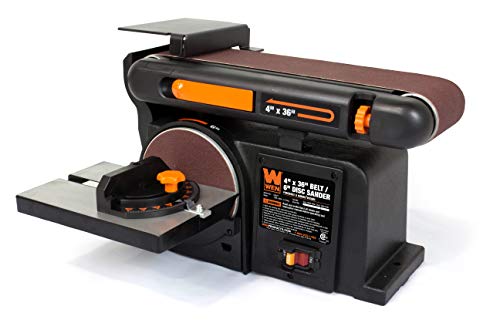
WEN 6502T Belt and Disc Sander
Independent switches let the belt keep running while the disc sits idle, a rare feature at this size. A 4.3 amp motor drives both stations on the WEN 6502T’s cast base. Table tilt spans 0 to 45 degrees, enough range for mitered edges on trim and small panels.
Pros
- Belt and disc switch on and off independently
- 45 degree table tilt covers most bevel work
- Cast base keeps the footprint small enough for a bench
Cons
- 6 inch disc limits how wide a panel edge can be trued
- Dust collection needs a shop vacuum attached to stay clean

Grizzly G0764 6 Inch x 48 Inch Belt / 12 Inch Disc Combo Sander
Grizzly built the G0764 for shops that sand daily rather than occasionally. A 1.5 HP two speed motor spins a 6 by 48 inch belt above a 12 inch disc, both mounted on cast iron tables. The enclosed cabinet base doubles as storage and keeps vibration low during long runs.
Pros
- Two speed motor adapts to wood and steel stock
- 12 inch disc covers wider panel edges than smaller combos
- Enclosed cabinet stand adds storage and cuts vibration
Cons
- Cabinet footprint needs dedicated floor space
- Uncrating the unit takes two people due to its weight

Shop Fox W1855 6 Inch x 48 Inch Belt / 9 Inch Disc Sander
Cast iron carries both the belt and disc stations on the W1855, adding mass that resists flex under load. A 1 HP motor powers the 6 by 48 inch belt and 9 inch disc together. Belt table tilt reaches a full 90 degrees for vertical sanding against a fence, and Shop Fox includes a miter gauge for the disc side.
Pros
- Cast iron frame resists flex during heavy passes
- Belt table tilts fully vertical for fence sanding
- Ships with a miter gauge for the disc table
Cons
- Belt housing has no built in dust port
- Single speed motor limits fine metal finishing

Rikon 50-121 6 Inch x 48 Inch Belt / 9 Inch Disc Sander
Deburring welds and rounding cut steel edges is where the Rikon 50-121 earns its keep. A 3/4 HP motor turns a 6 by 48 inch belt and 9 inch disc, both set on cast iron tables that owners say hold flat under repeated metal contact. A quick release tension lever cuts the time needed to swap grits between wood and metal jobs.
Pros
- Quick release lever speeds up grit changes
- Cast iron tables stay flat under repeated metal contact
- Compact enough to mount on a mobile base
Cons
- 3/4 HP motor slows down on thick hardwood stock
- Dust collection requires an added shroud
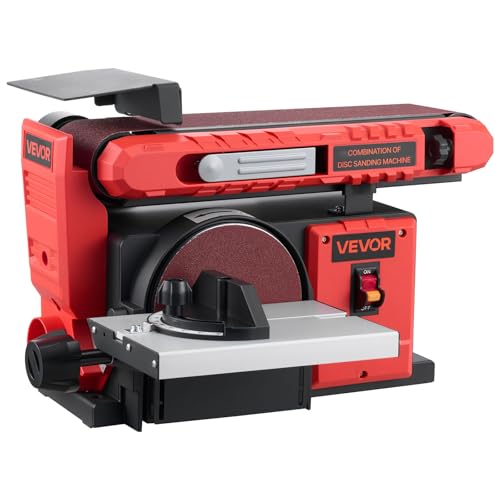
Grizzly G1015 4 Inch x 36 Inch Belt / 6 Inch Disc Combo Sander
Garage and hobby shops gain a two-station sander without giving up bench space with the G1015. Its 1/3 HP motor keeps the draw low enough for a standard 15 amp circuit, and the whole unit weighs about 44 pounds. A 4 by 36 inch belt pairs with a 6 inch disc that tilts to 45 degrees for angled edges on small parts.
Pros
- Under 44 pounds, light enough to move between benches
- Low amp draw works on a shared 15 amp circuit
- Small footprint suits garage and hobby spaces
Cons
- 1/3 HP motor struggles with dense hardwoods
- Disc table skips a miter gauge slot

POWERTEC BD1400 1 Inch x 30 Inch Belt / 5 Inch Disc Sander
Light trim work and hobby projects suit the BD1400 better than daily production sanding. A 3.5 amp motor drives a 1 by 30 inch belt and 5 inch disc on a cast iron base that keeps the machine from walking during use. The belt swings from horizontal to vertical for edge sanding against a fence.
Pros
- Lower cost entry point into combo sanding
- Cast iron base adds stability during use
- Belt tilts vertical for edge sanding against a fence
Cons
- 1 by 30 inch belt limits stock width
- Motor bogs down during extended sanding runs

WEN 6523 1 Inch x 30 Inch Belt / 5 Inch Disc Sander
A built in work light sets the WEN 6523 apart from other entry level combo sanders. Its 3.5 amp motor covers light woodworking and craft projects through a 1 by 30 inch belt and 5 inch disc, mounted on a cast iron base. Dual dust ports connect to a shop vacuum, keeping the bench cleaner during longer sessions.
Pros
- Built in work light aids precise sanding
- Dual dust ports connect directly to a shop vac
- Compact size suits a first home workshop
Cons
- 3.5 amp motor underpowered for hardwood stock removal
- Disc table lacks a full miter gauge
How they stack up
| # | Model | Motor | Best for | Score | Price |
|---|---|---|---|---|---|
| 1 | WEN 6502T Belt and Disc Sander | 4.3 amp | Best Overall | 9.4 | Check price |
| 2 | Grizzly G0764 6 Inch x 48 Inch Belt / 12 Inch Disc Combo Sander | 1.5 HP, 110V/220V | Best Premium | 9.2 | Check price |
| 3 | Shop Fox W1855 6 Inch x 48 Inch Belt / 9 Inch Disc Sander | 1 HP, 110V | Best Value | 9.0 | Check price |
| 4 | Rikon 50-121 6 Inch x 48 Inch Belt / 9 Inch Disc Sander | 3/4 HP, 110V | Best for Metalworking | 8.8 | Check price |
| 5 | Grizzly G1015 4 Inch x 36 Inch Belt / 6 Inch Disc Combo Sander | 1/3 HP, 110V | Best for Small Shops | 8.6 | Check price |
| 6 | POWERTEC BD1400 1 Inch x 30 Inch Belt / 5 Inch Disc Sander | 3.5 amp, 110V | Best Budget | 8.3 | Check price |
| 7 | WEN 6523 1 Inch x 30 Inch Belt / 5 Inch Disc Sander | 3.5 amp, 110V | Best for Beginners | 8.0 | Check price |
Frequently asked questions
What is a combination belt and disc sander used for?
It combines two sanding stations in one machine, a belt for fast stock removal and a disc for fine trimming against a fence or miter gauge, covering wood or metal edges.
Is a 6 inch belt better than a 4 inch belt for shop sanding?
A 6 inch belt covers wider stock in fewer passes and usually comes with a stronger motor, while a 4 inch belt suits benchtop work and smaller parts.
Can a belt and disc combo sander handle metal?
Models with cast iron tables and a motor built for continuous duty, such as the Rikon 50-121, deburr welds and round steel edges without trouble.
Are combination sanders worth it for a home workshop?
For shops mixing wood and metal projects, one combo machine saves more bench space than two separate sanders, though dedicated disc-only users may prefer a single-purpose tool.
What size dust port does a benchtop combo sander use?
Most benchtop models connect through a 2 to 2.5 inch port sized for a standard shop vacuum rather than a full dust collection system.
Belt sander vs disc sander: which works better on edges?
The belt moves faster along long straight edges, while the disc offers tighter control on curves and small angled cuts.
Do floor standing combo sanders need 220V power?
Larger cabinet models like the Grizzly G0764 offer a 220V wiring option, but most benchtop combos run on a standard 110V circuit.
How much bench space does a benchtop belt and disc sander need?
Plan on roughly two feet of bench depth plus clearance on both sides so stock can pass through the belt and disc freely.
Which combination sander suits a first home workshop?
Entry level models like the WEN 6523 pair a built in work light with dual dust ports, useful for beginners still learning sanding technique.
The verdict
WEN’s 6502T stays the strongest all-around pick for shops splitting time between wood and light metal work, thanks to independent belt and disc switches and a 45 degree tilting table. Shops running steel parts daily should choose the Rikon 50-121 instead, since its cast iron tables and quick release tension lever hold up better under repeated metal contact. Buyers on a tight budget can start with the WEN 6523, though its 3.5 amp motor will struggle once projects move past craft-scale work.


