Compact Battery Testers Worth Keeping in Your Glovebox
Topdon BT100 rates best overall for its clear digital readout and direct clamp-on CCA testing. KAIWEETS BT-01 matches that accuracy at a lower cost, and Ancel BA101 fits owners who just want a pass or replace verdict. None of the three need a phone app or separate printer.
Topdon BT100 tops this comparison, clamping onto battery terminals and showing cold cranking amps plus a pass or fail verdict in seconds. Weekend mechanics get a fast reading without pairing a phone. Bluetooth logging is missing here, a feature reserved for shop tools like the Foxwell BT705.
Some testers only check voltage, while others estimate true cranking capacity or scan the charging system too, and picking the wrong type wastes money on features a home garage never uses. Clamp quality, display readability, CCA range, and charging checks drove these rankings, based on manufacturer specifications and owner feedback from retailer listings.
The shortlist, ranked

Topdon BT100
Clamping directly onto battery terminals, the BT100 shows cold cranking amps, state of charge, and a pass or fail result on a backlit LCD within seconds. Flooded, AGM, and gel 12 volt batteries are all supported up to 220 CCA on standard passenger vehicles. No smartphone pairing is needed, so every result stays on the unit itself.
Pros
- Reads results without a phone app
- Backlit screen works in dim garages
- Covers three common battery chemistries
Cons
- Limited to 12V, no 24V truck support
- No data logging or export option
KAIWEETS BT-01
Smaller than a smartphone, this unit packs CCA testing, voltage reading, and a battery health percentage into one dial. A single 100 to 2000 CCA range covers motorcycles through larger trucks without a settings menu. Its alligator clamps run shorter than most rivals, which can matter in a cramped engine bay.
Pros
- Wide CCA range covers small to large batteries
- Small enough for a glovebox or toolbox
- Reads battery health as a simple percentage
Cons
- Shorter clamp cables limit reach in tight bays
- No charging system alternator test mode

Ancel BA101
Voltage, CCA, and a basic good or replace verdict make up the entire feature set here, with no extra menus to dig through. Standard 12 volt flooded and AGM batteries, the type found in most passenger cars, are its focus. A smaller screen than the BT100 or KW600 can make fine print harder to read in direct sunlight.
Pros
- Lowest cost option in this comparison
- Simple one-button operation
- No batteries or charging needed to operate
Cons
- Smaller screen is harder to read in sunlight
- Fewer battery chemistry options than pricier units
Konnwei KW600
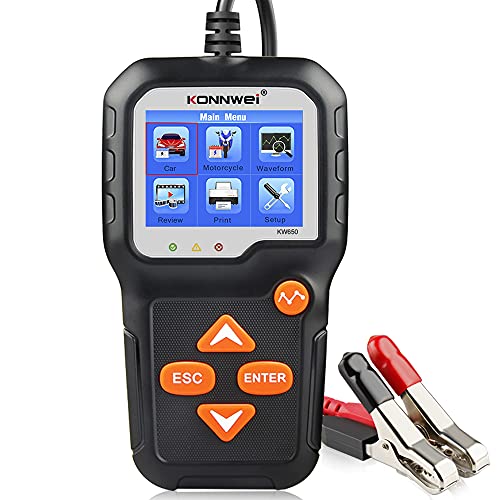
Conductance-based testing, rather than a simple voltage drop check, gives the KW600 a closer estimate of true cranking amps under load. Batteries rated from 100 to 2000 CCA fall within its range, and it flags cases where a battery reads fully charged yet fails under load. Learning the menu-driven interface takes longer than a single-button tester.
Pros
- Conductance testing catches load failures voltage checks miss
- Wide CCA range fits most consumer vehicles
- Flags weak batteries before they strand a driver
Cons
- Menu navigation is slower than one-button testers
- Learning curve for first-time users

Innova 3721
Starter draw and alternator output get tested alongside battery health here, tracing a no-start problem to its actual source. Color-coded LED results simplify interpretation for owners unfamiliar with raw voltage numbers. Part of the test sequence needs the engine running, a step the simpler clamp testers skip.
Pros
- Diagnoses charging system, not just battery health
- Color-coded results simplify quick decisions
- Catches alternator problems clamp-only testers miss
Cons
- Requires running the engine mid-test
- Bulkier than pure clamp-style testers
Foxwell BT705
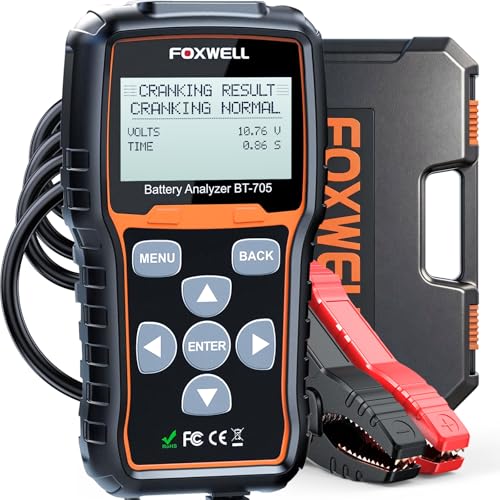
Switching between 12 volt and 24 volt systems lets the BT705 cover light trucks and dual-battery equipment alike. Multiple test results save to onboard memory, useful for a fleet technician checking several vehicles in one shift. Portability takes a hit here, since the unit runs larger than the pocket testers in this lineup.
Pros
- Only tester here supporting 24V systems
- Stores results for multiple vehicles
- Handles start-stop battery technology
Cons
- Larger footprint than pocket-sized competitors
- Overkill for single passenger-car ownership

Schumacher BT-100
Scaled for smaller 6 volt and 12 volt batteries, this model targets motorcycles, ATVs, and lawn equipment over full-size car batteries. Its clamps fit smaller terminal posts than a typical automotive clamp. Maximum testing range sits lower than the truck-focused units here, so commercial batteries are out of scope.
Pros
- Clamp size fits small powersports terminals well
- Covers both 6V and 12V batteries
- Compact enough for a motorcycle saddlebag
Cons
- CCA range too low for truck batteries
- Not suited to commercial or 24V equipment
How to pick the right one
What a Compact Battery Tester Actually Measures Voltage, cold cranking amps, and an overall health estimate come from one clamp-on reading on most handheld testers. Voltage by itself only hints at charge level, since a battery reading 12.6 volts can still fail under starter load. Simulating that load electronically is what CCA testing does, then comparing the result against the label’s rated CCA. Internal plate condition gets estimated too on conductance-based units like the Konnwei KW600, going beyond a single-moment reading.
Clamp Testers vs Multimeters vs Conductance Analyzers Reporting voltage alone is all a basic multimeter does, leaving load performance and internal condition unmeasured. Load or algorithm-based estimates come built into clamp-style CCA testers like the Topdon BT100 or Ancel BA101, skipping a separate load bank. Electrical resistance across the plates gets measured by conductance analyzers, catching batteries that hold voltage but can’t deliver current under real cranking demand. Warranty claim shops typically lean toward conductance testing, since it produces a more defensible pass or fail verdict.
Matching a Tester to Your Vehicle Type A single 12 volt battery runs most passenger cars and SUVs, so any tester in this comparison handles that job. Dual-battery 24 volt setups show up in trucks, RVs, and heavier equipment, and only the Foxwell BT705 here reads that voltage correctly. Different terminal spacing on motorcycles, ATVs, and lawn equipment calls for a compact unit like the Schumacher BT-100. Fleet operators benefit from stored test memory, since checking ten vehicles one at a time without it grows tedious fast.
How to Read a Battery Tester’s Results Meeting or exceeding the CCA number printed on the battery’s original label is generally what a pass reading means. Borderline results suggest the battery still starts the vehicle today but is losing capacity and may fail within months. Regardless of what the voltage display shows, a replace result means the battery can no longer deliver its rated cranking amps. Testing after the engine sits off for several hours gives a more accurate baseline than testing right after a drive.
Side by side
| # | Model | Battery Types | Best for | Score | Price |
|---|---|---|---|---|---|
| 1 | Topdon BT100 | Flooded, AGM, Gel (12V) | Best Overall | 9.4 | Check price |
| 2 | KAIWEETS BT-01 | Flooded, AGM, Gel, Deep Cycle (12V) | Best Value | 9.1 | Check price |
| 3 | Ancel BA101 | Flooded, AGM (12V) | Best Budget | 8.8 | Check price |
| 4 | Konnwei KW600 | Conductance-based CCA analysis | Best for Cranking Amp Accuracy | 8.6 | Check price |
| 5 | Innova 3721 | Battery, starter draw, alternator output | Best for Charging System Diagnostics | 8.4 | Check price |
| 6 | Foxwell BT705 | 12V and 24V systems | Best for Trucks and 24V Systems | 8.2 | Check price |
| 7 | Schumacher BT-100 | 6V and 12V, powersports-focused | Best for Motorcycles and Powersports Batteries | 8.0 | Check price |
Frequently asked questions
What does CCA mean on a battery tester?
Cold cranking amps measure how much current a battery can deliver for 30 seconds at 0 degrees Fahrenheit while staying above a usable voltage. Testers compare a measured result against the CCA number printed on the battery’s label to judge remaining capacity.
Can a battery tester tell if the alternator is bad?
Basic clamp testers like the BT100 or BA101 only check the battery itself. Units built for charging system diagnostics, such as the Innova 3721, add a separate alternator output test that requires the engine running.
Is a compact tester as accurate as a shop load tester?
Conductance-based compact testers, including the Konnwei KW600, come close to shop-grade accuracy for routine pass or fail checks. Full carbon-pile load testers used in some shops still offer finer diagnostic detail for warranty disputes.
Do battery testers work on AGM and gel batteries?
Flooded, AGM, and gel chemistries are supported through a selectable battery type setting on most testers in this comparison, including the Topdon BT100 and KAIWEETS BT-01. Checking the manual before testing confirms the correct chemistry is selected, since a wrong setting skews the reading.
Which battery tester is best for a motorcycle?
Standard automotive testers size their clamps for larger terminal posts, which fit poorly on motorcycle batteries. A powersports-focused tester like the Schumacher BT-100 uses smaller clamps sized for those terminals instead.
How often should I test my car battery?
Testing twice a year, typically before summer and winter extremes, catches most batteries before they fail unexpectedly. Testing again anytime the vehicle struggles to start adds an extra data point.
Does a battery tester need the engine running?
Most CCA and conductance testers, including the KW600 and BT100, test with the engine off and read results directly from the battery terminals. Charging system testers like the Innova 3721 require the engine running for the alternator portion of the test.
What is the difference between a 12V and 24V battery tester?
Single-battery passenger vehicle systems are all a 12 volt tester reads accurately. Trucks and equipment wired for 24 volts, often two 12 volt batteries in series, need a tester like the Foxwell BT705 built to read that combined voltage correctly.
Is a clamp tester or a multimeter better for checking a battery?
A multimeter only reports voltage, missing how the battery performs under actual cranking load. A clamp tester adds a CCA estimate on top of voltage, giving a clearer pass or fail picture without a separate load bank.
The bottom line
Most car and SUV owners get the best mix of speed and accuracy from the Topdon BT100, without paying for features they won’t use. Anyone running a 24 volt dual-battery truck or fleet setup should reach for the Foxwell BT705 instead, since it’s the only tester here built for that range. Riders testing motorcycle or powersports batteries get a better clamp fit from the compact Schumacher BT-100.
