Compact Reciprocating Saws That Cut Big Without the Bulk
The Milwaukee M12 Fuel Hackzall is the best compact reciprocating saw for most people. It offers excellent cutting speed in a body that fits one hand, making it ideal for overhead work and tight spots. Its main limitation is that it uses 12V batteries, so it won’t handle the heaviest demolition tasks.
A full size reciprocating saw is a powerhouse, but it can be heavy and awkward in cramped spaces. Compact reciprocating saws offer a lighter, more maneuverable alternative without sacrificing much cutting ability.
These tools excel at pruning branches, cutting PVC, and making demolition cuts in tight corners. With advances in brushless motors and battery technology, they now deliver impressive performance in a smaller package.
What we recommend
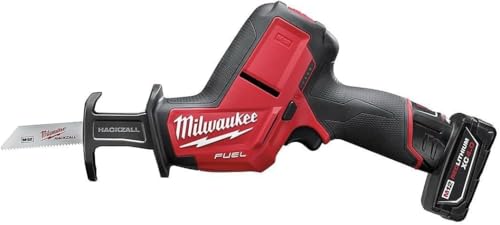
Milwaukee M12 Fuel Hackzall
The Milwaukee M12 Fuel Hackzall is a compact powerhouse that delivers up to 3,000 strokes per minute. Its one-handed design allows for easy control and access in tight spots, and the adjustable shoe provides stability. Users praise its battery life and durability, though it requires the M12 battery system.
Pros
- Exceptional power in a compact size
- Great balance and low vibration
- Barely any kickback
Cons
- Uses M12 batteries, not compatible with M18
- No variable speed trigger

DEWALT 20V MAX XR Compact Reciprocating Saw (DCS367B)
The DEWALT DCS367B is a compact reciprocating saw with a brushless motor and a 1-1/8 inch stroke length. It features a variable speed trigger with a dial for precise speed control. Owners report that the LED light and rafter hook are handy, and the tool is well balanced. It comes as a bare tool, so you need a 20V battery.
Pros
- Variable speed dial for fine control
- Accepts universal T-shank blades
- Durable construction
Cons
- A bit heavier than some competitors
- Bare tool requires separate battery purchase

Makita XRJ04Z 18V LXT Brushless Recipro Saw
The Makita XRJ04Z is a brushless compact recipro saw with a 1-1/8 inch stroke and a variable speed trigger. It delivers 3,600 SPM and features a tool-less blade change and an adjustable shoe. Users note that it cuts quickly and has low vibration, but the trigger lock is awkward for some.
Pros
- Fast cutting speed
- Low vibration for fatigue reduction
- Excellent dust protection
Cons
- Heavier than some competitors
- No on-board wrench storage
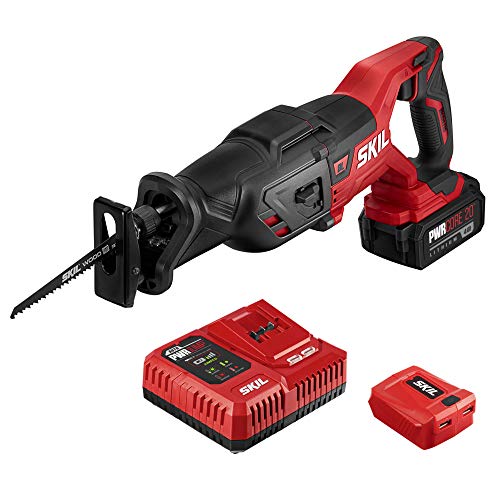
SKIL 20V Compact Reciprocating Saw (CR5406-00)
The SKIL CR5406-00 is an affordable cordless reciprocating saw that offers surprising power for its price. It features a brushless motor, a 1 inch stroke length, and a variable speed trigger. It comes with a PWRCore 20 battery and charger, making it a complete kit. Owners say it handles most tasks well, but it’s not as refined as premium models.
Pros
- Great value with battery and charger included
- Lightweight and easy to handle
- Tool-less blade change
Cons
- Shorter stroke length
- Plastic housing feels less durable

DEWALT 12V MAX Cordless Reciprocating Saw (DCS312B)
The DEWALT DCS312B is a 12V reciprocating saw designed for light-duty cutting. It weighs just 2.1 pounds and fits in tight spaces where larger saws cannot. It has a 5/8 inch stroke length and a variable speed trigger. Users appreciate its lightweight and ease of use, but it lacks the power for heavy cutting.
Pros
- Extremely light and easy to control
- Ideal for overhead work
- Accepts T-shank blades
Cons
- Limited power for tough materials
- Bare tool only

Ryobi P519 One+ 18V Brushless Reciprocating Saw
The Ryobi P519 is a brushless reciprocating saw that works with the extensive One+ battery system. It offers a 1 inch stroke length and gets up to 3,200 SPM. It features an adjustable shoe and a variable speed trigger. It is a good choice for homeowners who already own Ryobi tools, but it is not as refined as premium brands.
Pros
- Compatible with all One+ batteries
- Brushless motor for efficiency
- LED light for visibility
Cons
- Slightly bulkier than competitors
- No battery included

PORTER-CABLE PCC670B 20V MAX Compact Reciprocating Saw
The PORTER-CABLE PCC670B is a compact reciprocating saw that offers a good balance of power and affordability. It features a 1 inch stroke length and a variable speed trigger. It is a bare tool, but it is often available at a low price. Owners say it works well for occasional projects, but it lacks the power for continuous heavy use.
Pros
- Affordable price point
- Simple and reliable design
- Rubber overmold grip
Cons
- Brushes wear over time
- Less efficient than brushless models
What to look for
How they stack up
| # | Model | Motor | Best for | Score | Price |
|---|---|---|---|---|---|
| 1 | Milwaukee M12 Fuel Hackzall | Brushless | Best overall for one-handed use | 9.4 | Check price |
| 2 | DEWALT 20V MAX XR Compact Reciprocating Saw (DCS367B) | Brushless | Best for precise cuts with adjustable speed | 9.2 | Check price |
| 3 | Makita XRJ04Z 18V LXT Brushless Recipro Saw | Brushless | Best for fast cutting with low vibration | 9.0 | Check price |
| 4 | SKIL 20V Compact Reciprocating Saw (CR5406-00) | Brushless | Best budget option | 8.6 | Check price |
| 5 | DEWALT 12V MAX Cordless Reciprocating Saw (DCS312B) | Brushed | Best for ultralight one-handed tasks | 8.4 | Check price |
| 6 | Ryobi P519 One+ 18V Brushless Reciprocating Saw | Brushless | Best value for One+ battery users | 8.2 | Check price |
| 7 | PORTER-CABLE PCC670B 20V MAX Compact Reciprocating Saw | Brushed | Best for occasional DIY use | 8.0 | Check price |
Frequently asked questions
What is the difference between a compact and full-size reciprocating saw?
Compact reciprocating saws are smaller, lighter, and often have shorter stroke lengths. They are easier to handle in tight spaces and for overhead work, but they may have less power and slower cutting speeds. Full-size saws are more powerful and can handle heavier demolition tasks, but they are heavier and more cumbersome.
Can a compact reciprocating saw cut through metal?
Yes, with the correct blade. Use a bi-metal or carbide-coated blade designed for metal cutting. Set the saw to a slower speed and use cutting fluid to reduce heat. A compact saw may take longer than a full-size saw, but it can still cut through rebar, conduit, and sheet metal.
How do I choose the right blade for a compact reciprocating saw?
Consider the material you are cutting and the desired finish. For wood, use a blade with 5-6 teeth per inch (TPI). For metal, use a blade with 14-24 TPI. Bi-metal blades are versatile and durable. Match the blade length to the thickness of the material. Always ensure the shank is T-shank for compatibility.
Are compact reciprocating saws suitable for pruning trees?
Yes, they are excellent for pruning. Use a wood-cutting blade with a high TPI for clean cuts. The lightweight design makes it easy to maneuver around branches. However, for very thick limbs, a pole saw or chainsaw may be more appropriate.
What is the advantage of a brushless motor?
Brushless motors are more efficient, providing longer battery life and more power. They also have no brushes to wear out, so they last longer and require less maintenance. Many brushless models also offer better speed control and reduced vibration.
Can I use a compact reciprocating saw for demolition work?
Yes, but with limitations. A compact saw can cut through drywall, lumber, and even nails. However, for extensive demolition, a full-size saw with a longer stroke and more power will be faster and less likely to stall. Use a demolition blade for the best performance.
How long does a battery last on a compact reciprocating saw?
Battery life depends on the battery capacity and the intensity of use. Typically, a 2.0Ah battery may last for about 15-20 minutes of continuous cutting. Higher capacity batteries, such as 4.0Ah or 5.0Ah, provide longer runtime. Keep a spare battery on hand for longer projects.
Do all compact reciprocating saws have a variable speed trigger?
Most modern models do, but some budget options may have a fixed speed. Variable speed is important for controlling the cut and preventing blade damage. Look for a saw with a trigger that allows you to modulate speed smoothly.
What is the weight of a typical compact reciprocating saw?
The weight ranges from about 2 to 4 pounds, depending on the battery and motor. Lighter models are easier to use overhead but may have less power. Heavier models offer more stability but can cause fatigue. Choose a weight that you can comfortably manage for your tasks.
Can I use a compact reciprocating saw with a cord?
Yes, there are corded compact reciprocating saws available. They offer unlimited runtime and consistent power, but they restrict mobility. Cordless models provide convenience but require battery management. Consider your typical work environment when making a choice.
Our pick
For most homeowners and DIYers, the Milwaukee M12 Fuel Hackzall is the clear winner because it offers the best combination of power, portability, and control. If you need a saw for occasional light duty and want to save money, the SKIL CR5406-00 is a solid budget pick. For professionals who need the most cutting speed, the Makita XRJ04Z is worth the extra weight.