Compact Solar RV Tire Pressure Monitors Worth Your Dash Space
For most RV owners, the TireMinder Smart TPMS is the best compact solar option. It pairs a solar charging panel with a reliable, user-friendly display and a robust sensor system. Owners report that its signal strength and battery life outshine many competitors. However, it is more expensive than other models, and some users find the sensor mounting hardware a bit fiddly.
Proper tire pressure is critical for RV safety, fuel economy, and tire longevity. A tire pressure monitoring system (TPMS) gives you real-time data and alerts. Compact solar models are popular because they don’t require wiring and keep your dash free of cords.
We compared seven compact solar RV TPMS that are currently available. Owners report on accuracy, ease of installation, and whether the solar charging actually keeps up. Here are the best options to consider.
How to choose
Our top picks

TireMinder Smart TPMS
The TireMinder Smart TPMS is a compact solar monitor that offers a large, easy-to-read display with color coding. It supports up to 22 tires for trailers and towables. Owners report excellent signal strength and a battery that lasts between charges. The solar panel keeps it topped up, but some say the included suction mount is weak.
Pros
- Excellent signal range and reliability
- Handles multiple trailers and tire configurations
- Color-coded alerts for easy reading
Cons
- Higher price point
- Mounting hardware could be sturdier
EEZTire TPMS Solar
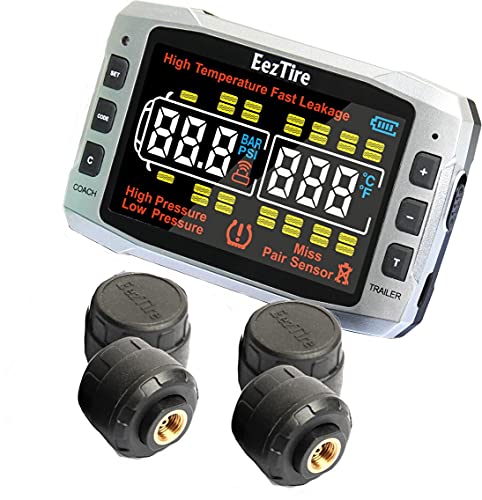
The EEZTire TPMS offers a compact solar display with a built-in rechargeable battery. It supports up to 6 tires, which is sufficient for most RVs. Users report that the sensors are accurate and the alarm is loud. The solar panel works well, but in low light you’ll need the USB charging cable.
Pros
- Affordable for basic TPMS needs
- Large display with easy-to-read numbers
- Loud alarm and visual warnings
Cons
- Shorter range than premium models
- No option for internal sensors

Tymate TPMS Solar
The Tymate TPMS is designed for trailers with up to 6 wheels. It features a compact solar monitor with a stable mount. Owners appreciate the easy installation and the ability to set high and low pressure alerts. However, some users note that the sensors are a bit bulky and may require additional clearance on some wheels.
Pros
- Simple setup and calibration
- Stable mounting options
- Good value for the price
Cons
- Sensors can be bulky
- No signal strength indicator for sensors

MAXXHAUL TPMS Solar
The MAXXHAUL TPMS supports up to 22 tires, making it a great choice for large fifth wheels and RVs towing trailers. The monitor is compact and solar powered. Owners report that the alarm is very loud, which is helpful. However, the menu navigation is not intuitive, and the solar panel may not be sufficient in cloudy climates.
Pros
- Handles many tires with ease
- Very loud alarm
- Compact design
Cons
- Menu navigation is clunky
- Solar charging can be slow in overcast weather

Fosmon TPMS Solar
The Fosmon TPMS features a high-visibility LCD that remains readable in direct sunlight. It supports up to 6 tires and comes with a simple mounting option. Owners like the clear pressure and temperature readings. The trade-off is a shorter range and fewer advanced features compared to pricier models.
Pros
- Excellent visibility in bright conditions
- Compact and lightweight
- Quick sensor pairing
Cons
- Range is limited
- No backlight for night driving

TireMinder TM5
The TireMinder TM5 is another solid offering from TireMinder, focusing on simplicity. It has a compact solar display and supports up to 6 wheels. Owners report that the setup is straightforward and the buttons are responsive. The main downside is that it lacks the expandability of the Smart model.
Pros
- Very easy to set up and use
- Clear and concise display
- Good battery life with solar assist
Cons
- Limited to 6 tires
- No temperature alerts on base model

BougeRV TPMS Solar
The BougeRV TPMS offers a compact solar display with a companion app for detailed monitoring. It supports up to 6 tires and provides real-time alerts on your phone. Owners appreciate the ability to track pressure history. However, the app can be glitchy, and the solar panel is small, so regular USB charging is often needed.
Pros
- Smartphone app for data logging
- Accurate readings
- Customizable alarm settings
Cons
- App connectivity issues reported
- Solar panel is not powerful enough
Compared at a glance
| # | Model | Display | Best for | Score | Price |
|---|---|---|---|---|---|
| 1 | TireMinder Smart TPMS | 2.9 inch color LCD | Best overall with reliable performance | 9.4 | Check price |
| 2 | EEZTire TPMS Solar | 4 inch color LCD | Best budget-friendly option | 8.8 | Check price |
| 3 | Tymate TPMS Solar | 2.5 inch color LCD | Best for dual-axle trailers | 8.5 | Check price |
| 4 | MAXXHAUL TPMS Solar | 2.8 inch color LCD | Best for large RVs and trailers | 8.2 | Check price |
| 5 | Fosmon TPMS Solar | 4 inch sunlight-readable LCD | Best for easy reading in bright sunlight | 8.0 | Check price |
| 6 | TireMinder TM5 | 2.6 inch color LCD | Best for user-friendly interface | 8.7 | Check price |
| 7 | BougeRV TPMS Solar | 4 inch color LCD | Best for tech-savvy RVers | 8.3 | Check price |
Common questions
How does a solar TPMS work?
A solar TPMS has a small solar panel on the monitor that charges a built-in battery. The monitor receives wireless signals from sensors attached to each tire. It displays pressure and temperature, and alerts you if readings are outside your set range.
Can I install a solar TPMS myself?
Yes, most external sensor models are DIY-friendly. You simply screw the sensors onto the valve stems and pair them with the monitor. Internal sensors require a tire shop to mount them inside the wheel.
How many sensors do I need for my RV?
A typical RV has 4 to 6 tires, but if you tow a trailer, you will need sensors for those tires too. Some TPMS units support up to 22 sensors, so choose one that matches your setup.
Will the solar panel charge the monitor in all weather?
No, the solar panel works best in direct sunlight. In cloudy or shaded conditions, the battery may not fully charge. Most monitors come with a USB cable for backup charging.
Are external sensors accurate?
Yes, external sensors are accurate within a few PSI. They measure the actual pressure in the tire. However, they are not as precise as internal sensors, which are directly in the air chamber.
How often should I check my tire pressure?
You should check your tire pressure at least once a month and before long trips. A TPMS gives you real-time readings so you can catch slow leaks early.
Can a TPMS prevent blowouts?
A TPMS can alert you to underinflation or rapid pressure loss, which are common causes of blowouts. By giving you early warning, it helps you pull over before a tire fails.
What is the typical battery life of the sensors?
External sensors have batteries that last 1 to 2 years, depending on usage. Internal sensors can last 5 to 10 years. Some TPMS units indicate low battery on the display.
The verdict
For most RVers, the TireMinder Smart TPMS is the best investment. It offers proven reliability, excellent range, and the ability to expand to multiple trailers. If you are on a tight budget, the EEZTire TPMS provides solid performance at a lower cost. Choose a model with a solar panel, but remember that USB backup is essential for cloudy days.