7 compact squares for framing and fine joinery
Swanson Tool Co S0101 Speed Square handles most layout, with a 7 inch cast aluminum body, stair gauge slots and a fence thick enough to steer a circular saw. Empire Level e250 reads more clearly in dim light. Woodpeckers 1281 Precision Woodworking Square covers joinery accuracy.
Swanson Tool Co S0101 Speed Square suits carpenters who frame walls, cut rafters and crosscut with a circular saw. One 7 inch aluminum casting marks 90 and 45 degrees, reads common pitches and guides a saw shoe. Stamped scales are its weak point, since sawdust settles into the numbers and dims them.
Two different tools share the word square. Framing versions are rugged castings scaled in degrees. Precision versions are milled or ground, then quoted in thousandths of an inch. We compared blade material, stated accuracy, graduation style and edge finish. Owner feedback about drops, edge wear and readability after a season settled the close calls.
Our top picks

Swanson Tool Co S0101 Speed Square
Aluminum alloy casting gives this 7 inch square a fence stiff enough to steer a circular saw shoe. Stair gauge slots, a diamond cutout for rafter tails and quarter inch scribe notches cover routine framing layout. Swanson includes a printed Blue Book of rafter tables in the box.
Pros
- Fence thickness suits circular saw guiding
- Castings shrug off drops from staging
- Scribe notches speed up repeat marking
Cons
- Stamped numbers blur once dust fills them
- Degree scale is too coarse for joinery

Empire Level e250 Magnum Rafter Square
Laser etching and black fill keep every graduation visible under sawdust and shop light. Ribs behind the blade add stiffness, so a hard landing rarely bends the body. Layout features track the Swanson closely, with stair gauge slots plus rafter and hip scales on the face.
Pros
- Clearest graduations among the framing squares here
- Ribbed body resists flex under saw pressure
- Black fill stays readable in low light
Cons
- Etched finish wears when dragged on concrete
- Corners can raise burrs that need filing

Stanley 46-053 Quick Square
Impact-resistant polymer drops the weight, which matters when a square rides in a nail bag all day. Molded scales cover 90 degrees, 45 degrees and common rafter pitches. Polymer flexes more than cast metal, so treat this one as a marking tool rather than a saw fence.
Pros
- Lightest square in this group
- Will not rust or stain wet lumber
- Easy to keep one in every bag
Cons
- Body flexes if used as a saw guide
- Molded edges dull faster than machined ones
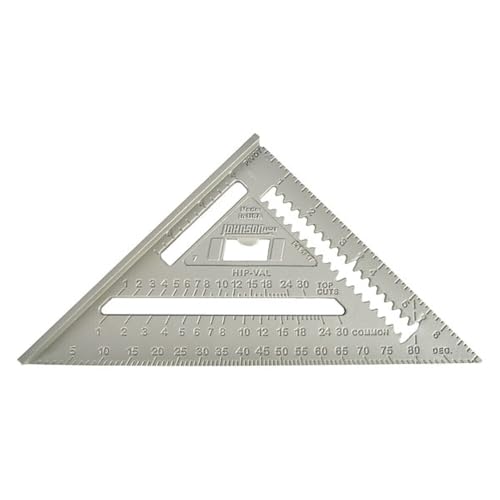
Johnson Level & Tool RAS-1 Johnny Square
Scales are engraved into the aluminum instead of stamped, so a pencil tip drops into the groove and stays put. Rafter, hip and valley tables sit on the face for cutting roof angles without arithmetic. Stair gauge slots accept standard hex nuts for repeat riser and tread marks.
Pros
- Engraved grooves steer a pencil accurately
- Full roof framing tables printed on the tool
- Handles daily framing abuse
Cons
- Bare aluminum picks up visible scratches
- Fence sits thinner than the Swanson casting

Woodpeckers 1281 Precision Woodworking Square
Machined 6061 aluminum and a rated accuracy near 0.001 inch over the blade let this square check table saw fences and case assemblies. A grid of small holes takes a mechanical pencil lead for parallel lines at fixed offsets. Anodizing guards the surface, though the tool belongs on a rack rather than in a tool belt.
Pros
- Tight enough to dial in a saw or jointer fence
- Hole grid replaces a separate marking gauge
- Stays true when stored carefully
Cons
- Aluminum dents on a concrete floor
- More resolution than framing work needs

Starrett 20-4-4R Double Square
A hardened steel blade slides through the head and locks anywhere along its length. That turns one tool into a square, a depth gauge and a height gauge for small parts. Graduations follow the 4R pattern, reading in eighths, sixteenths, thirty-seconds and sixty-fourths.
Pros
- Sliding blade reads depth and step height
- Finest graduations of any pick here
- Fits an apron pocket
Cons
- Steel needs oil after humid shop sessions
- Short blade limits it to small parts
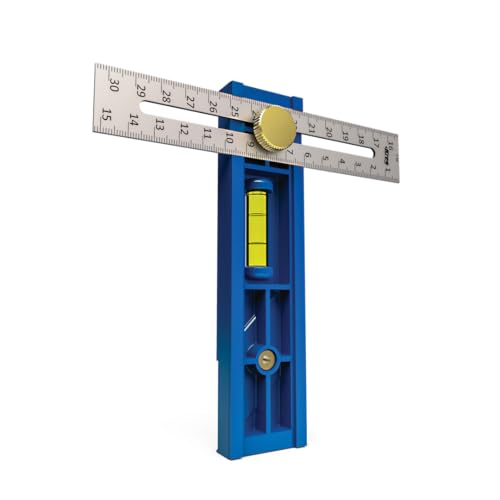
Kreg KMA2900 Multi-Mark Multi-Purpose Marking Tool
Kreg pairs a sliding rule with 90 and 45 degree references, so one body marks lines, sets depths and finds centers on narrow stock. Sheet goods layout gains the most, because the rule rides a panel edge for repeatable offsets. Accuracy lands at carpentry level, not machinist level.
Pros
- Covers square, depth gauge and marking gauge duties
- Reads both imperial and metric
- Rule locks firmly for repeat marks
Cons
- Less rigid than a one-piece square
- Not precise enough for joinery fitting
Compared at a glance
| # | Model | Size | Best for | Score | Price |
|---|---|---|---|---|---|
| 1 | Swanson Tool Co S0101 Speed Square | 7 inch | Best overall | 9.4 | Check price |
| 2 | Empire Level e250 Magnum Rafter Square | 7 inch | Best value | 9.2 | Check price |
| 3 | Stanley 46-053 Quick Square | 7 inch | Best budget | 9.0 | Check price |
| 4 | Johnson Level & Tool RAS-1 Johnny Square | 7 inch | Best for rafter and stair layout | 8.8 | Check price |
| 5 | Woodpeckers 1281 Precision Woodworking Square | Machined 6061 aluminum, anodized | Best for fine woodworking | 8.6 | Check price |
| 6 | Starrett 20-4-4R Double Square | 4 inch, sliding and lockable | Best for machinist accuracy | 8.3 | Check price |
| 7 | Kreg KMA2900 Multi-Mark Multi-Purpose Marking Tool | Sliding, marked in inches and metric | Best multi-purpose square | 8.0 | Check price |
Before you buy
What to look for in a compact square Start by deciding whether your work is measured in degrees or thousandths. Framing calls for a rugged casting with rafter tables, a thick fence and legible scales, which describes the Swanson S0101, Empire e250 and Johnson RAS-1. Shop work calls for a milled or ground tool with a published tolerance, which is where the Woodpeckers 1281 and Starrett 20-4-4R sit. Marking style decides how long the tool stays useful. Engraved and etched graduations outlast stamped ones by years.
Materials: cast aluminum, polymer and hardened steel Cast aluminum absorbs impacts and keeps its reference edge, which explains its hold on framing. Polymer weighs less and ignores rain, as on the Stanley 46-053, but it flexes under a saw shoe. Machined aluminum measures beautifully and dents just as easily. Hardened steel wears slowest of the four, then rusts if left damp. Match the material to where the tool actually lives: nail bag, truck box or shop drawer.
How to use a speed square as a saw guide Running a circular saw along the blade saves setup on repetitive crosscuts. Success depends on a thick square fence and a body stiff enough to resist sideways push, which the Swanson and Empire castings supply. Press the fence against the board edge, then start the cut with the shoe already flat. Skip this trick with polymer or precision squares. A saw shoe scores a bevel into the reference edge, and that tool never reads true again.
Best squares for cabinetmaking and machine setup Squaring a drawer box or checking a blade against the miter slot needs a published tolerance. Woodpeckers rates the 1281 near 0.001 inch over its blade, enough to catch fence drift invisible to the eye. Smaller jobs suit the Starrett double square, which sets chisel depth and measures a rabbet shoulder. One caution applies to every precision square. A dropped one can read out of square while looking perfect, so flip it against a straight edge and compare two lines before trusting it.
Good to know
What is the difference between a speed square and a rafter square?
Both names describe the same triangular tool. Swanson trademarked Speed Square, so rivals label theirs rafter squares or triangle squares. Shape, pivot point and degree scale carry across all of them.
Which compact square is best for framing?
Swanson S0101 covers general framing, thanks to a thick fence and stair gauge slots. Roof cutting favors the Johnson RAS-1, which engraves hip and valley tables directly on the face.
How accurate does a small square need to be?
Framing tolerances sit around a sixteenth of an inch, and any cast square clears that. Cabinet and drawer work wants roughly a thousandth over a few inches, the figure precision squares publish.
Can you cut angles with a circular saw and a speed square?
Yes, for 90 and 45 degree cuts. Hold the fence tight to the board edge and run the saw shoe along the blade. Use a cast aluminum square, because polymer bodies flex under that pressure.
Is a 7 inch square big enough?
For studs, joists and standard lumber, yes. Wider stock such as a 12 inch stair tread needs a 12 inch square, since two overlapping marks introduce error. Many carpenters keep a 7 inch on the belt and a larger one in the truck.
How do you check whether a square is still true?
Mark a line along a straight board edge. Flip the square over and mark again from the same point. Diverging lines mean the tool is out of square, and the gap doubles the real error, which makes the test unusually sensitive.
Speed square vs combination square, which should you buy first?
Framing, rafter cutting and saw guiding point to the speed square. Furniture work points to a combination or double square such as the Starrett 20-4-4R, whose sliding blade also sets depths and heights.
Do aluminum squares wear out?
Reference edges wear slowly from concrete drags and saw shoe contact. Stamped markings fade long before the geometry drifts. Keeping the square off the ground and away from blades adds years of useful life.
What is the best compact square for a beginner woodworker?
Kreg KMA2900 earns its place in a first kit, because one tool marks lines, sets depths and finds centers on shelving and cabinet parts. Add a precision square later, once joinery fits start mattering.
The verdict
Swanson Tool Co S0101 Speed Square stays the default buy for carpenters, since its cast fence guides a saw and its tables cover roof and stair layout. Anyone squinting at stamped numbers should take the Empire e250 instead, for the black-filled etching alone. Furniture makers get little from either and should spend on the Woodpeckers 1281, which resolves errors a framing square cannot see.


