Compact Subwoofers That Deliver Big Bass
The SVS SB-1000 Pro is the top pick for most people because it combines a 12 inch driver with a compact sealed cabinet, offering deep, accurate bass that outperforms its size. Its main advantage is app based control and room correction, but its main limitation is a higher price than some competitors.
Small rooms and apartments need big bass without the bulky footprint. Compact subwoofers have improved dramatically, with powerful drivers and digital amplification delivering room shaking lows from enclosures that fit under a desk or beside a sofa.
This roundup compares seven of the best selling compact subwoofers on Amazon, from budget friendly options to high end models. We focus on real world performance and user satisfaction to help you choose the right one for your space and listening habits.
The best picks, ranked

SVS SB-1000 Pro
The SVS SB-1000 Pro packs a 12 inch driver into a sealed cabinet that measures just over 13 inches cubed. It delivers deep, tight bass down to 20 Hz, and its smartphone app allows for easy tuning and presets. Owners praise its clean output and musicality, though it commands a premium price.
Pros
- Exceptional low frequency extension
- App based room correction
- Compact sealed design
Cons
- Premium price
- Requires break in period
Polk Audio PSW10
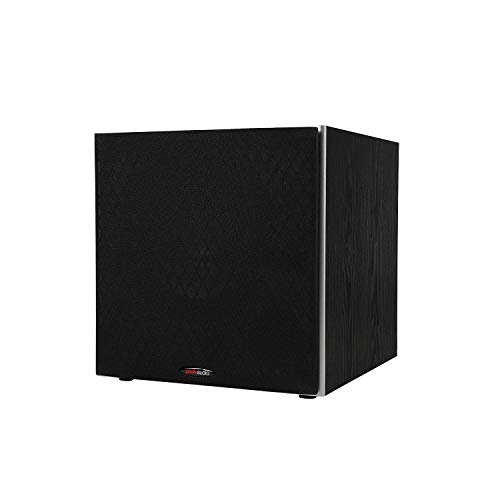
The Polk PSW10 is a 10 inch subwoofer in a modest sized cabinet, known for its value and reliable performance. It features a down firing driver and a 50 watt amplifier, which is modest but sufficient for small to medium rooms. Owners find it a solid entry into home theater bass.
Pros
- Very affordable
- Compact footprint
- Easy setup
Cons
- Limited output at low frequencies
- No auto on/off

Yamaha NS-SW050
Yamaha’s NS-SW050 features a 8 inch driver with a twisted flare port, designed to deliver clean, articulate bass for music. Its advanced YST II technology provides deep, rich sound without distortion. Reviewers note its punchy response and compact size that fits easily into stereo setups.
Pros
- Great for music reproduction
- Compact and stylish
- Auto standby feature
Cons
- Not the deepest bass
- Limited LFE input

Klipsch R-120SW
The Klipsch R-120SW is a 12 inch subwoofer in a front firing design, delivering powerful, room filling bass. Its digital amplifier provides 400 watts of peak power, and the all digital circuitry ensures high efficiency. It includes volume, low pass crossover, and phase control for flexible setup.
Pros
- High output for its size
- Good low end extension
- Phase control for alignment
Cons
- Large for a compact sub
- No auto on feature
Definitive Technology SuperCube 2000
The SuperCube 2000 is a force of nature, with a 10 inch driver and dual 10 inch passive radiators in a surprisingly small cabinet. It produces deep, thunderous bass down to 22 Hz, and its 1400 watt digital amplifier ensures incredible dynamics. Owners describe it as a giant killer.
Pros
- Extremely deep bass
- Pristine clarity
- Small footprint relative to output
Cons
- Very expensive
- Needs careful placement for best performance

JBL Arena 120P
JBL’s Arena 120P brings cinema style bass with a 12 inch driver and a slot port design. It delivers high impact sound effects with deep extension, making movies and games more immersive. The sleek design and wired remote add convenience.
Pros
- Powerful home theater performance
- Wired remote included
- Attractive design
Cons
- Port noise at high volumes
- Bulky for tight spaces

Monoprice 9723
The Monoprice 9723 is a 10 inch subwoofer that offers substantial bass at an unbeatable price. It features a 150 watt amplifier and a down firing design, providing a good balance of output and size. Many users find it an excellent entry point into subwoofer ownership.
Pros
- Low cost
- Solid performance for price
- Compact shape
Cons
- Build quality could be better
- No auto on/off
Side by side
| # | Model | Driver | Best for | Score | Price |
|---|---|---|---|---|---|
| 1 | SVS SB-1000 Pro | 12 inch front firing | Best overall compact subwoofer | 9.4 | Check price |
| 2 | Polk Audio PSW10 | 10 inch down firing | Best budget compact subwoofer | 8.2 | Check price |
| 3 | Yamaha NS-SW050 | 8 inch cone | Best for music listening | 8.5 | Check price |
| 4 | Klipsch R-120SW | 12 inch copper spun | Best high output compact subwoofer | 9.0 | Check price |
| 5 | Definitive Technology SuperCube 2000 | 10 inch active, dual 10 inch passive | Best premium compact subwoofer | 9.2 | Check price |
| 6 | JBL Arena 120P | 12 inch polycellulose | Best for home theater | 8.8 | Check price |
| 7 | Monoprice 9723 | 10 inch down firing | Best value compact subwoofer | 8.0 | Check price |
Before you buy
Good to know
What is the smallest size subwoofer I should consider?
An 8 inch subwoofer is the smallest commonly available. It works well for music and small rooms, but for home theater, a 10 inch is often recommended for deeper impact.
Can a compact subwoofer produce deep bass?
Yes, modern compact subs with high excursion drivers and powerful amplifiers can reach down to 20 Hz or lower, like the SVS SB-1000 Pro. However, they may not have the sheer output of larger subs at high volumes.
Do I need a subwoofer for music listening?
If your main speakers lack bass below 50 Hz, a subwoofer can add depth and presence. For many music genres, a compact sub with a sealed design can improve accuracy.
How do I connect a compact subwoofer to my system?
Most subwoofers have a line level input that connects to the subwoofer output on an AV receiver. Some have speaker level inputs for systems without a dedicated output. Check your receiver’s manual.
What is the difference between a powered and passive subwoofer?
A powered subwoofer has a built in amplifier, so it only needs a signal from the receiver. A passive subwoofer requires an external amplifier. Most home subwoofers are powered.
How much power do I need for a compact subwoofer?
Power ratings vary, but for a small room, 100 to 200 watts RMS is sufficient. For larger rooms, look for 300 watts or more. Higher power allows for louder output without distortion.
Is a ported subwoofer louder than a sealed one?
Generally, yes. Ported designs use the port to reinforce low frequencies, increasing efficiency. However, they may have less accurate bass and can produce port noise at extreme volumes.
Can I use a compact subwoofer in an apartment?
Yes, but be mindful of neighbors. A compact sub with a sealed design and adjustable volume can provide good bass without excessive sound leakage. Use bass traps and isolation pads to minimize transmission.
What is the ideal crossover frequency for a subwoofer?
Set the crossover around 80 Hz for home theater, as this is the THX standard. For music, you might set it higher if your main speakers are small. Adjust based on your main speakers’ rolloff.
Do compact subwoofers require special cables?
No, standard RCA cables are used for line level connections. For speaker level connections, use standard speaker wire. Ensure the cable length is sufficient for placement.
Our pick
For most people, the SVS SB-1000 Pro is the best compact subwoofer because it offers an unmatched combination of deep bass, small size, and user friendly app control. If your budget is tighter, the Polk PSW10 provides reliable performance at a low cost. For premium output, the Definitive Technology SuperCube 2000 is a top choice, but it costs more.


