Compasses Compared: Baseplate vs Lensatic Navigation
The Suunto MC-2 is our top overall pick for its mirror sighting and adjustable declination. The Suunto A-10 is the best value for straightforward map and trail work, and the Cammenga 3H Tritium Lensatic is the pick for precise field bearings in low light.
For most hikers the Suunto MC-2 is the compass to own, because a mirror sight plus adjustable declination covers both careful map work and long distance bearings. The Suunto A-10 does the everyday job for a fraction of the outlay, and the Cammenga 3H suits anyone who needs repeatable bearings after dark.
Compass shopping goes wrong because the important features are invisible in a product photo. Whether declination is adjustable, whether the needle is balanced for your hemisphere and whether the sighting method suits your eyes all change how usable the tool is in the field. We compared declination systems, sighting designs, scales and luminescence based on specifications, and we weighed what long term users report about bubbles, needle drift and durability.
How to choose
Baseplate, mirror or lensatic Baseplate compasses have a clear plastic plate that sits on a map, so you can plot bearings directly against grid lines. Mirror sighting compasses add a hinged lid that lets you aim at a distant feature while reading the dial in the mirror, which roughly doubles practical accuracy over long legs. Lensatic compasses use a floating dial and a folding magnifier for very precise sighting, but their opaque bodies make map plotting fiddly. Most hikers are best served by a baseplate or mirror model, and only choose lensatic if precise field bearings in darkness are the priority.
Declination is the feature that prevents real errors Magnetic north and true north differ by an amount that depends on where you are, ranging from a couple of degrees to twenty or more. Adjustable declination lets you set that offset once so every bearing you take is already corrected. Without it, you must add or subtract the correction on every single reading, which is exactly the kind of mental arithmetic that fails when you are cold and tired. If you navigate in an area with significant declination, adjustable models such as the MC-2, Ranger 2.0 and TruArc range are worth the extra outlay.
Global needles and why compasses fail abroad The earth’s magnetic field dips into the ground at an angle that varies with latitude, so needles are traditionally balanced for a particular zone. A northern hemisphere compass taken to Australia will tilt and drag against the capsule, giving sluggish or unusable readings. Globally balanced needles, as used in the Brunton TruArc models, are engineered to stay level anywhere. If you travel across hemispheres, this feature saves buying a second compass.
Bubbles, magnets and keeping a compass working Small bubbles in the capsule usually appear at altitude or in cold weather and often disappear as the compass returns to normal conditions. A large permanent bubble means a seal has failed and the compass should be replaced. The bigger risk is magnetism: phones, speakers, magnetic pack buckles, car bodywork and even a knife can reverse or weaken the polarity of a needle. Store a compass away from magnets, and check periodically that it still points the same way as a known reference before trusting it in the field.
The top picks, ranked

Suunto MC-2 Mirror Sighting Compass
The MC-2 combines a clear baseplate for map work with a sighting mirror that lets you hold a distant landmark and read the bearing at the same time. Declination is adjustable with the included key and stays set, which removes the most common source of navigation error. A clinometer and luminous markings round out a compass that genuinely covers both backcountry travel and classroom style map exercises.
Pros
- Mirror sighting gives accurate distant bearings
- Set and forget declination adjustment
- Clinometer useful for slope and avalanche assessment
Cons
- Bulkier than a plain baseplate compass
- Mirror hinge needs care in a packed rucksack

Silva Ranger 2.0 Compass
The Ranger 2.0 is Silva’s long running mirror sighting compass, with a large clear baseplate, magnifier and a declination scale that suits regular map plotting. The lid protects the capsule and doubles as a sighting mirror for reciprocal bearings. Owners report the needle settles quickly and the baseplate markings stay legible after seasons of use.
Pros
- Large baseplate is easy to use with a map
- Fast settling, well damped needle
- Protective lid shields the capsule
Cons
- More expensive than simple baseplate models
- Hinged design adds bulk for ultralight packing

Suunto A-10 Recreational Field Compass
The A-10 is the compass to keep permanently in a day pack, small and light with a liquid filled capsule and clear baseplate scales. It handles taking a bearing off a map and following it on the ground, which covers the majority of real hiking navigation. There is no adjustable declination, so you must add or subtract the local correction mentally.
Pros
- Light and inexpensive enough to always carry
- Clear, uncluttered baseplate for map work
- Fast settling needle for the price
Cons
- No adjustable declination
- No sighting mirror for long bearings

Cammenga 3H Tritium Lensatic Compass
The 3H is the military pattern lensatic compass with tritium vials that glow continuously for years without any charging from a light source. Its induction damped dial and folding lens allow careful bearings on a distant object even in darkness. It is heavy, uses a floating dial rather than a needle, and its solid body makes map plotting less convenient than a clear baseplate.
Pros
- Readable at night without any battery or charging
- Extremely robust build
- Precise sighting through the folding lens
Cons
- Heavy compared with baseplate compasses
- Opaque body makes map plotting awkward
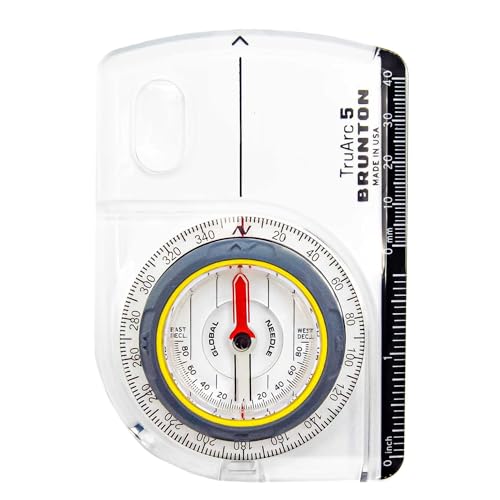
Brunton TruArc 3 Baseplate Compass
The TruArc 3 uses a globally balanced needle, so it works in both hemispheres without the dragging or tilting that afflicts zone specific compasses taken abroad. The baseplate carries multiple map scales and a tool free declination adjustment. It is compact and light enough for a pocket, though it lacks a sighting mirror for very long bearings.
Pros
- Works in either hemisphere without needle drag
- Declination adjusts without a separate key
- Compact and pocketable
Cons
- No sighting mirror
- Smaller baseplate than dedicated map compasses
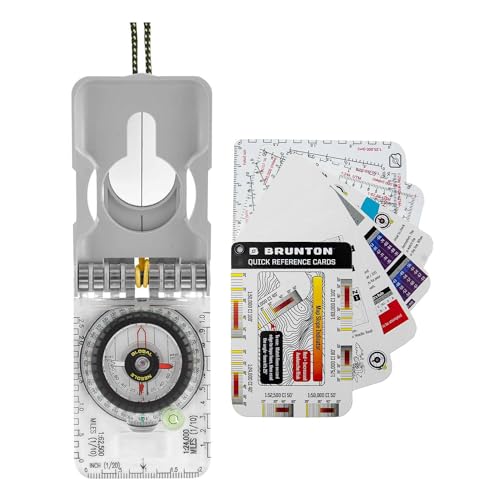
Brunton TruArc 20 Sighting Compass
The TruArc 20 adds a sighting mirror and a globally balanced needle to a full size baseplate, making it a strong choice for repeatable bearings across long distances. Two degree graduations and a clinometer support slope measurement and route planning. Owners report the hinge and mirror need a little protection in a pack, which is true of every mirror compass.
Pros
- Accurate long distance sighting
- Global needle balancing
- Fine graduations for careful bearings
Cons
- Bulkier than pocket baseplate models
- Mirror is the most fragile part in a pack
Silva Starter 1-2-3 Compass
The Starter 1-2-3 is designed for teaching, with the three basic steps of taking a bearing printed straight onto the baseplate. It is very light and cheap enough to hand to a scout group or keep as a spare. Accuracy and features are basic, so treat it as a first compass or a backup rather than a long term primary tool.
Pros
- Instructions printed on the baseplate for learners
- Extremely light and inexpensive
- Perfect as a spare in a group kit
Cons
- Basic accuracy and no adjustable declination
- Plastic construction feels light duty
How they stack up
| # | Model | Type | Best for | Score | Price |
|---|---|---|---|---|---|
| 1 | Suunto MC-2 Mirror Sighting Compass | Mirror sighting baseplate | Best overall | 9.4 | Check price |
| 2 | Silva Ranger 2.0 Compass | Mirror sighting baseplate | Best for map and route work | 9.2 | Check price |
| 3 | Suunto A-10 Recreational Field Compass | Baseplate | Best value | 9.0 | Check price |
| 4 | Cammenga 3H Tritium Lensatic Compass | Lensatic with floating dial | Best for night navigation | 8.8 | Check price |
| 5 | Brunton TruArc 3 Baseplate Compass | Baseplate | Best for global travel | 8.6 | Check price |
| 6 | Brunton TruArc 20 Sighting Compass | Mirror sighting baseplate | Best for surveying style accuracy | 8.3 | Check price |
| 7 | Silva Starter 1-2-3 Compass | Baseplate | Best for beginners | 8.0 | Check price |
Common questions
Do I still need a compass if I carry a phone GPS?
Yes as a backup. A compass needs no battery, works in cold weather and does not fail if a screen cracks or a signal drops. Most experienced navigators carry both and use the map and compass as the fallback.
What is declination and do I have to adjust for it?
Declination is the angle between magnetic north and true north at your location. You must account for it either by setting an adjustable compass once or by adding and subtracting the correction on every reading.
Why does my compass needle stick or tilt?
Usually because it is balanced for a different magnetic zone, or because it has been near a magnet. A globally balanced needle such as the one in the Brunton TruArc 3 solves the zone problem.
Can a compass lose its magnetism?
The needle can be weakened or reversed by strong magnets in phone cases, speakers or magnetic closures. Check the compass against a known direction if you suspect a problem, and store it away from magnetic sources.
Is a bubble in the capsule a problem?
A small bubble that appears in cold or at altitude is normal and usually vanishes at lower elevation and warmer temperature. A large bubble that persists indicates a failed seal and the compass should be replaced.
What is a clinometer used for?
It measures slope angle, which matters for assessing avalanche terrain, estimating grades on a route and matching contour lines on a map to what you see in front of you.
Are lensatic compasses more accurate than baseplate models?
For taking a single precise bearing on a distant object, yes. For plotting on a map, a clear baseplate compass such as the Suunto MC-2 is far more practical, which is why most hikers choose one.
Does tritium illumination need charging?
No. Tritium in the Cammenga 3H glows continuously without any light exposure and lasts for many years. Luminous paint markings on other compasses need to be charged with a light source first.
Our take
The Suunto MC-2 is the compass that handles the widest range of real navigation, combining map plotting, adjustable declination and accurate mirror sighting in one tool. Casual hikers will be perfectly served by the far cheaper Suunto A-10, while anyone who needs dependable bearings in darkness should choose the tritium lit Cammenga 3H.
You might also need
Luggage Scales Compared: Digital vs Manual Hooks

Binoculars Compared: Magnification, Optics and Weight