Compost Bins Compared: Tumblers vs Static Bins
The FCMP Outdoor IM4000 dual chamber tumbler is the best all round composter, letting one side finish while the other fills. The Geobin gives the most volume for the least outlay, and the OXO Good Grips Easy-Clean Compost Bin handles the kitchen scraps side without the smell.
Most households are best served by the FCMP Outdoor IM4000 tumbler, with the Geobin the choice when you have garden volume rather than kitchen scraps and the OXO Good Grips caddy handling the countertop stage that every system needs.
Composting advice gets confusing because tumblers, static bins and worm systems are judged on completely different terms, and manufacturer capacity figures rarely match usable volume. We compared current bins on published specifications, materials and what owners report about turning effort, drainage, rodents and how quickly each one stalls in cold weather.
The shortlist, ranked

FCMP Outdoor IM4000 Tumbling Composter
The IM4000 is the tumbler most people should start with, because two separate chambers let one batch finish undisturbed while you keep adding to the other. Deep internal fins break up clumps as it rotates, which is where single chamber drums often fall down. Owners report finished compost in weeks rather than months when the mix is balanced.
Pros
- Dual chambers allow continuous composting
- Sealed drum keeps rodents out
- Turning takes seconds rather than shovel work
Cons
- Assembly involves a lot of small screws
- Gets heavy to turn when a chamber is full
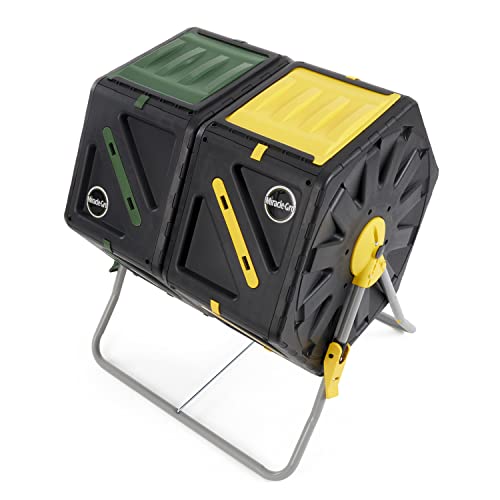
Miracle-Gro Dual Chamber Compost Tumbler
Miracle-Gro’s tumbler keeps the dual chamber approach in a footprint that suits a patio or a narrow side return. The sliding doors are easier to manage one handed than the clip lids on some rivals. Based on specifications it holds slightly less than larger drums, which is a fair trade when space rather than volume is the constraint.
Pros
- Small footprint suits patios
- Sliding doors are easy one handed
- Sturdy powder coated frame
Cons
- Smaller batches than full size drums
- Doors can jam if overfilled
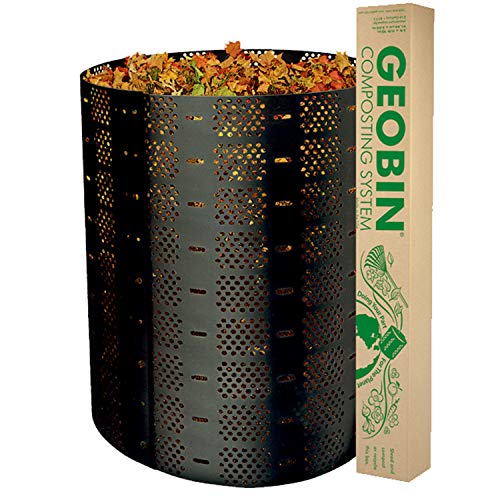
Geobin Compost Bin
The Geobin is a sheet of perforated plastic you roll into a cylinder and clip, and that simplicity is its strength. It handles enormous garden volume for very little outlay and expands or shrinks to whatever diameter suits the pile. Owners report it is the fastest way to deal with autumn leaf fall, though it needs turning with a fork like any static heap.
Pros
- Enormous capacity for the outlay
- Adjustable diameter to suit the pile
- Sets up in minutes with no tools
Cons
- Open base gives rodents access
- Turning requires a fork and effort

VIVOSUN Outdoor Tumbling Composter
VIVOSUN’s dual chamber drum is aimed at gardeners who want a steady rotation of finished compost through the growing season. Adjustable air vents let you dial airflow up as a batch heats or down when it dries out too fast. Owners report the sliding doors seal well enough to keep flies down in warm weather.
Pros
- Adjustable vents give real control
- Large capacity for a tumbler
- Doors seal well against flies
Cons
- Full chambers are heavy to rotate
- Assembly instructions are terse

Envirocycle The Composter
Envirocycle sits its drum on a base that catches the liquid runoff, so you collect compost tea instead of losing it into the lawn. It is also the tidiest looking composter here, which matters if yours lives near a patio rather than behind a shed. Based on specifications capacity is modest, so it suits kitchen scraps more than heavy garden waste.
Pros
- Captures liquid runoff for plant feeding
- Presentable enough for a patio
- Rolls on its base for easy turning
Cons
- Single chamber means batch composting only
- Limited volume for garden waste

Exaco Aerobin 400 Insulated Composter
The Aerobin’s insulated walls and internal aeration core keep a pile working when open bins have gone dormant, which is the main argument for it in a cold region. A lower hatch lets you draw finished material out from the bottom without disturbing the top. Owners report it needs less turning than any other static design here.
Pros
- Keeps working through cold weather
- Very little turning required
- Harvest hatch avoids disturbing the pile
Cons
- Large and not easy to relocate
- Slow to fill for small households

OXO Good Grips Easy-Clean Compost Bin
Every outdoor system needs an indoor collector, and the OXO caddy is the one that solves the two problems that make people give up, smell and cleaning. The lid flips up and stays open while you scrape a board, and the smooth walls rinse clean rather than trapping residue. Owners report it holds a couple of days of scraps for a small household.
Pros
- Genuinely easy to rinse clean
- Lid stays open while you scrape
- Small enough to keep on the counter
Cons
- No carbon filter on the standard model
- Needs emptying every few days
Compared at a glance
| # | Model | Capacity | Best for | Score | Price |
|---|---|---|---|---|---|
| 1 | FCMP Outdoor IM4000 Tumbling Composter | 37 gal total across two chambers | Best overall | 9.4 | Check price |
| 2 | Miracle-Gro Dual Chamber Compost Tumbler | 27.7 gal total | Best for small gardens | 9.2 | Check price |
| 3 | Geobin Compost Bin | Up to 216 gal expanded | Best value | 9.0 | Check price |
| 4 | VIVOSUN Outdoor Tumbling Composter | 43 gal total | Best for fast batches | 8.7 | Check price |
| 5 | Envirocycle The Composter | 35 gal drum | Best for compost tea | 8.5 | Check price |
| 6 | Exaco Aerobin 400 Insulated Composter | 113 gal | Best for cold climates | 8.2 | Check price |
| 7 | OXO Good Grips Easy-Clean Compost Bin | 0.75 gal | Best for kitchen scraps | 8.0 | Check price |
Before you buy
Tumbler or static bin Tumblers win on speed, cleanliness and rodent resistance, because the drum is sealed and turning takes seconds. Static bins win decisively on volume, which matters if you have lawn clippings, hedge trimmings and autumn leaves rather than just kitchen waste. A common setup is a tumbler for food scraps near the door and an open bin further down the garden for bulk material.
Get the green to brown ratio right Nitrogen rich greens like vegetable peelings and grass clippings need carbon rich browns like dry leaves, cardboard and shredded paper to balance them. Roughly two to three parts browns by volume to one part greens is the usual starting point. A slimy, smelly pile is almost always short of browns, while a dry pile that never heats up needs more greens and moisture.
Pests, drainage and placement Rodents are attracted by food waste in bins with an open base, so keep cooked food, meat and dairy out of static piles entirely. Sealed tumblers tolerate a wider range of inputs. Place any bin on level ground with some sun, since warmth speeds decomposition, and leave room to open doors fully and get a wheelbarrow alongside.
What slows composting down The three usual culprits are pieces that are too large, a pile that is too dry and a pile that is too small to hold heat. Chopping material before it goes in makes a bigger difference than most people expect. In cold months everything slows regardless, so either accept a winter pause, insulate the bin, or keep filling and let it restart in spring.
Questions worth asking
How long does compost take?
A well balanced tumbler batch that is turned regularly can finish in around six to eight weeks in warm weather. A static open bin usually takes several months to a year depending on how often it is turned and how finely material was chopped.
Can I compost cooked food and meat?
Not in an open static bin, where they attract rodents and create odour. Sealed tumblers handle small amounts better, but most guidance still recommends keeping meat, dairy and oily food out. Bokashi systems are the usual answer if you need to process them.
Why does my compost smell bad?
A sour or ammonia smell almost always means too much wet green material and not enough air. Add shredded cardboard or dry leaves, turn the pile to introduce oxygen, and the smell usually clears within a few days.
Do compost bins work in winter?
Activity slows sharply below about forty degrees Fahrenheit and may stop entirely. Insulated bins keep working longer, and larger piles retain heat better than small ones. You can keep adding material through winter and let the pile restart as temperatures rise.
How big a compost bin do I need?
For kitchen scraps from a small household, a tumbler in the thirty to forty gallon range is ample. If you are composting lawn clippings and leaves, you need something in the hundreds of gallons or you will fill it in a single autumn.
Do I need a compost starter or activator?
Usually not. A handful of finished compost or garden soil introduces the same microbes. Activators can help a stalled pile restart, but correcting the moisture and green to brown balance solves the problem more reliably.
Can I put a compost bin on a hard surface?
Tumblers are designed for it since they sit on a frame. Open bottomed static bins work better on soil because worms and soil organisms can move in, but they will still compost on paving if you seed them with a layer of garden soil.
How do I know when compost is ready?
Finished compost is dark, crumbly and smells earthy rather than of the ingredients that went in. You should not be able to identify what the material used to be, apart from the occasional stubborn twig or eggshell fragment.
Our pick
The FCMP Outdoor IM4000 is the composter that suits the most households, turning kitchen and garden waste around quickly while keeping rodents out. If your problem is bulk garden waste rather than speed, spend far less on a Geobin and let time do the work. Pair either with the OXO caddy indoors, since the kitchen stage is where most composting habits succeed or fail.


