Stainless Steel vs Nonstick: Choosing a Cookware Set
Cuisinart MCP-12N MultiClad Pro delivers fully clad stainless construction at a mid-range price. All-Clad D3 suits cooks who want decades of use from heavier-gauge metal. T-fal Ultimate Hard Anodized covers nonstick needs at a low cost per pan. Ceramic and specialty sets fill narrower roles.
Cuisinart MCP-12N MultiClad Pro is the set most kitchens should buy first. All-Clad D3 earns its higher price if you cook daily and want the set to outlast the kitchen itself. T-fal Ultimate Hard Anodized handles eggs and low-fat cooking at a fraction of the cost.
Piece counts inflate easily with lids and plastic utensils, making sets look bigger than their real pan count. Coating chemistry decides how long a nonstick pan lasts, often just a few years regardless of brand. We compared cladding construction, cooktop and oven compatibility, actual pan counts, handle design and the wear patterns owners report after sustained use.
The best picks, ranked

Cuisinart MCP-12N MultiClad Pro Stainless Steel 12-Piece Cookware Set
Fully clad tri-ply construction runs an aluminum core through the base and up the sides, spreading heat evenly instead of stopping at a disc bottom. That build usually costs more than this set charges. Handles stay cool on the stovetop, and every piece is oven safe to 550 degrees Fahrenheit.
Pros
- Full cladding at a mid-range price
- Works on gas, electric, ceramic and induction
- Cool-touch riveted handles
Cons
- Needs proper preheating to avoid sticking
- Angular handle shape suits some hands less

All-Clad D3 Stainless Steel 10-Piece Cookware Set
All-Clad D3 uses the same tri-ply principle with tighter manufacturing tolerances and thicker-gauge metal. Heat spreads more evenly across the pan base than budget-tier cladding manages. Cost only makes sense for cooks who use the set daily and plan to keep it for decades.
Pros
- Exceptional heat evenness across the base
- Built for decades of daily use
- Rated oven safe to 600 degrees
Cons
- Highest price among these seven sets
- Handles heat up inside the oven
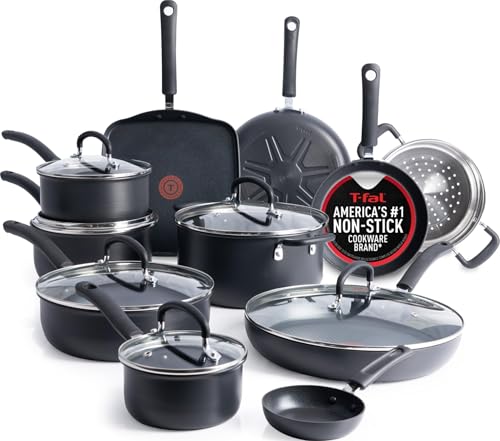
T-fal Ultimate Hard Anodized Nonstick 17-Piece Cookware Set
T-fal packs a large hard-anodized nonstick set into a price many brands charge for three pans. A built-in heat indicator signals when the pan reaches cooking temperature. Nonstick coatings wear out over time, so treat this set as a multi-year purchase rather than a lifetime one.
Pros
- Large piece count for the price
- Heat indicator signals cooking temperature
- Strong release for eggs and pancakes
Cons
- Not compatible with induction cooktops
- Coating wears down eventually

Tramontina Tri-Ply Clad 12-Piece Cookware Set
Tramontina brings genuine tri-ply cladding to a price close to disc-bottom sets. That combination explains why it shows up across so many recommendation lists. Handle refinement and finish trail Cuisinart and All-Clad, but cooking performance per dollar is hard to match.
Pros
- Real tri-ply cladding at a budget price
- Induction-ready construction
- Rated oven safe to 500 degrees
Cons
- Handles feel less refined than rivals
- Finish shows marks more easily

GreenPan Valencia Pro Ceramic Nonstick 11-Piece Cookware Set
GreenPan coats a hard-anodized body with a ceramic-based nonstick made without PFAS, PFOA, lead or cadmium. Induction compatibility and a 600-degree oven rating stand out among nonstick sets. Ceramic coatings lose their release properties sooner than traditional nonstick, especially under high heat.
Pros
- Coating made without PFAS or PFOA
- Works on induction cooktops
- High oven-safe rating for a nonstick set
Cons
- Release fades faster than traditional nonstick
- Needs low to medium heat to preserve coating
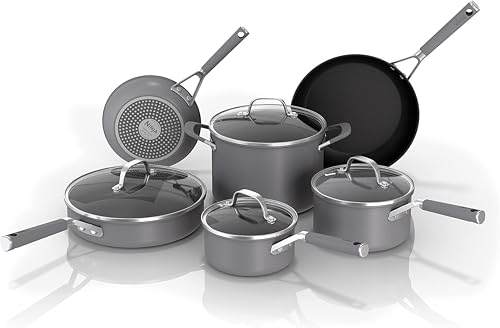
Ninja Foodi NeverStick Premium 10-Piece Cookware Set
Ninja bonds its nonstick coating at high temperature instead of spraying it on, targeting the usual complaint that nonstick fails within a year. Solid handles and induction compatibility come standard. Heavier gauge metal adds weight that makes a full pan tiring to lift one-handed.
Pros
- Bonded coating outlasts typical nonstick
- Compatible with induction cooktops
- Solid, heavy-gauge construction
Cons
- Heavier than comparable nonstick sets
- Priced above budget nonstick options

Caraway Ceramic Nonstick Cookware Set
Caraway pairs ceramic nonstick pans with matched lid and pan storage racks, solving real clutter in a kitchen with open shelving. Pans heat quickly and clean easily at low to medium heat. High heat shortens ceramic coating life considerably, as with any ceramic nonstick.
Pros
- Storage racks solve a real shelving problem
- Easy cleanup at moderate heat
- Displays well on open shelving
Cons
- Only four pans included
- Coating life sensitive to high heat
Compared at a glance
| # | Model | Construction | Best for | Score | Price |
|---|---|---|---|---|---|
| 1 | Cuisinart MCP-12N MultiClad Pro Stainless Steel 12-Piece Cookware Set | Fully clad tri ply stainless | Best overall | 9.4 | Check price |
| 2 | All-Clad D3 Stainless Steel 10-Piece Cookware Set | Bonded tri ply stainless | Best long term investment | 9.2 | Check price |
| 3 | T-fal Ultimate Hard Anodized Nonstick 17-Piece Cookware Set | Hard anodised aluminium, nonstick | Best nonstick value | 9.0 | Check price |
| 4 | Tramontina Tri-Ply Clad 12-Piece Cookware Set | Fully clad tri ply stainless | Best budget stainless | 8.8 | Check price |
| 5 | GreenPan Valencia Pro Ceramic Nonstick 11-Piece Cookware Set | Hard anodised body, ceramic nonstick | Best ceramic nonstick | 8.6 | Check price |
| 6 | Ninja Foodi NeverStick Premium 10-Piece Cookware Set | Hard anodised with bonded nonstick | Best durable nonstick | 8.3 | Check price |
| 7 | Caraway Ceramic Nonstick Cookware Set | Aluminium core with ceramic nonstick | Best for open kitchens | 8.0 | Check price |
How to choose
Which material fits how you actually cook? Stainless steel browns food, tolerates metal utensils and reaches high oven temperatures, but needs correct preheating to avoid sticking. Nonstick handles eggs, fish and low-fat cooking with ease, and needs replacing every few years. Ceramic nonstick offers similar release through different coating chemistry, often made without PFAS, at the cost of a shorter lifespan. Most kitchens end up with a stainless set plus one or two nonstick pans rather than committing fully to one material.
What does fully clad construction mean? Cladding sandwiches an aluminum or copper core through the pan base and up the sides. Heat spreads evenly instead of concentrating on the base, which prevents scorched edges when reducing sauces. A disc-bottom pan only bonds a heat-spreading plate to the base, fine for boiling water but uneven for anything reduced. Listings that say tri-ply or fully clad describe the construction worth paying for.
How many pans do you actually need? A seventeen-piece set can mean seven pans, four lids and six plastic utensils. Checking the actual pan list against real cooking habits matters more than the total count. Most households need a small and large saucepan, a large skillet, a lidded saute pan and a stockpot. Extra pieces beyond that just take up cupboard space.
Which cookware works on induction cooktops? Induction cooktops need a magnetic pan base, so plain aluminum and some anodized cookware will not heat at all. Holding a magnet against the base confirms compatibility when a listing is unclear. Oven-safe temperature limits usually come from the handles and lids, not the pan body. Nonstick and ceramic coatings last longest with low to medium heat, no metal utensils and hand washing instead of a dishwasher cycle.
Frequently asked questions
Is stainless steel or nonstick cookware better?
They serve different jobs. Stainless browns food properly and lasts for decades, while nonstick handles eggs and low-fat cooking more easily but wears out within a few years.
What does fully clad mean on a cookware set?
It means the heat-conducting core runs through the pan base and up the sides, not just across the bottom. That gives more even heating and stops scorching at the edges.
How many pieces of cookware do you actually need?
Most households cover every meal with a small and large saucepan, a large skillet, a lidded saute pan and a stockpot. Anything beyond that tends to sit unused.
Will this cookware work on an induction cooktop?
Only if the base is magnetic. Press a magnet against the bottom of the pan; a firm grip confirms it will heat on an induction cooktop.
How long does nonstick coating actually last?
Typically a few years with careful use, and less with high heat, metal utensils or dishwasher cycles. Nonstick pans are consumables, not heirlooms.
Is ceramic nonstick safer than traditional nonstick?
GreenPan and Caraway make their ceramic coatings without PFAS, PFOA, lead or cadmium, which is why many buyers choose them. The trade off is a shorter coating lifespan, especially under high heat.
Can cookware go in the dishwasher?
Stainless generally survives dishwasher cycles, though the finish dulls over time. Coated pans should be hand washed even when the manufacturer allows a dishwasher, since detergent wears coatings faster.
Why does food stick to a stainless steel pan?
Usually because the pan was not hot enough before food went in, or the food was moved too soon. Preheat the pan, add fat, then let proteins release naturally.
Cookware set vs buying pans individually: which is better?
A set covers common sizes at a lower combined cost, while buying individually lets you mix materials, such as stainless for sauces and nonstick for eggs.
What is the best cookware set for a small kitchen?
Caraway’s four-pan set with matched storage racks suits small kitchens and open shelving, trading piece count for a smaller footprint.
The bottom line
Cuisinart MCP-12N MultiClad Pro remains the set to recommend for most kitchens, since fully clad construction at this price covers everything short of eggs. All-Clad D3 suits cooks who plan to keep their cookware for decades. Whichever stainless set you pick, add one nonstick or ceramic pan rather than expecting one material to do every job.