Compact vs Whole Room: Comparing Top Dehumidifiers
The Midea Cube 50 Pint wins overall with an expandable tank and quiet operation. The Frigidaire FFAD5033W1 is the dependable value pick for basements, and the Pro Breeze Mini suits closets and small rooms where a compressor unit is overkill.
For a damp basement, the Midea Cube 50 Pint stands out because its expandable reservoir means far fewer trips to empty it. The Frigidaire FFAD5033W1 is the dependable value choice, and the Pro Breeze Mini fits a wardrobe or small bathroom better than a full compressor unit.
Dehumidifier shopping gets confusing because pint ratings were redefined under newer test conditions, so a modern 50 pint unit does roughly what an older 70 pint one did. Coverage claims also assume conditions most basements don’t have. We ranked these seven on published extraction figures, drainage design and what owners report about coil frosting and real world noise.
How to choose
Why don’t pint ratings mean what they used to? Testing standards for dehumidifiers were revised, and units now get rated at a lower test temperature than before. In practice, a modern 50 pint model does roughly what an older 70 pint model claimed. Don’t assume a smaller number on a new unit means less real capacity than an older one.
How do you size a dehumidifier for a damp room? Coverage figures on the box assume moderate humidity. A basement that smells musty, shows condensation on the walls or has visible damp patches needs far more capacity per square foot than a slightly humid living room. Undersizing is the most common mistake, and it shows up as a unit that runs constantly without hitting its target reading.
Which drainage option should you pick? A bucket that fills every few hours in a damp basement quickly turns into a chore people stop doing. A gravity hose to a floor drain solves that, provided a drain sits lower than the unit. If the only outlet is a sink or a window above the machine, a model with an internal pump becomes necessary, since gravity alone won’t lift water uphill.
Do cold rooms need a different type of dehumidifier? Compressor dehumidifiers condense moisture on cold coils, and in a cool basement those coils can frost over and stall extraction. Models rated for low temperature operation include an automatic defrost cycle that clears ice periodically. In genuinely cold spaces like unheated garages, desiccant dehumidifiers keep working where compressors give up.
The shortlist, ranked

Midea Cube 50 Pint Dehumidifier
A reservoir that expands from a standard bucket into a much larger tank cuts emptying trips dramatically in a damp basement. It runs quietly for its class, connects to an app for humidity scheduling, and supports continuous drain through a hose or the built in pump on that model.
Pros
- Expandable tank means far fewer emptying trips
- Quieter than most compressor units of this size
- App control adds humidity scheduling
Cons
- Bulky footprint once the tank expands
- Pump version costs noticeably more

Frigidaire FFAD5033W1 Dehumidifier
Straightforward controls, an effective humidistat and a continuous drain port make this 50 pint unit the workhorse choice. A competent automatic defrost cycle helps it handle cold basements better than many rivals.
Pros
- Reliable defrost cycle for cooler basements
- Simple controls that are easy to set and forget
- Auto restart after a power cut
Cons
- Noisier than premium quiet models
- No built in pump on the standard version

hOmeLabs 4,500 Sq Ft Energy Star Dehumidifier
A generous bucket, a turbo mode for faster moisture removal and a 24 hour timer come paired with a rating for very large areas. Wheels and side handles make it far easier to move between floors than its weight suggests.
Pros
- Large coverage rating for open basements
- Turbo mode speeds up initial drying
- Wheels and handles make it genuinely portable
Cons
- Turbo mode runs noticeably louder
- Bucket gets heavy when full
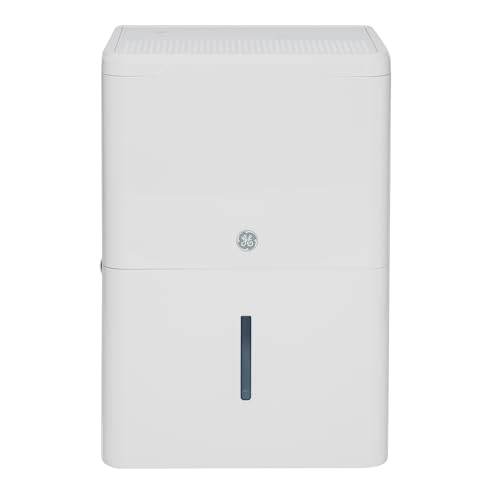
GE APER50LZ Dehumidifier
Low temperature operation is the design focus here, so extraction continues in cooler basements where cheaper compressors frost up and stall. Clear controls, a washable filter and a continuous drain option round out the feature set.
Pros
- Keeps working in cooler basement temperatures
- Washable filter avoids consumable costs
- Straightforward controls and a clear display
Cons
- No integrated pump for uphill drainage
- Middle of the pack on noise

Waykar 2000 Sq Ft Dehumidifier
A drain hose ships in the box, and continuous operation is the default rather than an afterthought, which suits a crawl space or utility room you rarely visit. Settings survive a power interruption, and a sleep mode covers bedrooms.
Pros
- Drain hose included rather than sold separately
- Remembers settings after power interruptions
- Quiet sleep mode for occupied rooms
Cons
- Gravity drain needs an outlet lower than the unit
- Coverage claim assumes fairly mild conditions

Pro Breeze Mini Dehumidifier
A thermoelectric design rather than a compressor keeps this unit small, near silent, and limited to modest moisture removal. That fits a wardrobe, a caravan or a small bathroom, and rules it out for a genuinely damp basement.
Pros
- Near silent and light enough to move anywhere
- Low power draw for continuous running
- Auto shut off prevents overflow
Cons
- Extraction rate is a fraction of compressor units
- Ineffective in cool or genuinely damp spaces

Eva-Dry E-333 Renewable Dehumidifier
Silica gel crystals absorb moisture instead of electricity, and an indicator changes color when it’s time to plug the unit in and dry the crystals back out. Gun safes, wardrobes and boats suit this better than open rooms.
Pros
- Needs no power or drainage while working
- Reusable for years with no consumables
- Fits inside safes, wardrobes and lockers
Cons
- Tiny capacity suited only to enclosed spaces
- Needs recharging every few weeks
The lineup, side by side
| # | Model | Capacity | Best for | Score | Price |
|---|---|---|---|---|---|
| 1 | Midea Cube 50 Pint Dehumidifier | 50 pints per day | Best overall | 9.4 | Check price |
| 2 | Frigidaire FFAD5033W1 Dehumidifier | 50 pints per day | Best value | 9.2 | Check price |
| 3 | hOmeLabs 4,500 Sq Ft Energy Star Dehumidifier | Rated up to 4500 square feet | Best for large spaces | 9.0 | Check price |
| 4 | GE APER50LZ Dehumidifier | 50 pints per day | Best for cold basements | 8.8 | Check price |
| 5 | Waykar 2000 Sq Ft Dehumidifier | Rated up to 2000 square feet | Best for continuous drainage | 8.6 | Check price |
| 6 | Pro Breeze Mini Dehumidifier | Thermoelectric Peltier | Best for small rooms | 8.3 | Check price |
| 7 | Eva-Dry E-333 Renewable Dehumidifier | Renewable silica gel | Best for closets and safes | 8.0 | Check price |
Frequently asked questions
What size dehumidifier do I need for a basement?
A 50 pint unit under current ratings suits most basements up to around 1500 square feet. Very damp basements with visible moisture need more capacity than floor area alone suggests, so size up if unsure.
What humidity level should I set a dehumidifier to?
Between 45 and 50 percent relative humidity is the usual target. That discourages mould and dust mites without making a room uncomfortable, and lower settings just make the unit work harder for little benefit.
Why does my dehumidifier ice up?
Compressor units condense moisture on cold coils, which can frost over in a cool room. Models with an automatic defrost cycle clear it themselves. Below roughly 15 degrees Celsius with no defrost function, a desiccant model fits better.
Do I need a dehumidifier with a built in pump?
Only if the drain point sits higher than the unit, such as a sink or window. Gravity drainage works fine with a floor drain below the machine, and it’s one less component that can fail.
How much electricity does a dehumidifier use?
Compressor models in the 50 pint class typically draw a few hundred watts while running. Energy Star certified units use less for the same extraction, which adds up over a damp season of near daily running.
Can a dehumidifier run continuously?
Yes, and many people run one continuously with a hose connected. A humidistat cycles the compressor off once the target is reached, which uses less energy than running flat out and avoids over-drying the room.
Will a dehumidifier help with mould?
Keeping relative humidity below about 50 percent removes the conditions mould needs to spread, making it an effective preventive step. Existing mould still needs cleaning, and the underlying leak or drainage issue needs fixing separately.
How often should I clean a dehumidifier filter?
Check it monthly during heavy use. Most units use a washable mesh filter that rinses clean in a couple of minutes, and a clogged filter cuts airflow, which reduces extraction and strains the machine.
The verdict
The Midea Cube 50 Pint belongs in a damp basement, since its expandable tank solves the emptying problem that makes people give up on dehumidifiers. The Frigidaire FFAD5033W1 handles the same core job for less with a dependable defrost cycle. The Pro Breeze Mini is the sensible pick for a wardrobe or small bathroom where a compressor would be wasted.