Upgrade Your Workspace: Top Desk Speakers Compared
For most people, the Audioengine A2+ Wireless is the top choice due to its rich, detailed sound and versatile connectivity, but its small size means limited deep bass.
A good pair of desk speakers can transform your daily computer use, making music, videos, and calls more enjoyable. The right set should deliver clear highs, present mids, and enough bass to feel engaging without taking over your desk.
We compared several top-rated models, focusing on sound quality, connectivity options, and form factor. Whether you need compact speakers for a small desk or powerful monitors for critical listening, this guide covers the best options available.
What we recommend

Audioengine A2+ Wireless
The Audioengine A2+ Wireless delivers a surprisingly big sound for their small footprint. They offer a balanced frequency response with clear vocals and crisp highs, suitable for music, movies, and gaming. The built-in DAC and aptX Bluetooth support ensure high-quality wireless streaming, while multiple wired inputs provide flexibility.
Pros
- Excellent clarity and detail
- Compact size fits any desk
- Multiple connectivity options
Cons
- Limited deep bass extension
- Price is higher than some competitors
Edifier R1280T
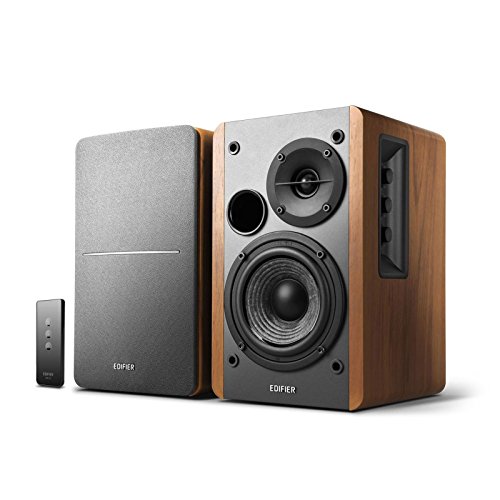
The Edifier R1280T is a classic choice for budget-conscious buyers. It provides a warm, full sound with decent bass for its price. The wooden build reduces resonance and adds a touch of class. With RCA and auxiliary inputs, it is easy to connect to computers, TVs, and other devices.
Pros
- Great sound for the price
- Classic wood finish
- Easy setup
Cons
- No Bluetooth
- Bass can be boomy at high volumes

PreSonus Eris E3.5
Designed for near-field monitoring, the PreSonus Eris E3.5 offers a flat frequency response that many audio professionals trust. They reveal details in recordings that consumer speakers often mask. The acoustic tuning controls allow you to adjust the sound to your room, and the front panel headphone jack is convenient.
Pros
- Accurate, uncolored sound
- Tuning controls for room correction
- Compact design
Cons
- Not ideal for casual listening
- No Bluetooth

Creative Pebble Pro
The Creative Pebble Pro is a tiny speaker set that delivers surprisingly good audio for its size. It features a USB-C connection with a built-in DAC and Bluetooth, making it easy to connect to modern devices. The downward-firing drivers and passive radiators produce more bass than expected, and the spherical design looks neat on any desk.
Pros
- Very compact and lightweight
- Good bass for size
- USB-C and Bluetooth
Cons
- Sound quality is limited at high volumes
- No volume knob on each speaker

Razer Nommo V2
The Razer Nommo V2 is a 2.1 speaker system with a dedicated subwoofer, designed for immersive gaming. The THX Spatial Audio and RGB lighting enhance the gaming experience. The two satellite speakers deliver clear dialogue and effects, while the wireless subwoofer adds deep, room-shaking bass.
Pros
- Powerful bass with subwoofer
- THX Spatial Audio for gaming
- Wireless subwoofer reduces cable clutter
Cons
- Large footprint, especially with subwoofer
- RGB lighting may not suit all setups

Sony SRS-XB43
While technically a portable Bluetooth speaker, the Sony SRS-XB43 can serve as a desk speaker if you want something versatile. It offers extra bass with its X-Balanced speaker units and passive radiators. The speaker is durable with an IP67 rating, making it resistant to dust and water. It also has a long battery life and can be used while charging.
Pros
- Portable and durable
- Powerful sound with extra bass
- Battery operation
Cons
- Not a traditional desk speaker
- Sound may be less detailed than dedicated desk speakers

KEF LSX II
The KEF LSX II is a premium wireless speaker system that offers exceptional audio quality and streaming capabilities. It uses KEF’s Uni-Q driver array for a wide soundstage and accurate imaging. The speakers support AirPlay 2, Chromecast, Bluetooth, and wired connections, and they can handle high-resolution audio up to 24-bit/192kHz. The built-in room correction and multiple EQ presets allow for fine-tuning.
Pros
- Superb sound quality and detail
- Wide range of connectivity options
- High-resolution audio support
Cons
- Very expensive
- May require additional app for setup
Before you buy
How they stack up
| # | Model | Type | Best for | Score | Price |
|---|---|---|---|---|---|
| 1 | Audioengine A2+ Wireless | Powered bookshelf | Best Overall for Desktop Sound | 9.4 | Check price |
| 2 | Edifier R1280T | Powered bookshelf | Best Value for Money | 9.1 | Check price |
| 3 | PreSonus Eris E3.5 | Powered studio monitor | Best for Accurate Sound | 9.0 | Check price |
| 4 | Creative Pebble Pro | Powered desktop | Best Compact and Affordable | 8.6 | Check price |
| 5 | Razer Nommo V2 | 2.1 powered speaker system | Best for Gaming | 8.8 | Check price |
| 6 | Sony SRS-XB43 | Portable Bluetooth speaker | Best Portable Option | 8.4 | Check price |
| 7 | KEF LSX II | Powered wireless speakers | Best High-End Wireless | 9.2 | Check price |
Frequently asked questions
Do I need a subwoofer for desk speakers?
Not always. Many compact speakers have sufficient bass for everyday listening. A subwoofer adds deep bass that can enhance movies and music, but it also takes up space and increases cost. If you enjoy bass-heavy genres, consider a 2.1 system like the Razer Nommo V2.
Can I use Bluetooth speakers as desk speakers?
Yes, many Bluetooth speakers can work well on a desk. They offer convenience and portability. However, they may have higher latency and lower audio quality compared to wired speakers. Look for models with aptX or AAC codecs for better wireless performance.
What is the ideal size for desk speakers?
The ideal size depends on your desk. For a typical desk, speakers with 3 to 5 inch drivers are common. Larger drivers produce more bass and volume but may not fit. Measure your space and ensure there is room for proper placement without blocking your monitor.
Do I need an amplifier for powered speakers?
No, powered speakers have a built-in amplifier, so they can be connected directly to your computer or phone. Passive speakers require a separate amplifier, but they are less common for desktop use.
Are studio monitors good for casual listening?
Studio monitors are designed for accuracy, which can sound less flattering than consumer speakers. If you want to hear the music as the artist intended, they are great. For casual listening, some may find them too revealing. It depends on your preference.
How do I connect my desk speakers to my computer?
Most desk speakers offer multiple connection methods. You can use a USB cable, a 3.5mm audio cable, or Bluetooth. Simply plug in the cable or pair via Bluetooth, then select the speakers as your output device in the computer’s settings.
What is the difference between 2.0 and 2.1 speakers?
2.0 speakers consist of two speakers that produce the full range of sound. 2.1 systems add a subwoofer to handle low frequencies, allowing the main speakers to focus on mids and highs. This can result in deeper bass and better overall clarity.
Can I use desk speakers for gaming?
Yes, many desk speakers are suitable for gaming. Look for models with a 3.5mm input or USB connection. For immersive gaming, consider speakers with surround sound simulation or a subwoofer for impact.
Final word
After comparing these seven desk speakers, the Audioengine A2+ Wireless stands out as the best all-rounder for most users, offering a perfect balance of sound quality, size, and features. If you are on a tight budget, the Edifier R1280T provides remarkable value. For audiophiles seeking the highest fidelity, the KEF LSX II is worth the investment, but only if you prioritize sound above all else.