How to Choose a Desktop Computer That Fits Your Budget
Apple’s Mac Mini with M4 leads for near silent performance in a tiny chassis, ideal for work and study. Dell’s XPS 8960 offers the widest upgrade path for Windows users. Gamers get the fastest start from the CyberPowerPC Gamer Xtreme VR, which ships ready with discrete graphics installed.
Apple’s Mac Mini with M4 tops this ranking for silent, compact performance. Dell’s XPS 8960 and the CyberPowerPC Gamer Xtreme VR follow for upgradable Windows work and gaming. Office tasks, study, creative work and gaming all get covered across these seven picks, all currently sold on Amazon.
Two desktops sharing a processor name can perform very differently once graphics, cooling and upgrade room enter the picture. We compared published specifications, chassis layouts and expansion room, then weighed owner reports on fan noise, thermal behavior and how easily each case opens.
What we recommend

Apple Mac Mini with M4
Desktop class performance comes from a chassis small enough to disappear behind a monitor. Writing, coding, photo work and everyday video editing all run faster here than on far larger Windows towers. Memory and storage stay fixed at purchase though, so specify carefully on day one.
Pros
- High performance per watt
- Stays near silent under normal load
- Takes almost no desk space
Cons
- Memory and storage can’t be upgraded later
- Limited support for Windows only software

Dell XPS 8960 Desktop
A standard power supply, accessible drive bays and a full length graphics slot make this tower upgradable rather than disposable. Configurations range from mainstream office builds to serious creative rigs. Owners report quieter cooling than most prebuilt towers at similar performance levels.
Pros
- Real upgrade path for memory, storage and graphics
- Quieter cooling than most prebuilt towers
- Wide range of configurations available
Cons
- Takes real desk or floor space
- Some builds use a proprietary power supply layout
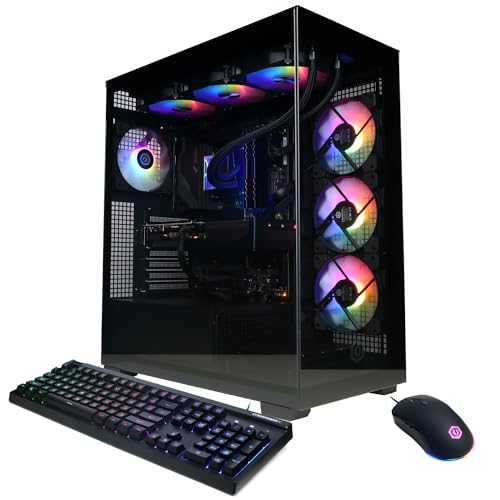
CyberPowerPC Gamer Xtreme VR Gaming PC
Discrete graphics and a gaming oriented processor arrive preinstalled, ready for modern titles out of the box. Front airflow keeps components cool under load. Build quality stays functional rather than premium, and cable management is basic, but assembly is done for you.
Pros
- Discrete graphics card included
- Standard parts simplify future upgrades
- Arrives configured and ready to use
Cons
- Fans get audible under gaming load
- Bundled keyboard and mouse are basic

HP Envy Desktop TE02
Photo and video work benefit more here than gaming does, thanks to generous memory options and quiet cooling. Front USB C and a card reader speed up offloading from cameras and drives. Graphics stay modest, since that isn’t the point of this build.
Pros
- Stays quiet under sustained workloads
- Convenient front port selection
- Compact footprint for a mid tower
Cons
- Entry graphics options limit gaming
- Interior stays tight for larger upgrade cards

Lenovo IdeaCentre 5 Desktop
Browsing, documents, video calls and light photo editing define this small tower’s job. It runs quieter and smaller than a gaming case while still allowing memory and storage upgrades. Nobody buys it for graphics performance, and that fits its intended use fine.
Pros
- Small footprint for a serviceable tower
- Memory and storage stay upgradable
- Runs quiet in normal office use
Cons
- Integrated graphics only on most configurations
- Limited expansion slots

Acer Aspire TC-1780 Desktop
Essentials come first here: a current generation processor, an SSD and enough memory for browsing, office work and streaming. The plain case matches the plain mission. Owners report it opens easily for adding memory or a second drive.
Pros
- Strong specification for the price bracket
- Simple to open for memory and storage upgrades
- Compact, conventional tower shape
Cons
- Integrated graphics only
- Basic power supply limits graphics card upgrades

Skytech Shadow Gaming PC
Multiple fans behind a mesh front panel help a discrete graphics card hold its clocks during long sessions. Specifications land at the entry to mid gaming range depending on configuration. Standard components throughout make swapping the graphics card or adding storage straightforward later.
Pros
- Strong airflow for sustained gaming
- Standard parts throughout ease upgrades
- Discrete graphics at an accessible level
Cons
- Multiple fans make it the loudest option here
- RGB lighting won’t suit every taste
Side by side
| # | Model | Processor | Best for | Score | Price |
|---|---|---|---|---|---|
| 1 | Apple Mac Mini with M4 | Apple M4 | Best overall | 9.4 | Check price |
| 2 | Dell XPS 8960 Desktop | Intel Core i7 class options | Best for upgrades | 9.2 | Check price |
| 3 | CyberPowerPC Gamer Xtreme VR Gaming PC | Intel Core gaming class | Best value for gaming | 9.0 | Check price |
| 4 | HP Envy Desktop TE02 | Intel Core i7 options | Best for creative work | 8.8 | Check price |
| 5 | Lenovo IdeaCentre 5 Desktop | Intel Core or AMD Ryzen options | Best for home office | 8.6 | Check price |
| 6 | Acer Aspire TC-1780 Desktop | Intel Core i5 class | Best budget | 8.3 | Check price |
| 7 | Skytech Shadow Gaming PC | AMD Ryzen or Intel Core options | Best for first time gamers | 8.0 | Check price |
What matters most
What desktop specs actually matter for your work? Office work, browsing and video calls need only a current processor, 16 GB of memory and an SSD. Photo and video editing rewards extra memory and faster storage. Gaming is the one common use where the graphics card outweighs every other purchase. Buying a gaming tower for spreadsheets mostly buys fan noise.
Where do prebuilt desktops cut corners? An attractive headline spec often hides 8 GB of memory or a small SSD. Sixteen gigabytes is the sensible baseline now, and 512 GB of SSD storage is the point below which space runs out constantly. Towers let you upgrade these parts cheaply yourself. A Mac Mini fixes them forever at purchase, which changes the calculation.
Can you upgrade a prebuilt desktop later? A standard power supply, a free full length slot and spare drive bays keep a tower improvable for years. Compact and proprietary designs often limit you to memory and one drive. Check tool free panels, how many memory slots sit occupied already, and whether the power supply has headroom for a future graphics card.
How much noise and desk space should you expect? A mesh fronted gaming case with several fans gets audible in a quiet room, which matters if the machine sits in a bedroom or shared office. A Mac Mini or a well cooled mid tower stays far calmer. Decide whether the machine lives on the desk, under it, or behind the monitor before choosing a case size.
Questions worth asking
Is a desktop still better value than a laptop?
For the same money a desktop generally offers more performance, better cooling, quieter operation and easier upgrades. A laptop wins only on portability. If the machine will sit in one place, a desktop plus a good monitor is usually the stronger purchase.
How much memory does a desktop computer need?
Sixteen gigabytes is the sensible baseline for general use and light creative work. Thirty two gigabytes helps with video editing, large photo libraries or heavy multitasking. Eight gigabytes works for basic browsing but leaves no headroom.
Do you need a discrete graphics card?
Only for gaming, three dimensional work or GPU accelerated video rendering. Modern integrated graphics handle multiple monitors, video playback and everyday photo editing perfectly well. Adding a discrete card to an office machine mostly adds heat and noise.
Can you upgrade a prebuilt desktop?
Usually yes for memory and storage, and often for graphics on full size towers such as the Dell XPS 8960. Watch the power supply capacity, the physical clearance inside the case and whether the motherboard uses standard mounting.
Mac Mini vs Windows tower: which is better?
Choose the Mac Mini for quiet, compact performance if your software runs on macOS. Choose a Windows tower for gaming, specific Windows only applications, or a memory, storage and graphics setup you plan to upgrade over time.
How long should a desktop computer last?
Five to eight years is realistic for general use, longer if you add memory and storage along the way. Gaming machines feel dated sooner as requirements rise, but swapping just the graphics card is far cheaper than replacing the system.
Do desktop computers come with a monitor, keyboard and mouse?
Rarely with a monitor. Gaming prebuilts often bundle a basic keyboard and mouse, and business towers sometimes include them too. Read the listing carefully and budget for a monitor separately.
SSD or hard drive: which do you need?
The system drive should always be an SSD, since the responsiveness gap dwarfs any processor upgrade at this level. A traditional hard drive still earns its keep as a secondary drive for large media archives.
What’s the best desktop for a first gaming PC?
The Skytech Shadow Gaming PC, since its mesh airflow case and standard parts make it easy to hold performance now and swap the graphics card later without rebuilding the whole machine.
The bottom line
Apple’s Mac Mini with M4 belongs on most desks, since it runs fast, tiny and quiet once you specify enough memory upfront. Windows users planning to upgrade rather than replace should look at the Dell XPS 8960 instead. For the shortest path into desktop gaming, the CyberPowerPC Gamer Xtreme VR skips the build process entirely. Settle graphics and upgrade room first, and the rest of the spec sheet follows.