Top Desktop Scanners for Documents and Photos
For most households, the Epson WorkForce ES-400 is the best desktop scanner due to its blazing speed, automatic document feeder, and reliable software. It handles both documents and photos, but it is not ideal for fragile or oversized items. The Fujitsu ScanSnap iX1600 offers similar performance with a touchscreen, while the Canon CanoScan LiDE400 is a budget-friendly flatbed for occasional use. If you need to digitize photos, the Epson Perfection V600 is a top choice.
Desktop scanners have become essential for digitizing paperwork, preserving old photos, and reducing clutter. With so many models on the market, choosing the right one can be overwhelming. This roundup compares the best options based on real-world user experiences and technical specifications.
Whether you need a fast document feeder for a home office or a high-resolution flatbed for photo scanning, there is a scanner that fits your needs. We analyzed speed, image quality, software, and value to help you make an informed decision.
What matters most
The top picks, ranked

Epson WorkForce ES-400
The Epson WorkForce ES-400 is a top-rated desktop scanner known for its fast 35-page automatic document feeder and duplex scanning. It scans both sides of a page simultaneously, making it ideal for busy home offices. Users praise its reliable software and quick setup.
Pros
- Fast duplex scanning
- Compact design
- Reliable document feed
Cons
- No flatbed for photos
- Requires USB connection

Fujitsu ScanSnap iX1600
The Fujitsu ScanSnap iX1600 offers one-touch scanning to multiple destinations via its large touchscreen. It scans up to 40 pages per minute and includes Wi-Fi connectivity. Owners appreciate the intuitive interface and excellent OCR accuracy.
Pros
- Touchscreen interface
- Wi-Fi and cloud scanning
- Excellent software suite
Cons
- Higher price point
- No flatbed

Canon CanoScan LiDE400
The Canon CanoScan LiDE400 is a slim flatbed scanner that delivers excellent image quality for photos and documents. It is lightweight and powered via USB, making it a great choice for occasional use. Users note its easy operation and energy efficiency.
Pros
- High resolution for photos
- Compact and portable
- Affordable price
Cons
- No automatic document feeder
- Slower scanning speeds

Epson Perfection V600
The Epson Perfection V600 is a flatbed scanner with a transparency unit for scanning slides and negatives. It offers 6400 dpi resolution and Digital ICE technology for removing scratches and dust. Photographers appreciate its color accuracy and depth of field.
Pros
- Scans slides and negatives
- High resolution
- Dust removal technology
Cons
- Slow scanning speed
- No ADF

Brother ADS-1700W
The Brother ADS-1700W is a compact document scanner with built-in Wi-Fi and a 20-sheet ADF. It scans to email, cloud, and mobile devices. Users like its portability and straightforward setup.
Pros
- Wireless scanning
- Small footprint
- Battery-free operation
Cons
- Smaller ADF capacity
- Lower speed than competitors
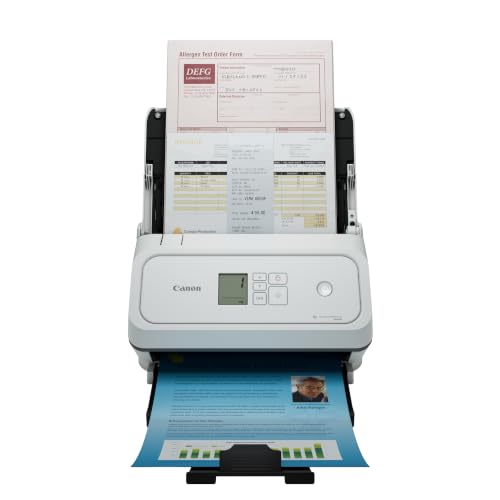
Canon imageFORMULA R40
The Canon imageFORMULA R40 is a sheet-fed scanner designed for high-volume office scanning. It scans up to 40 pages per minute and features a 60-sheet ADF. Its ultrasonic double-feed detection prevents misfeeds. Owners praise its durability and scanning accuracy.
Pros
- High-speed scanning
- Large ADF capacity
- Reliable document handling
Cons
- No flatbed
- Bulky for some desks

Plustek ePhoto Z300
The Plustek ePhoto Z300 is a dedicated photo scanner with an automatic photo feeder that can process up to 30 photos at a time. It scans at 300 dpi, which is sufficient for sharing and printing up to 4×6 inches. Users find it convenient for digitizing large photo collections.
Pros
- Automatic photo feeder
- Easy to use
- Compact design
Cons
- Lower resolution for large prints
- Only scans photos, not documents
Side by side
| # | Model | Scan Speed | Best for | Score | Price |
|---|---|---|---|---|---|
| 1 | Epson WorkForce ES-400 | 35 ppm (simplex), 70 ipm (duplex) | Fast document scanning with ADF | 9.4 | Check price |
| 2 | Fujitsu ScanSnap iX1600 | 40 ppm (simplex), 80 ipm (duplex) | Versatile scanning with touchscreen | 9.2 | Check price |
| 3 | Canon CanoScan LiDE400 | 8 seconds per page (color) | Budget-friendly flatbed scanning | 8.8 | Check price |
| 4 | Epson Perfection V600 | 6400 dpi | Photo and film scanning | 9.0 | Check price |
| 5 | Brother ADS-1700W | 17 ppm (simplex), 34 ipm (duplex) | Wireless document scanning | 8.7 | Check price |
| 6 | Canon imageFORMULA R40 | 40 ppm (simplex), 80 ipm (duplex) | Heavy-duty office use | 8.9 | Check price |
| 7 | Plustek ePhoto Z300 | 1 second per photo (300 dpi) | Photo scanning with auto feeder | 8.5 | Check price |
Common questions
What is the difference between a flatbed and a sheet-fed scanner?
A flatbed scanner has a glass surface where you place documents or photos flat. It can handle books, fragile items, and bound documents. Sheet-fed scanners pull pages through a feeder, making them faster for stacks of paper but unsuitable for bulky or delicate items.
Can a desktop scanner scan both sides of a document?
Yes, many desktop scanners have duplex scanning capability. They can automatically scan both sides of a page in one pass, which is useful for double-sided documents and receipts.
What is optical resolution and why does it matter?
Optical resolution is the actual sharpness of the scanner’s sensor, measured in dots per inch (dpi). Higher dpi captures more detail, which is essential for scanning photos or small text. For general documents, 300 dpi is sufficient, while for photos, 600 dpi or higher is recommended.
Do I need a scanner with Wi-Fi?
Wi-Fi connectivity allows you to scan wirelessly to your computer, smartphone, or cloud services without a cable. It is convenient for shared use or if your computer is not near the scanner. However, USB-only scanners are often cheaper and faster for direct connection.
What is OCR and why is it useful?
OCR (Optical Character Recognition) software converts scanned images into editable text. This allows you to search within PDFs, copy text, and reduce the need for retyping. Many scanners include OCR software, but its accuracy varies.
Can I scan photos with a document scanner?
Document scanners with ADF are not ideal for photos because they can damage fragile prints. Flatbed scanners are safer for photos. Some models like the Plustek ePhoto Z300 are specifically designed for photo scanning with a gentle feeder.
How fast are desktop scanners?
Scanning speed varies widely. Entry-level flatbeds may take several seconds per page, while high-end document scanners can scan 40 pages per minute or more. Consider your typical workload to choose the right speed.
What should I look for in scanning software?
Look for software that is easy to use, supports OCR, and allows you to save in multiple formats (PDF, JPEG, TIFF). Some scanners come with proprietary software, while others are compatible with third-party apps like Adobe Scan or VueScan.
Are desktop scanners compatible with macOS?
Most modern scanners support both Windows and macOS, but it is important to check the manufacturer’s specifications. Some older models may only have Windows drivers. Look for TWAIN or ICA drivers for Mac compatibility.
How do I clean a scanner?
Turn off the scanner and unplug it. Use a soft, lint-free cloth slightly dampened with water or a mild glass cleaner to wipe the flatbed glass. For ADF rollers, use a lint-free cloth with isopropyl alcohol. Allow it to dry completely before use.
Our take
Based on your scanning habits, the right choice varies. For most households that need fast document scanning without breaking the bank, the Epson WorkForce ES-400 is the clear winner. It offers speed, reliability, and a reasonable price. If you are a photo enthusiast, the Epson Perfection V600 is your best bet for high-quality scans of prints and film. Ultimately, prioritize your main scanning tasks and choose accordingly.