How to Pick Dog Boots That Won’t Fall Off Mid-Walk
Ruffwear Grip Trex ranks first for Vibram soles and a secure strap placed above the dewclaw. PawZ disposable rubber boots offer the cheapest protection against road salt. Kurgo Blaze Cross balances grip and price for daily pavement walks, rounding out the top three picks.
Ruffwear Grip Trex tops this list for trail grip and retention. PawZ rubber boots solve road salt cheaply. Kurgo Blaze Cross covers everyday pavement walks without the premium price.
Boots falling off is usually a fit problem, not a quality one. Every brand sizes differently, so guessing rarely works. We compared sole builds, closure designs, published sizing charts and owner reports on slipping and rubbing, then ranked by grip and retention.
What matters most
How to measure paws before buying Stand your dog on paper with weight on the paw, since a paw spreads under load. Mark the widest points and measure across. Compare against each brand’s own chart, since sizing varies between manufacturers. Front and rear paws often differ, so measure both. Most falling-off complaints trace back to a boot that runs one size too large.
Why closure design decides if boots stay on A strap above the dewclaw, around the narrower leg, holds better than one at the widest part of the paw. Two straps outperform one on active dogs. Wide hook and loop bands survive more fastening cycles than thin ones. A well-fitted boot that still slides off usually has the wrong strap geometry.
Which boot suits which hazard Hot pavement calls for a thick insulating sole. Road salt calls for waterproof coverage over raw grip, which is why thin rubber boots work well there. Rocky trails need a real lugged outsole. Snow needs a tall cuff and warm lining. One boot rarely covers every condition, so many owners keep a summer pair and a winter pair.
How to get a dog used to wearing boots The high-stepping walk in new boots is normal and fades with practice. Start indoors for a few minutes, pair the session with treats, and build up to all four paws over several tries. Skip going straight from unboxing to a long walk. Check between the toes for rubbing after early outings, and trim nails and paw fur, since both affect fit.
The best picks, ranked
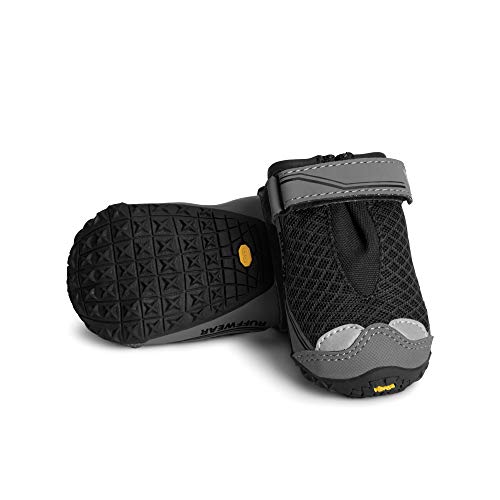
Ruffwear Grip Trex Dog Boots
Grip Trex uses genuine Vibram outsoles for traction on wet rock and loose trail surfaces. Mesh uppers keep paws cool on long walks. A wide hook and loop strap sits above the dewclaw, where it holds instead of sliding down.
Pros
- Best wet-surface grip in this group
- Mesh upper resists overheating on long walks
- Strap position keeps boots from sliding off
Cons
- Priced above every other boot here
- Needs careful measurement to fit right

PawZ Water-Proof Dog Boots
PawZ boots are thin rubber sleeves that stretch over each paw. They block road salt, mud and moisture completely, with no rigid sole to get used to. A pack replaces itself every few walks rather than lasting for years.
Pros
- Dogs adjust to them within minutes
- Fully blocks salt, mud and moisture
- Lowest cost per pack in this list
Cons
- Wears through after a handful of walks
- Offers no defense against sharp objects

Kurgo Blaze Cross Dog Shoes
Blaze Cross pairs a rugged sole with reflective trim for low-light walks, at a price below premium trail boots. Its strap wraps high enough to resist twisting. Rough terrain still favors the Vibram sole above it.
Pros
- Solid grip for the price point
- Reflective trim aids visibility after dark
- Comfortable across typical daily distances
Cons
- Struggles on wet rock compared to Vibram soles
- Mesh traps grit on muddy trails
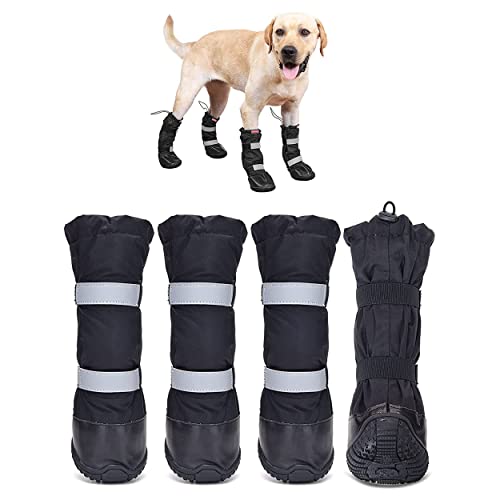
Muttluks Fleece Lined Dog Boots
Fleece lining and a soft leather sole suit winter walks, especially for older dogs that resist stiff boots. A tall cuff and adjustable strap hold firm in deep snow. Summer abrasion wears the leather sole quickly, so treat this as a seasonal pick.
Pros
- Keeps paws warm through winter walks
- Flexible sole most dogs accept quickly
- Tall cuff resists pulling off in snow
Cons
- Leather sole wears fast on rough ground
- Runs too warm for summer use
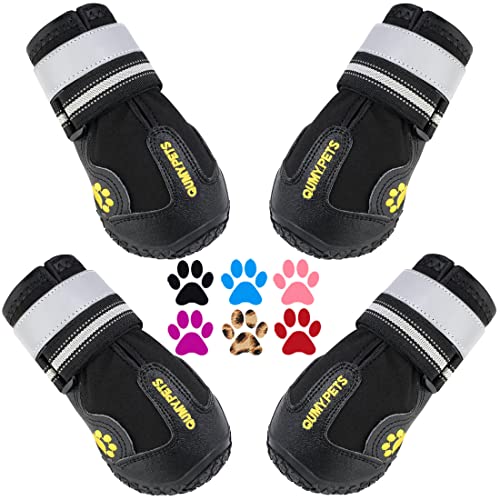
QUMY Dog Boots
QUMY extends into larger sizes than most competitors, filling a gap for big dogs whose paws exceed premium brands’ charts. A rugged sole grips pavement well, and twin straps add hold. Fit runs generous, so sizing down often works better than sizing up.
Pros
- Sizing covers genuinely large breeds
- Two straps add secure hold
- Good build quality for the price
Cons
- Generous fit requires careful measuring
- Feels stiff out of the box

Ultra Paws Durable Dog Boots
A wide opening and stretchy top make these among the easiest boots to put on, which matters through four paws per walk. Broad, flat paws that struggle in tapered boots fit well here. Grip stays adequate rather than exceptional, suiting pavement and park use.
Pros
- Easiest boot in this group to put on
- Fits wide or flat paw shapes well
- Double straps stay fastened during walks
Cons
- Grip falls short on wet surfaces
- Fabric shows wear after moderate use

My Busy Dog Water Resistant Dog Shoes
A thick rugged sole insulates paws from hot summer pavement and blocks sharp gravel. That extra thickness feels less natural underfoot, so some dogs need longer to accept it. Reflective straps help during early morning and evening summer walks.
Pros
- Meaningful insulation from hot ground
- Blocks sharp gravel effectively
- Reflective straps aid low-light visibility
Cons
- Thick sole feels unnatural to some dogs
- Runs warmer inside than mesh boots
The lineup, side by side
| # | Model | Sole | Best for | Score | Price |
|---|---|---|---|---|---|
| 1 | Ruffwear Grip Trex Dog Boots | Vibram outsole | Best overall | 9.4 | Check price |
| 2 | PawZ Water-Proof Dog Boots | Natural rubber | Best budget | 9.2 | Check price |
| 3 | Kurgo Blaze Cross Dog Shoes | Rugged moulded rubber | Best value | 9.0 | Check price |
| 4 | Muttluks Fleece Lined Dog Boots | Fleece | Best for cold weather | 8.8 | Check price |
| 5 | QUMY Dog Boots | Wide range including large breeds | Best for large breeds | 8.6 | Check price |
| 6 | Ultra Paws Durable Dog Boots | Wide opening for broad paws | Best for wide paws | 8.3 | Check price |
| 7 | My Busy Dog Water Resistant Dog Shoes | Thick anti slip rubber | Best for hot pavement | 8.0 | Check price |
Common questions
How do I stop dog boots from falling off?
Check size first, since oversized is the usual culprit. Look at where the strap sits next; it should wrap above the dewclaw, not around the widest part of the paw. Two straps hold better than one on active dogs.
Do dogs really need boots?
Not for ordinary walks in mild weather. They matter for hot pavement, road salt and ice, rough or sharp terrain, and for protecting injured paws or dressings. Many dogs never need a pair.
How hot is too hot for a dog to walk on pavement?
Press the back of your hand to the surface for several seconds. If it is uncomfortable for you, it is too hot for paws. Asphalt runs far hotter than air temperature in direct sun.
Is it safe to leave dog boots on all day?
No. Boots trap moisture and heat, which can soften pads and cause irritation. Put them on for the walk and remove them after. Check between the toes for redness after early uses.
What size dog boots should I buy?
Measure the paw while your dog stands, so it spreads under weight, then match it to that brand’s specific chart. Sizes do not carry across brands. Measure front and rear paws separately, since they often differ.
Why does my dog walk strangely in new boots?
Paw sensation matters heavily for balance, and boots change that feedback. The exaggerated high step is normal and fades with practice. Short indoor sessions with treats speed up acceptance.
Do dog boots protect against road salt?
Yes, and it is one of the strongest reasons to use them. Salt and de-icing chemicals irritate pads and are harmful if licked off. Waterproof rubber boots handle this well at low cost.
Can dog boots help with a paw injury?
They keep dressings dry and clean, which supports healing, but follow a vet’s guidance for the specific injury. Thin waterproof boots usually work better here than structured trail boots.
Dog boots vs booties, what is the difference?
The terms mostly describe the same product. Booties often means a softer, simpler design, while boots implies a structured sole. Trail-focused boots use lugged rubber or Vibram soles, while soft booties suit indoor recovery or light use.
The bottom line
Ruffwear Grip Trex suits dogs that cover real terrain, since Vibram soles and correct strap placement solve both grip and retention. PawZ rubber boots handle winter salt cheaply and effectively, and Kurgo Blaze Cross covers everyday pavement walking well. Measure the paw under weight before ordering, since an oversized boot is the top reason owners give up on them.


