Which Dynamic Microphone Fits Your Voice Setup
The Shure SM7B leads for podcast and broadcast tone, the Shure MV7 covers USB and XLR streaming setups, and the Rode PodMic offers similar broadcast styling for less. All three are cardioid dynamic mics that reject room noise better than typical condensers.
The Shure SM7B suits podcasters and streamers chasing broadcast-grade vocal tone, though its low output needs a strong preamp or inline booster to sound clean.
Dynamic mic spec sheets look similar at a glance, so we compared connector types, gain requirements and monitoring features against owner feedback to find real differences.
The best picks, ranked
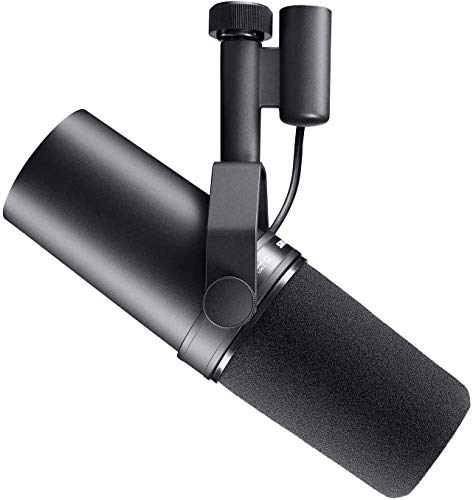
Shure SM7B
Shure built the SM7B for broadcast and podcast vocals around a cardioid pickup pattern. An internal pop filter and switchable bass rolloff and presence boost come built in. Output stays low, so a clean preamp or inline booster is needed to reach a usable level.
Pros
- Rejects room noise and computer fan hum well
- Internal shock mount cuts desk vibration
- Switchable presence boost and bass rolloff for voice
Cons
- Needs 60+ dB of clean gain from a preamp
- No USB option, requires an audio interface

Shure MV7
A cardioid dynamic capsule pairs with both USB-C and XLR outputs on the MV7. Its touch panel adjusts gain and headphone monitoring without extra software. The ShurePlus MOTIV app adds tone-shaping presets for streaming and voiceover work.
Pros
- Works as plug-and-play USB or full XLR studio mic
- Touch panel controls gain without a computer
- Built-in headphone jack for real-time monitoring
Cons
- Costs more than single-connector USB dynamic mics
- MOTIV app needed to access advanced tone presets

Rode PodMic
Rode styled the PodMic after studio broadcast microphones at a friendlier cost. An internal pop filter and swing mount suit boom arm setups straight out of the box. Like other low-output dynamic mics, it benefits from a preamp with real clean gain headroom.
Pros
- Internal pop filter reduces plosives with no foam cover
- Metal body and swing mount suit boom arm rigs
- Priced well below broadcast mics with similar tone
Cons
- No USB option, needs an interface or mixer
- Low output needs a preamp with strong clean gain
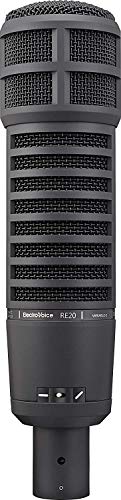
Electro-Voice RE20
Radio booths have relied on the RE20’s large-diaphragm cardioid capsule for decades. Its internal Variable-D design limits proximity-effect bass buildup as a speaker moves closer. It needs a solid preamp but less gain overall than the SM7B.
Pros
- Variable-D design keeps bass consistent at close range
- Internal shock mount isolates handling noise
- Trusted in radio booths for consistent voice tone
Cons
- No USB output, needs an interface or console
- Large body needs a sturdy boom arm or stand

Audio-Technica ATR2100x-USB
Both USB-C and XLR outputs sit on this cardioid dynamic mic from Audio-Technica. A headphone jack lets a user monitor their own voice with zero delay. An included stand mount and carrying pouch suit a first home podcasting setup.
Pros
- Works straight into a computer with no interface
- XLR output allows upgrading to a mixer later
- Lightweight and easy to mount on a boom arm
Cons
- USB preamp noise floor is higher than the XLR path
- Plastic body feels less rugged than metal broadcast mics

Samson Q2U
Samson positions the Q2U as an entry-level mic with both USB and XLR outputs. It bundles a mic clip, tripod desk stand, foam windscreen and both cables. A headphone jack supports zero-latency monitoring while recording.
Pros
- Includes stand, clip, windscreen and cables in the box
- Dual output covers USB now and XLR upgrades later
- Budget price paired with a metal mic body
Cons
- USB output carries more self-noise than premium mics
- Desk stand is basic compared to boom arm mounts

Elgato Wave DX
Elgato built the Wave DX for streaming and gaming voice chat over USB-C alone. Skipping XLR entirely means no audio interface or phantom power is needed. A desktop stand and low-profile shock mount come included.
Pros
- Plug-and-play USB-C needs no separate interface
- Wave Link software mixes game audio and mic live
- Compact desktop stand saves space near a monitor
Cons
- No XLR output, can’t connect to a mixing console
- Fixed cardioid pattern with no polar pattern options
Before you buy
What makes a dynamic mic different from a condenser Dynamic capsules use a moving coil instead of a charged plate, so they need no phantom power. That design rejects off-axis room noise and handles loud sources without distorting. Condensers pick up more detail but also capture more of the surrounding room, fans and echo.
USB or XLR: which connection fits your setup? USB dynamic mics plug straight into a computer and need no separate hardware. XLR mics route through an audio interface or mixer, which usually gives cleaner gain and lower noise. Hybrid models like the Shure MV7 and Audio-Technica ATR2100x-USB offer both, useful for anyone planning to upgrade later.
Matching a mic to podcasting, streaming or radio work Podcast hosts recording alone often want a broadcast-style mic like the SM7B or PodMic for warm, close-up tone. Streamers juggling game audio and voice chat benefit from USB-C mics with built-in mixing software, such as the Wave DX. Radio and voiceover booths still lean on the RE20 for its steady bass response at close mic distances.
Why some dynamic mics need extra gain Broadcast-style dynamic mics like the SM7B and PodMic have very low sensitivity by design, which keeps stray noise out. That same trait means a standard interface may not supply enough clean volume without hiss. Buyers pairing these mics with a basic audio interface often add an inline preamp booster to compensate.
Compared at a glance
| # | Model | Polar pattern | Best for | Score | Price |
|---|---|---|---|---|---|
| 1 | Shure SM7B | Cardioid | Best overall | 9.4 | Check price |
| 2 | Shure MV7 | Cardioid | Best for streamers who want USB and XLR flexibility | 9.2 | Check price |
| 3 | Rode PodMic | Cardioid | Best value | 9.0 | Check price |
| 4 | Electro-Voice RE20 | Cardioid | Best for broadcast and radio work | 8.7 | Check price |
| 5 | Audio-Technica ATR2100x-USB | Cardioid | Best for beginners setting up their first USB mic | 8.5 | Check price |
| 6 | Samson Q2U | Cardioid | Best budget | 8.2 | Check price |
| 7 | Elgato Wave DX | Cardioid | Best for gaming streamers who want plug-and-play USB | 8.0 | Check price |
Good to know
Are dynamic microphones good for podcasting?
Yes. Dynamic mics reject room echo and background noise better than most condensers, which suits untreated home offices and shared spaces common to podcasting.
What is the difference between a dynamic and condenser microphone?
A dynamic mic uses a moving coil and needs no external power, while a condenser uses a charged plate that requires phantom power and generally picks up more room ambience.
Do dynamic microphones need phantom power?
No. Standard dynamic mics like the SM7B, PodMic and RE20 work without phantom power, though USB models still draw power through the USB connection itself.
Can I use a dynamic mic without an audio interface?
USB dynamic mics such as the Samson Q2U, Audio-Technica ATR2100x-USB and Elgato Wave DX plug directly into a computer with no interface. XLR-only mics like the SM7B and PodMic require one.
Which dynamic microphone is best for streaming?
The Shure MV7 suits streamers who want USB simplicity with an XLR upgrade path, while the Elgato Wave DX targets gamers who want plug-and-play USB-C with built-in audio mixing.
Is the Shure SM7B worth it for beginners?
It delivers broadcast-grade tone, but its low output needs a preamp with strong clean gain or an inline booster, which adds cost for someone just starting out.
USB vs XLR dynamic mic: which should I buy?
Choose USB for a simple single-cable setup with no extra gear. Choose XLR if you already own or plan to buy an audio interface and want more control over gain and routing.
How close should I talk to a dynamic microphone?
Most broadcast-style dynamic mics sound best two to four inches from the mouth, close enough to capture warmth without the mic overloading on breath pops.
Which dynamic mic suits radio and voiceover booths best?
The Electro-Voice RE20’s Variable-D design keeps bass steady at close mic range, a trait radio and voiceover booths have favored for decades.
Can a dynamic microphone record singing or music vocals?
It can, though lower sensitivity and less extended high end suit spoken word better than the delicate detail a condenser captures on harmonies.
Our pick
The Shure SM7B remains the strongest overall pick for anyone recording podcasts or streams who already owns an interface with enough clean gain. Streamers who want one mic that works over USB without extra gear should pick the Shure MV7 instead. Buyers on a tight budget get most of the same dual-connector flexibility from the Samson Q2U for a fraction of the cost.