Choosing an Electric Bike for Commutes and Trails
The Aventon Level 2 is our overall pick, pairing a torque sensor with commuter friendly kit. The ENGWE Engine Pro 2.0 suits riders who want fat tyres and range, while the Vivi Folding Electric Bike is the sensible value choice for short urban trips.
The Aventon Level 2 is the electric bike we would point most commuters towards, because its torque sensor makes the assistance feel like pedalling rather than being pushed. For rougher terrain and longer distances the ENGWE Engine Pro 2.0 carries a bigger battery and fat tyres, and the Vivi Folding Electric Bike covers short city trips without a large outlay.
Electric bikes are difficult to compare because the advertised range assumes flat ground, low assist and a light rider, so real figures often land well below the number on the box. Motor placement and sensor type change the riding feel more than watt ratings do. We compared published battery capacities, motor specifications, braking hardware, weight and included equipment such as racks, lights and fenders, alongside what owners report about hill performance and service support.
Before you buy
Torque sensor or cadence sensor A cadence sensor simply detects that the pedals are turning and applies a set amount of power, which feels like being pushed and can surge away from a standing start. A torque sensor measures how hard you press and scales assistance to match, which feels like riding a normal bike with strong legs. If you will ride in traffic or on shared paths, the torque sensor is the upgrade worth paying for.
Read range claims sceptically Advertised range assumes the lowest assist level, a flat route, mild weather and a light rider. Hills, headwinds, cold temperatures, heavy loads and high assist all cut it substantially. A useful rule is to assume around half the headline figure for real mixed riding, then check whether that still covers your commute with margin for the return leg.
Match the class and motor to local rules Electric bikes are typically grouped into classes by whether they have a throttle and what speed assistance cuts out at, and local regulations may restrict where each class can ride. Paths and trails often permit pedal assist bikes while excluding throttle equipped ones. Check the rules for the routes you actually use before buying, since it affects which bike is legal to ride there.
Brakes, weight and equipment matter more than watts An electric bike is much heavier and faster than a regular bike, so braking hardware deserves attention. Hydraulic disc brakes need less maintenance and give better control under load than mechanical ones. Consider the total weight if you have stairs, and check whether fenders, lights and a rack are included, since buying them separately adds up and fitting them afterwards is fiddly.
What we recommend
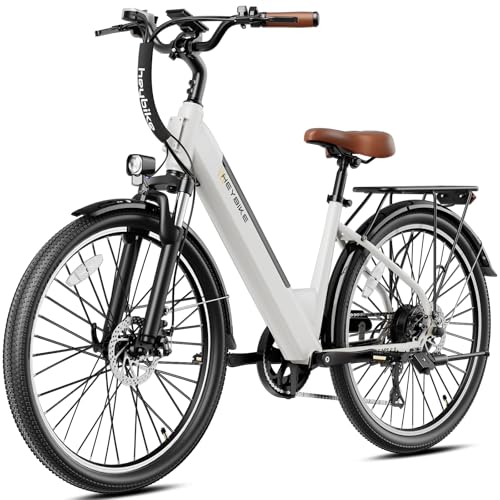
Aventon Level 2 Commuter Ebike
The Level 2 uses a torque sensor rather than a simple cadence sensor, so power arrives in proportion to how hard you pedal. That makes it far smoother in traffic than most bikes at this level. It arrives with fenders, lights, a rack and hydraulic disc brakes, which covers everything a commuter actually needs.
Pros
- Natural feeling power delivery
- Fully equipped for commuting
- Hydraulic brakes as standard
Cons
- Heavy to carry upstairs
- Frame sizing runs limited

ENGWE Engine Pro 2.0
The Engine Pro pairs a large capacity battery with fat tyres and full suspension, which suits gravel paths, sand and broken tarmac. It folds, though it is heavy enough that folding is more about storage than carrying. Owners report strong hill performance and a genuinely long range at moderate assist levels.
Pros
- Long range at moderate assist
- Comfortable on rough surfaces
- Removable battery for indoor charging
Cons
- Very heavy to lift
- Fat tyres slow it on smooth roads

Heybike Mars 2.0
The Mars 2.0 folds down small enough for a car boot or an apartment hallway, which is the main reason to choose it. Fat tyres and a suspension fork smooth out potholes, and the step through folding frame is easy to mount. It is a practical bike for mixed commutes involving a car or a train.
Pros
- Folds for car or flat storage
- Easy to step through and mount
- Comfortable on poor road surfaces
Cons
- Awkward weight when folded
- Cadence sensor feels less natural

Cyrusher XF900
The XF900 is built around a powerful motor and full suspension, aimed at riders facing steep gradients or carrying loads. Hydraulic brakes are a sensible match for the extra speed and weight. It is closer to a light electric motorbike in character than a bicycle, so expect to work with its size rather than against it.
Pros
- Climbs steep hills confidently
- Full suspension smooths rough ground
- Strong braking hardware
Cons
- Very heavy overall
- Bulky for indoor storage

Vivi Folding Electric Bike
A straightforward folding commuter with a removable battery and a simple three mode controller. It is not fast or sophisticated, but for flat city trips of a few miles it does the job at a low entry point. Owners report it works best treated as a pedal assist bike rather than relying on throttle only riding.
Pros
- Affordable way into ebikes
- Folds for small flats
- Simple controls
Cons
- Modest hill performance
- Mechanical brakes need regular adjustment

Jasion EB5
The EB5 is one of the most popular entry level electric bikes, with a suspension fork, 26 inch wheels and a battery hidden in the frame. Assistance is cadence based, so it feels more like a push than a boost. For light recreational riding on mostly flat ground it is a reasonable starting point.
Pros
- Low cost entry point
- Clean integrated battery
- Comfortable upright position
Cons
- Cadence assist feels abrupt
- Limited torque on steep climbs

Gotrax F2 Folding Electric Bike
The F2 keeps weight lower than most folding fat tyre bikes, which matters if you are lifting it onto a train or into a car. Range is modest and the motor is modest with it, so treat it as a short hop machine. Owners report the fold mechanism is quick and the bike is easy to store upright.
Pros
- Easier to lift than rivals
- Quick fold mechanism
- Compact stored footprint
Cons
- Shorter range than larger bikes
- Small wheels feel busy at speed
Side by side
| # | Model | Motor | Best for | Score | Price |
|---|---|---|---|---|---|
| 1 | Aventon Level 2 Commuter Ebike | Rear hub | Best overall | 9.4 | Check price |
| 2 | ENGWE Engine Pro 2.0 | Fat 20 inch | Best for range and rough surfaces | 9.1 | Check price |
| 3 | Heybike Mars 2.0 | Folding step through | Best folding option | 8.9 | Check price |
| 4 | Cyrusher XF900 | High torque hub | Best for hills | 8.7 | Check price |
| 5 | Vivi Folding Electric Bike | Folding | Best value | 8.5 | Check price |
| 6 | Jasion EB5 | 26 inch | Best budget | 8.2 | Check price |
| 7 | Gotrax F2 Folding Electric Bike | Folding aluminium | Best for mixed transport | 8.0 | Check price |
Frequently asked questions
How far can an electric bike really go on one charge?
Expect noticeably less than the advertised figure once you include hills, higher assist levels and your own weight. Planning around half the claimed range is a safe approach for mixed riding, and carrying a charger helps on longer days.
Do you still get exercise on an electric bike?
Yes, especially on pedal assist. Riders typically pedal for longer and travel further than they would on a regular bike, which often means more total activity even though each mile is easier.
What is the difference between hub and mid drive motors?
Hub motors sit in the wheel, are cheaper and need little maintenance, but they push the bike rather than driving through the gears. Mid drive motors sit at the cranks and use the gearing, which gives better hill climbing and balance at higher cost.
How long do electric bike batteries last?
Most packs are rated for several hundred full charge cycles before capacity drops noticeably. Storing the battery around half charge in a cool place and avoiding repeated full discharges extends useful life considerably.
Can you ride an electric bike in the rain?
Most are built to handle rain and wet roads, though they should not be submerged or pressure washed. Dry the connectors afterwards, and remember that braking distances increase on wet rims and discs.
Are folding electric bikes worth it?
They are if you combine cycling with a car, a train or a small flat. The compromise is smaller wheels, which feel less stable at speed, and extra hinge weight in the frame.
Do I need a licence or insurance?
Rules vary by region. Many places treat pedal assist bikes within a set speed limit as bicycles requiring neither, while faster or throttle equipped models can fall under different rules. Check local regulations before you ride.
What maintenance does an electric bike need?
The same as a bicycle plus battery care. Keep the chain clean and lubricated, check brake pads more often than on a regular bike because of the extra weight, and keep tyre pressures correct since low pressure hurts range as well as handling.
The bottom line
The Aventon Level 2 is the most complete commuter here, and its torque sensor is the single feature that most changes how an electric bike feels to ride. Riders covering longer distances or rougher ground should look at the ENGWE Engine Pro 2.0, while the Vivi Folding Electric Bike keeps short urban trips affordable. Whatever you choose, plan around roughly half the advertised range.