Top Electric Leaf Blowers for Landscaping Work
For most landscaping tasks, the EGO Power+ LB6504 stands out. Its 650 CFM air volume and 180 MPH speed handle heavy leaves and debris quickly, and it runs up to 75 minutes on a full charge. Owners report it is powerful but heavier than some rivals, so consider your arm strength if you will use it for long sessions.
Electric leaf blowers have become the go-to choice for many homeowners and professionals. They start instantly, require little maintenance, and produce no fumes. But with so many models on the market, finding the right one for your yard can feel overwhelming.
We compared seven of the best-selling electric leaf blowers to see which ones deliver real landscaping performance. From high-CFM backpack units to nimble handhelds, this roundup breaks down what each model does well and where it falls short.
What matters most
How to choose the right power level Look at CFM and MPH together. CFM measures air volume, while MPH measures speed. For clearing dry leaves on grass, you need at least 400 CFM. For wet leaves or heavy debris, aim for 600 CFM or more. A high MPH is useful for blowing out tight spaces, but volume matters more for moving piles.
Battery platform and runtime If you already own cordless tools from brands like DEWALT, RYOBI, or Craftsman, consider buying the bare tool to save money. Look at battery amp-hours (Ah) because higher Ah means longer runtime. For large yards, choose a 56V or 80V system. For small tasks, 18V or 20V may be enough.
Ergonomics and noise considerations Since you might use the blower for extended periods, comfort is key. Check the weight and balance. Some models have cruise control or variable speed triggers that reduce fatigue. Noise is also a factor in residential areas. Look for blowers with lower dB ratings, typically around 60-70 dB, which are quieter than gas models.
Maintenance and long-term cost Electric blowers need little maintenance compared to gas engines. You do not need to mix fuel or change spark plugs. However, batteries degrade over time and may need replacement. Factor in the cost of a spare battery if you have a large yard. Also, consider the warranty; most brands offer 2-3 years on tools and batteries.
The top picks, ranked

EGO Power+ LB6504 650 CFM Variable Speed Blower
The EGO Power+ LB6504 is a beast of a handheld blower. With a turbo button that boosts airspeed to 180 MPH and a volume of 650 CFM, it can move wet leaves and small branches. It is brushless, quiet for its power, and uses EGO’s 56V battery platform. Owners praise its battery life and variable speed trigger, but note that it is front-heavy after extended use.
Pros
- Excellent power for a handheld
- Long runtime with compatible battery
- Low noise compared to gas blowers
Cons
- Battery sold separately
- Can feel heavy after prolonged use

DEWALT 20V MAX XR Blower (DCBL770X1)
This DEWALT blower delivers 450 CFM and 125 MPH, which is plenty for everyday yard work. It is compatible with DEWALT’s extensive 20V battery system, so if you already own tools from that brand, you can save money by using existing batteries. The variable speed trigger and cruise control give you good control. It is a bit noisier than some rivals, but it is a solid performer.
Pros
- Shares batteries with other DEWALT tools
- Cruise control reduces fatigue
- Good balance for a handheld
Cons
- Not as powerful as 60V models
- Battery drains fast on high setting

Greenworks Pro 80V Cordless Axial Blower (BL80L2510)
Greenworks Pro 80V blower gives you significant power without the high price tag of some competitors. It pushes 145 MPH and 500 CFM, enough for most residential properties. The kit includes a 2.0Ah battery and charger, and it is surprisingly light at 5.9 pounds with battery. Owners like the variable speed trigger and the fact that it is quiet enough for suburban neighborhoods.
Pros
- Strong air output for the price
- Battery and charger included
- Quieter than gas blowers
Cons
- Battery runtime is moderate
- Not as durable as higher-end models

Makita XBU02PT1 36V (18V X2) LXT Brushless Cordless Blower
Makita’s XBU02PT1 runs on two 18V LXT batteries to deliver 473 CFM and 120 MPH. It is built like a tank, with a brushless motor and a variable speed trigger with cruise control. The kit comes with two 5.0Ah batteries and a dual charger. It is heavier than some handhelds, but the ergonomic grip and balanced design help reduce fatigue. Landscapers often choose this for its reliability.
Pros
- Excellent build quality
- Batteries and charger included
- Constant speed control
Cons
- Heavier than some rivals
- Two batteries required increases cost

RYOBI ONE+ 18V Cordless Jet Fan Blower (P2108A)
If you only need to clear light debris from a small yard, the RYOBI Jet Fan Blower is an affordable choice. It produces 110 MPH and 310 CFM, which is adequate for dry leaves on pavement. It is compatible with RYOBI’s 18V ONE+ battery system, so you can use your existing batteries. The tool is lightweight and easy to maneuver, though it lacks the power for heavy wet leaves.
Pros
- Very affordable
- Light and easy to handle
- Works with widely available RYOBI batteries
Cons
- Limited power for heavy tasks
- Battery not included
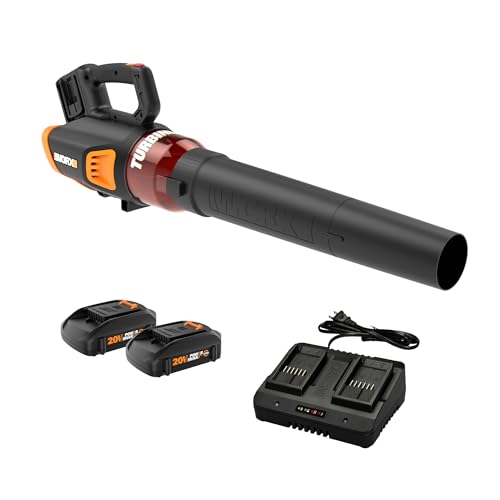
Worx WG584 40V Power Share Turbine Cordless Leaf Blower
The Worx WG584 is a turbine fan blower that moves 110 MPH and 400 CFM. It stands out for its low noise level, which is noticeable compared to other blowers. It is also one of the lightest options at 5.2 pounds with battery. The variable speed trigger and cruise control are handy, and it comes with a 4.0Ah battery and charger. Owners say it is great for regular maintenance between deeper cleans.
Pros
- Quiet operation
- Lightweight and comfortable
- Battery and charger included
Cons
- Not as powerful as higher-voltage models
- Battery runtime is moderate

Craftsman V20 Cordless Leaf Blower (CMCB520B)
The Craftsman V20 is a simple, no-frills blower that gets the job done on small properties. It provides 130 MPH and 400 CFM, which is decent for a 20V tool. It is lightweight and easy to store. The blower only is sold without a battery, but it is compatible with Craftsman V20 batteries. Owners appreciate its low price, but some note that the battery drains quickly if you run it on high.
Pros
- Very low cost
- Lightweight and compact
- Good for small patios and driveways
Cons
- Battery not included
- Battery life is short on high
How they stack up
| # | Model | Air Volume | Best for | Score | Price |
|---|---|---|---|---|---|
| 1 | EGO Power+ LB6504 650 CFM Variable Speed Blower | 650 CFM | best overall for heavy leaf cleanup | 9.4 | Check price |
| 2 | DEWALT 20V MAX XR Blower (DCBL770X1) | 450 CFM | best for those already on the DEWALT platform | 8.9 | Check price |
| 3 | Greenworks Pro 80V Cordless Axial Blower (BL80L2510) | 500 CFM | best battery value for large yards | 8.7 | Check price |
| 4 | Makita XBU02PT1 36V (18V X2) LXT Brushless Cordless Blower | 473 CFM | best for professionals needing durability | 9.1 | Check price |
| 5 | RYOBI ONE+ 18V Cordless Jet Fan Blower (P2108A) | 310 CFM | best budget pick for small yards | 8.3 | Check price |
| 6 | Worx WG584 40V Power Share Turbine Cordless Leaf Blower | 400 CFM | best for low noise and light weight | 8.6 | Check price |
| 7 | Craftsman V20 Cordless Leaf Blower (CMCB520B) | 400 CFM | best for tight budgets and light use | 8.0 | Check price |
Good to know
What is the difference between CFM and MPH?
CFM (cubic feet per minute) measures the volume of air the blower moves. MPH (miles per hour) measures the speed of the air leaving the nozzle. For moving piles of leaves, you want high CFM. For blasting debris out of tight spaces, high MPH is helpful.
How long does a battery leaf blower run?
Runtime varies widely based on battery capacity and the power setting. A typical 2.0Ah 20V battery may last 15-20 minutes on high, while a 5.0Ah 60V battery might run 45-60 minutes. Using lower speed settings extends runtime.
Are electric leaf blowers as powerful as gas ones?
Modern high-voltage electric blowers, especially those running on 56V or 80V, can match or exceed gas blowers in air volume and speed. They also have the advantage of instant start and no maintenance.
Do I need a backpack blower for landscaping?
Backpack blowers are typically more powerful and distribute weight better for extended use. However, they are heavier and more expensive. For most residential properties, a high-performance handheld like the EGO LB6504 is sufficient.
Can I use a leaf blower for clearing snow?
Yes, you can use a leaf blower to clear light, fluffy snow from driveways or sidewalks. For wet or deep snow, it is not effective. Some manufacturers do not recommend it for this purpose, so check your warranty.
How do I reduce the noise of my leaf blower?
Electric blowers are generally quieter than gas ones. To further reduce noise, look for models with lower dB ratings, use the lower speed setting when possible, and avoid blowing early in the morning or late at night to be considerate of neighbors.
What is the best voltage for a leaf blower?
Higher voltage (like 40V, 56V, or 80V) generally provides more power and longer runtime. For light tasks, 18V or 20V can work. Choose based on the size of your property and the density of leaves you typically deal with.
Can I use third-party batteries with my leaf blower?
It is not recommended to use third-party batteries as they may not have the same safety features or performance. Stick with the manufacturer’s batteries to ensure compatibility and avoid voiding the warranty.
How do I store my leaf blower during the off-season?
Store the blower in a dry place. Remove the battery and store it separately at room temperature. Charge the battery to about 50% before long-term storage. Check the manufacturer’s instructions for specific recommendations.
The bottom line
If you need a powerful electric leaf blower for serious landscaping work, the EGO Power+ LB6504 is the clear winner. It offers the best combination of power, runtime, and features for most yards. If you are on a tight budget, the RYOBI P2108A provides decent performance at a low cost, provided you already own RYOBI batteries. For professionals who value durability, the Makita XBU02PT1 is a solid investment. Choose the EGO unless you have a specific reason to stick with another battery platform.