Electric Water Heaters Worth Buying This Year
For most homes the Rheem ProTerra hybrid leads on efficiency, while the EcoSmart ECO 27 covers whole-house tankless demand and the Stiebel Eltron Tempra 24 Plus handles cold incoming water. Each fits a different climate and flow need.
The Rheem ProTerra hybrid is the efficiency pick for a full house, the EcoSmart ECO 27 suits warm-climate tankless setups, and the Stiebel Eltron Tempra 24 Plus copes better where groundwater runs cold. Point-of-use models like the Bosch Tronic and Ariston Andris solve a single sink or bathroom instead.
Electric water heaters split into three very different formats, so the right pick depends on your climate, flow rate, and panel capacity. We compared published wattage, tank capacity, voltage, and temperature-rise specs, then weighed owner feedback on install effort and recovery speed.
The shortlist, ranked

Rheem Performance Platinum ProTerra Hybrid 50 Gallon
This hybrid pulls heat from surrounding air and falls back to electric resistance during heavy demand. A 50 gallon tank suits a household of three to five. Owners report large drops in monthly running cost versus a standard element tank.
Pros
- Very low running cost from heat pump operation
- App control and leak detection built in
- First-hour delivery covers a busy morning
Cons
- Needs clearance and warm air around the unit
- Heavier and taller than a plain element tank

EcoSmart ECO 27 Tankless Electric Water Heater
Rated at 27 kilowatts, this unit self-modulates power to match the flow you draw. It runs multiple fixtures at once in warm and moderate climates. Installation asks for three double-pole breakers and heavy gauge wiring.
Pros
- Continuous hot water with no tank to refill
- Compact wall unit frees up floor space
- Digital dial sets temperature to the degree
Cons
- High amperage demand strains smaller panels
- Output drops when incoming water is very cold

Stiebel Eltron Tempra 24 Plus Tankless
Advanced Flow Control slows water slightly when demand outpaces heating, so temperature stays steady in winter. The German-built unit runs quietly with no exposed elements. It targets northern homes where inlet water arrives near freezing.
Pros
- Holds set temperature even in cold winters
- Flow control prevents sudden lukewarm output
- Sealed design resists mineral scaling
Cons
- Reduced flow trades speed for stable heat
- Premium unit among tankless options
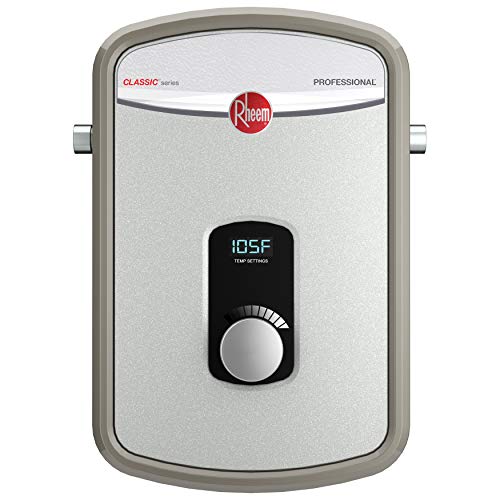
Rheem RTEX-13 Tankless Electric Water Heater
At 13 kilowatts this compact heater serves one shower or a small apartment. External controls adjust temperature in one degree steps. Owners like the simple two-wire hookup compared with larger whole-house units.
Pros
- Lower install cost than 27 kW units
- Self-modulating power saves energy at low flow
- Small footprint fits a closet or vanity
Cons
- One heavy fixture at a time in cold regions
- Not sized for a full family bathroom load

Bosch Tronic 3000 T 4 Gallon Mini Tank
This 4 gallon tank plugs into a standard 120 volt outlet and mounts under a sink. It delivers instant warm water at a remote faucet far from the main heater. A glass-lined tank resists corrosion over years of use.
Pros
- Plugs into a normal wall outlet
- Ends the cold-water wait at distant taps
- Wall or floor mounting options included
Cons
- Small tank suits handwashing, not showers
- Recovery lags after back-to-back draws

Ariston Andris 4 Gallon Mini Tank
The Andris holds 4 gallons and runs on a 120 volt plug, so no dedicated circuit is required. Adjustable thermostat lets you dial the outlet temperature. It works as a standalone source or a booster ahead of a main heater.
Pros
- No dedicated circuit needed for install
- Adjustable thermostat on the front
- Doubles as a booster for a far tap
Cons
- Limited to light single-fixture duty
- Refill heat time slows heavy use

Camplux TE05 1.3 Gallon Mini Tank
Camplux packs a 1.3 gallon tank into a body small enough for a cramped cabinet. It draws 1.5 kilowatts from a standard outlet and heats water in minutes. Owners use it for a bar sink, RV, or a rarely used guest bath.
Pros
- Fits the smallest under-sink cabinets
- Quick reheat for occasional use
- Light enough for RV and shop installs
Cons
- Tiny reserve empties fast at a shower
- Best for one low-flow fixture only
What matters most
What to look for in an electric water heater Start with format. Tankless units heat on demand and never run dry, while tank and hybrid models store hot water for a fast morning draw. Match wattage or gallons to how many fixtures run at once. Check your electrical panel too, since a 27 kilowatt tankless can pull well over 100 amps. Point-of-use tanks ask far less, plugging into an ordinary 120 volt outlet.
Sizing for climate and incoming water temperature Cold inlet water is the hidden variable with tankless heaters. A unit rated for 6 gallons per minute in Florida may deliver half that in Minnesota. Groundwater near freezing forces the heater to work harder for each degree of rise. In northern states, size up the wattage or pick a flow-control model like the Tempra 24 Plus. Warm-climate homes can run smaller units at full flow.
Best options for small spaces and single fixtures Not every job needs a whole-house system. A far bathroom or garage sink runs fine on a 4 gallon Bosch or Ariston mini tank. These mount under the counter and end the long wait for warm water to arrive. For an RV or bar sink, the 1.3 gallon Camplux fits where nothing larger will. Pair a mini tank as a booster when your main heater sits far from a heavy-use tap.
Running cost and long-term efficiency Hybrid heat pump models change the math on monthly bills. The ProTerra moves heat from the air instead of generating all of it, cutting energy use sharply against a standard element tank. Tankless units save by heating only when you draw water, with no standby loss from a stored tank. Weigh the higher upfront outlay of a hybrid against years of lower operating cost. Owner reports back the savings on efficient units.
The lineup, side by side
| # | Model | Type | Best for | Score | Price |
|---|---|---|---|---|---|
| 1 | Rheem Performance Platinum ProTerra Hybrid 50 Gallon | Heat pump hybrid tank | Best overall | 9.4 | Check price |
| 2 | EcoSmart ECO 27 Tankless Electric Water Heater | Whole-house tankless | Best whole-house tankless | 9.1 | Check price |
| 3 | Stiebel Eltron Tempra 24 Plus Tankless | Whole-house tankless | Best for cold climates | 8.9 | Check price |
| 4 | Rheem RTEX-13 Tankless Electric Water Heater | Point-of-use tankless | Best value tankless | 8.6 | Check price |
| 5 | Bosch Tronic 3000 T 4 Gallon Mini Tank | Point-of-use mini tank | Best point-of-use tank | 8.4 | Check price |
| 6 | Ariston Andris 4 Gallon Mini Tank | Point-of-use mini tank | Best for a single sink | 8.2 | Check price |
| 7 | Camplux TE05 1.3 Gallon Mini Tank | Point-of-use mini tank | Best budget mini tank | 8.0 | Check price |
Good to know
Are electric water heaters better than gas?
Electric models install more simply since they need no gas line or flue venting. They also run cleaner indoors. Gas units heat faster and often cost less to run where gas is cheap. Your local energy prices and existing hookups usually decide it.
What size electric water heater do I need?
Count how many fixtures run at once. A single shower fits a 13 kilowatt tankless or a 40 to 50 gallon tank. A full family running two showers needs 24 to 27 kilowatts tankless or a 50 gallon hybrid. A single remote sink needs only a 4 gallon mini tank.
Do tankless electric water heaters really give endless hot water?
They heat continuously as water flows, so they never empty like a tank. The limit is flow rate, not volume. Draw more fixtures than the unit is rated for and the temperature drops. Cold inlet water lowers that ceiling further in winter.
Can I install an electric water heater myself?
Mini tank units plug into a 120 volt outlet and many owners fit them without help. Whole-house tankless models need heavy wiring, multiple breakers, and often a licensed electrician. Local code frequently requires a permit for hardwired units. Check your panel capacity before buying a high-wattage heater.
Is a hybrid heat pump water heater worth it?
It costs more upfront but uses far less electricity by moving heat rather than making all of it. The savings add up over the unit’s life in most homes. It needs a warm space with clearance to breathe. Owners in mild garages or basements report the strongest results.
How long do electric water heaters last?
Tank and hybrid models commonly last eight to twelve years with regular anode and flush maintenance. Tankless units often run longer since there is no tank to corrode. Hard water shortens life on any type. Descaling and anode checks stretch the timeline.
What is the difference between point-of-use and whole-house units?
Point-of-use heaters sit near one fixture and serve just that tap or shower. Whole-house units feed every fixture from a single location. Mini tanks and small tankless models cover point-of-use jobs. A 24 to 27 kilowatt tankless or a 50 gallon tank handles a whole home.
Do electric tankless heaters work in cold climates?
They can, but cold inlet water cuts their effective flow rate. A model that delivers 6 gallons per minute in a warm state may manage 3 up north. Flow-control units hold temperature by slowing water when demand spikes. Sizing up the wattage helps in freezing regions.
How much does it cost to run an electric water heater?
Running cost tracks wattage, water use, and your local electricity rate. Hybrid heat pump models cut usage the most by drawing heat from the air. Tankless units avoid standby loss by heating only on demand. A standard element tank uses the most among these formats.
Our take
The Rheem ProTerra hybrid earns the top spot for whole-house efficiency, while the EcoSmart ECO 27 and Stiebel Eltron Tempra 24 Plus split tankless duty between warm and cold climates. For a single sink or an RV, a Bosch, Ariston, or Camplux mini tank does the job for a fraction of the effort.