Senior Friendly Ellipticals With Low Step-Up Heights
Teeter FreeStep LT3 leads for seniors because you sit, stay supported and never climb onto a moving pedal. Schwinn 470 suits steady walkers who want a 20 inch stride and 25 resistance levels. Cubii JR1 brings pedalling to an existing armchair. Floor space usually decides between them.
Teeter FreeStep LT3 tops this list for older adults who worry about losing balance. You sit down, push through the legs and pull the arm levers, with your back against a pad the whole time. Knees avoid the deep bend that standing machines create. Floor space is the trade, since this frame never folds away.
Marketing copy rarely lists the numbers that decide whether a machine gets used daily. We compared step-up height, handrail type, stride length, resistance steps and console text size across current listings. Owner comments about mounting, dismounting, joint comfort and motor noise shaped the order. Anyone managing a heart or joint condition should clear a new routine with their doctor first.
What to look for
What to look for in an elliptical for older adults Getting on and off decides whether a machine keeps getting used. Check step-up height first, meaning floor to pedal distance, and treat anything above 14 inches as awkward. Fixed handrails help balance more than moving arm levers do. Resistance should start genuinely light, because a lowest setting that already feels hard kills the habit in week one. Console text size matters as well, since small backlit digits blur once you are moving.
Seated vs standing ellipticals: which design fits your balance Seated cross trainers such as the Teeter FreeStep LT3 take balance out of the equation and hold the lower back. Standing machines like the Schwinn 470 recruit more muscle and pack more features into the same floor area. Under desk units sit between the two, moving the legs while you stay in a normal chair. Pick seated if dizziness, neuropathy or an unsteady gait is any part of your day. Choose standing only if you already walk unaided outdoors.
Best for small apartments and shared rooms Space, not capability, is the real limit in most homes. Compact standing frames like the Sunny SF-E3810 slide into a corner, while the NordicTrack SE9i folds upright against a wall. Cubii JR1 asks for the least room of all, since your existing armchair does the seating. Noise counts in shared spaces too, and magnetic drives stay quiet enough for conversation. A folding machine that never gets unfolded helps nobody, so be honest about where it will live.
Setting up safely and building the habit Full size ellipticals arrive in one heavy box, so arrange help for assembly and placement. Leave clear floor behind the machine, because a stumble sends you backwards. A rubber mat over hardwood cuts noise and stops the frame creeping. Start with five to ten minutes at the lowest resistance, then add time before adding effort. Anyone with ongoing knee pain or a recent fall should skip the standing machines entirely and use the Teeter or the Cubii instead.
What we recommend

Teeter FreeStep LT3 Recumbent Cross Trainer
Entry happens from the side onto a padded seat, so balance never becomes the obstacle. A linear stride pushes the foot forward instead of swinging it through a deep arc, which limits knee flexion. Arm levers move in time with the pedals, adding shoulders and back to a leg workout.
Pros
- Side entry removes any step onto a raised pedal
- Backrest keeps twenty minute sessions comfortable
- Magnetic drive runs quietly beside a television
Cons
- Frame does not fold, so the footprint is permanent
- Too heavy to reposition without help
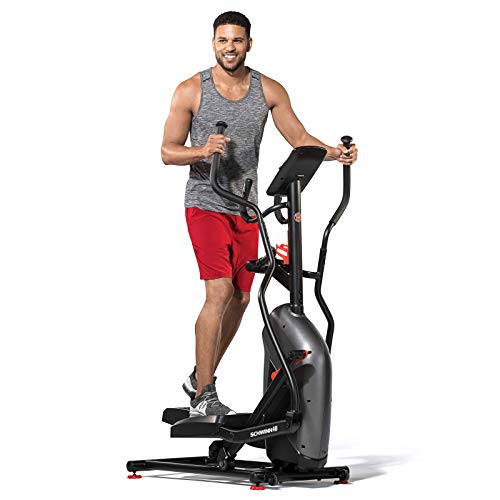
Schwinn 470 Elliptical
Steady walkers get the widest range on this list: 25 resistance levels and 29 built in programs. A 20 inch stride matches a natural walking step rather than forcing short chops. Two display panels show speed, time and heart rate at once, and Bluetooth passes each session to a phone.
Pros
- 20 inch stride fits users above 5 foot 8
- Twenty five levels allow small weekly increases
- Two screens show stats without scrolling menus
Cons
- Pedals sit well above the height of seated designs
- Assembly takes two people and a couple of hours

Horizon Fitness EX-59 Elliptical
Buttons run this console instead of a touchscreen, which suits anyone who dislikes nested menus. An 18 inch stride covers average heights without a cramped rhythm. Fixed side grips sit beside the moving levers, giving you something solid to hold on an unsteady day.
Pros
- Fixed grips give a steady hold mid stride
- Plain button layout needs no learning
- Frame weight keeps it planted under an adult
Cons
- Resistance steps are coarser than the Schwinn 470
- No folding option for a tight room
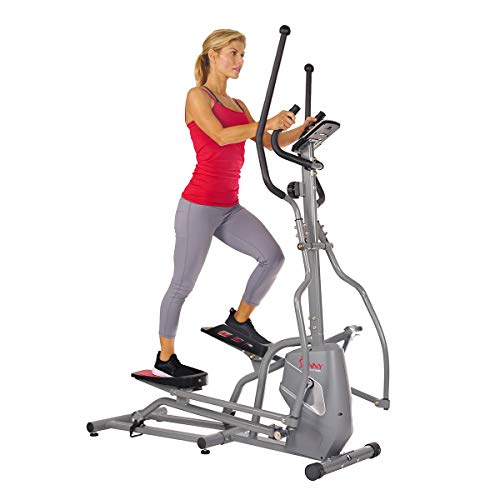
Sunny Health & Fitness SF-E3810 Magnetic Elliptical
Corners and alcoves take this one between sessions, which matters in an apartment. Eight tension levels cover gentle through moderate effort, the band most daily exercisers stay inside. A device holder sits above the LCD, and pulse grips read heart rate through the handlebars.
Pros
- Fits rooms that cannot take a full size frame
- One dial changes tension mid session
- Holder keeps a tablet at eye level
Cons
- Short stride feels choppy above 5 foot 8
- 220 pound capacity rules out heavier users

Cubii JR1 Under Desk Elliptical
Your own armchair becomes the seat, and only the pedal unit takes floor space. Eight resistance levels start light enough for someone rebuilding movement after illness. Pedal height stays low by design, so knees clear a desk or a coffee table.
Pros
- Works with a chair you already own
- Low profile clears most desks and side tables
- Slides out of the way between uses
Cons
- Arms and shoulders get no work at all
- A rolling chair drifts backwards while pedalling

NordicTrack SpaceSaver SE9i Elliptical
Folding upright hands the floor back to a shared living room between sessions. Guided iFit classes run on the touchscreen, which removes the job of planning a routine. Power adjustable incline shifts effort toward glutes and hamstrings without any change in speed.
Pros
- Folds upright against a wall after use
- Classes supply structure for new exercisers
- Incline raises effort at the same walking pace
Cons
- Most console features assume an active iFit membership
- Touchscreen menus frustrate button focused users

Stamina InMotion E1000 Compact Strider
Pedals, a tension knob and a small monitor make up the whole machine. Stand while holding a kitchen counter, or sit in a firm dining chair and pedal from there. Reverse motion works as well, which shifts load toward the hamstrings.
Pros
- Light enough to carry room to room
- Usable seated or standing
- Forward and reverse pedalling both available
Cons
- Standing use needs a counter or wall for balance
- No programs and no heart rate readout
Side by side
| # | Model | Type | Best for | Score | Price |
|---|---|---|---|---|---|
| 1 | Teeter FreeStep LT3 Recumbent Cross Trainer | Seated recumbent cross trainer | Best overall | 9.4 | Check price |
| 2 | Schwinn 470 Elliptical | 20 inches | Best full size machine | 9.2 | Check price |
| 3 | Horizon Fitness EX-59 Elliptical | 18 inches | Best value | 9.0 | Check price |
| 4 | Sunny Health & Fitness SF-E3810 Magnetic Elliptical | 8 levels of magnetic tension | Best compact standing machine | 8.8 | Check price |
| 5 | Cubii JR1 Under Desk Elliptical | Under desk seated elliptical | Best for seated pedalling | 8.6 | Check price |
| 6 | NordicTrack SpaceSaver SE9i Elliptical | Folds upright for storage | Best for guided workouts | 8.3 | Check price |
| 7 | Stamina InMotion E1000 Compact Strider | Compact portable strider | Best budget | 8.0 | Check price |
Questions worth asking
Is an elliptical good exercise for seniors?
Feet stay on the pedals throughout, so impact stays lower than walking on pavement. Owners commonly report longer sessions than they manage on a treadmill. Speak with your doctor first if you have a heart or joint condition.
Which elliptical is best for bad knees?
Seated designs load the knee least, which puts the Teeter FreeStep LT3 at the top here. Its linear stride skips the deep bend that some standing machines create. Starting at the lowest resistance matters more than which brand you buy.
Should a senior choose a seated or standing elliptical?
Seated suits anyone dealing with balance problems, dizziness or back fatigue. Standing works if you walk unaided and want the upper body involved. When the answer is unclear, seated is the safer default.
How low should the step-up height be?
Under about 14 inches feels comfortable for most older users. Compare it to a normal stair riser of 7 to 8 inches to judge the effort involved. Seated machines remove the question completely.
What stride length suits someone 5 foot 4?
Around 16 to 18 inches feels natural at that height, so the Horizon EX-59 fits well. Taller users do better with the 20 inch Schwinn stride. Overreaching comes from too much stride, a choppy rhythm from too little.
Are under desk ellipticals worth it for seniors?
For gentle movement while seated, yes, and the Cubii JR1 runs quietly enough for a living room. Upper body work stays at zero, so it will not replace a full machine. Treat one as a way to move more often through the day.
How long should an older beginner pedal each day?
Five to ten minutes at the lowest resistance is a realistic start. Build duration across the first month before touching the resistance dial. Stop and get advice if chest pain, dizziness or sharp joint pain appears.
Can you use an elliptical with arthritis?
Many owners with knee or hip arthritis prefer ellipticals to walking, because the gliding motion avoids heel strike. Short sessions spread through the day often feel better than one long one. Your rheumatologist or physiotherapist can confirm what suits your joints.
Do ellipticals need a lot of assembly?
Full size models like the Schwinn 470 and the NordicTrack SE9i need two people and roughly two hours. Sunny’s compact frame weighs less but still needs building. Cubii and Stamina units arrive essentially ready to use.
Our pick
Choose the Teeter FreeStep LT3 if balance, knees or back fatigue shape your day, because sitting down removes the two barriers that stop older users from sticking with a machine. Anyone still walking briskly and wanting upper body work should take the Schwinn 470 for its 20 inch stride and fine resistance steps. Where floor space is the binding constraint, a Cubii JR1 beside the armchair beats a folding machine that stays folded.