Hoop Size, Not Design Count, Should Drive Your Pick
The Brother SE1900 leads for combining a five by seven inch hoop with full sewing ability, the Brother SE600 gives beginners a capable four by four inch start, and the Janome Memory Craft 400E suits anyone embroidering often enough to want a dedicated machine.
Anyone stepping up in embroidery gets the best balance of hoop size and sewing ability from the Brother SE1900. The Brother SE600 works as an entry machine that will not feel limiting right away, and the Janome Memory Craft 400E rewards anyone ready to dedicate counter space to embroidery alone.
Built-in design counts get most of the attention, yet they matter least of any spec here. Embroidery field size quietly decides which projects are even possible, since a four inch hoop can never stitch a jacket back no matter how many designs load onto it. We compared maximum hoop dimensions, how designs transfer onto the machine, whether it also sews, extra hoop availability, and what owners report about thread breaks and tension over time.
The shortlist, ranked

Brother SE1900
A five by seven inch embroidery field pairs with a full sewing machine on the SE1900, covering most hobby projects without a second machine on the table. That larger field is the real difference between a pocket motif and a jacket back. Owners report it handles dense designs well once stabilizer choice gets dialed in.
Pros
- Larger hoop opens up bigger projects
- Combined sewing removes a second machine
- Bright touchscreen speeds up design editing
Cons
- Heavy to move between rooms
- Steep learning curve for first-time embroiderers
Brother SE600
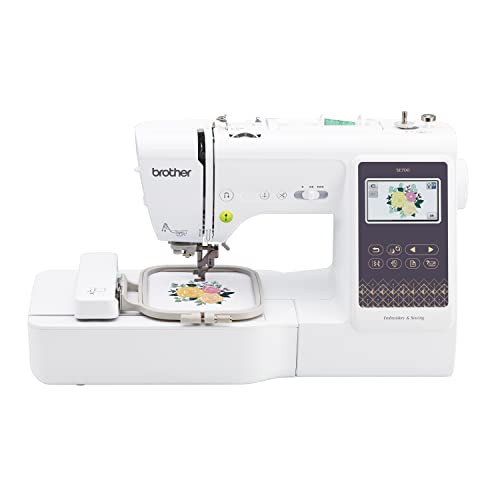
Most beginners start on the SE600, which pairs a four by four inch embroidery field with a capable sewing side in a manageable size. Its color touchscreen makes design editing far less intimidating than button-driven interfaces. Hoop size becomes the ceiling eventually, and hitting it is the usual reason owners upgrade.
Pros
- Approachable color touchscreen for new users
- Handles both sewing and embroidery
- Compact enough for a shared table
Cons
- Four inch field limits design size
- Not built for production volume

Janome Memory Craft 400E
Skipping a sewing mechanism entirely gives the 400E extra stability that shows up at higher stitching speeds. Its roughly 7.9 by 7.9 inch field handles substantial designs most hobby machines cannot fit in one hooping. Owners report consistent results on dense fills, though a separate sewing machine still handles construction work.
Pros
- Large field for its class
- Stable frame reduces vibration at speed
- Consistent results on dense designs
Cons
- No sewing function, so a second machine is needed
- Demands dedicated table space
Brother PE800
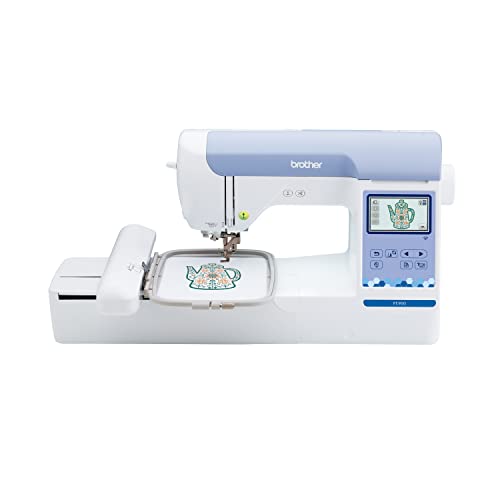
Embroidery-only design lets the PE800 fit a five by seven inch field into a machine built for people who already own a sewing machine. Its touchscreen handles on-machine resizing, repositioning, and color-order edits. Skipping the sewing mechanism keeps it lighter and simpler than a combination unit.
Pros
- Larger field without combination-unit cost
- On-screen editing for size and color order
- Simpler to learn than a dual-purpose machine
Cons
- No sewing function at all
- Fewer advanced editing tools than premium machines

Brother PE535
A four by four inch embroidery-only field keeps the PE535 focused on monograms, small motifs, and gift projects. Its smaller size stores easily between uses. Owners describe it as a straightforward starting point, provided the hoop limit is clear before buying.
Pros
- Low barrier to starting embroidery
- Light and easy to store
- Simple interface for basic designs
Cons
- Small field rules out larger designs
- No sewing capability

Bernette B70 DECO
Design software pairs naturally with the B70 DECO’s generous embroidery field, appealing to anyone who wants more control over digitizing. Build quality reflects its Bernina lineage. Owners describe a steeper learning curve, rewarding people willing to invest time on the software side.
Pros
- Strong build and stable stitching
- Works well with dedicated design software
- Generous embroidery area
Cons
- Steeper learning curve for beginners
- Fewer local dealers than Brother

Singer Legacy SE300
Garment sewing stays the focus on the Legacy SE300, which adds a moderate embroidery field for occasional decorative work. A broad stitch selection covers general sewing needs. Owners report solid all-purpose sewing performance, with embroidery best suited to simpler designs.
Pros
- Capable on general sewing tasks
- Reasonable embroidery area for the type
- Automatic needle threader saves time
Cons
- Embroidery side trails Brother equivalents
- Heavier than embroidery-only machines
Compared at a glance
| # | Model | Embroidery field | Best for | Score | Price |
|---|---|---|---|---|---|
| 1 | Brother SE1900 | 5 x 7 inches | Best overall | 9.4 | Check price |
| 2 | Brother SE600 | 4 x 4 inches | Best for beginners | 9.2 | Check price |
| 3 | Janome Memory Craft 400E | About 7.9 x 7.9 inches | Best dedicated embroidery machine | 9.0 | Check price |
| 4 | Brother PE800 | 5 x 7 inches | Best for larger designs on a budget | 8.7 | Check price |
| 5 | Brother PE535 | 4 x 4 inches | Best budget | 8.5 | Check price |
| 6 | Bernette B70 DECO | Large field for the class | Best for design editing | 8.2 | Check price |
| 7 | Singer Legacy SE300 | About 6.75 x 4.25 inches | Best for mixed sewing projects | 8.0 | Check price |
What to look for
Why hoop size matters more than design count Maximum embroidery field decides which designs fit in one pass, and no upgrade later changes it. A four by four field handles monograms, pocket logos, and small motifs well. Moving to five by seven opens up jacket backs, larger quilt blocks, and most commercial design files, which is the most common upgrade reason owners report.
Combination machine or embroidery-only: which fits your workflow? A machine that sews and embroiders saves money and counter space, ideal for anyone doing both occasionally. The tradeoff shows up when switching modes, since you cannot sew and embroider at once and the change takes a few minutes each way. Sewing and embroidering regularly on a steady basis usually favors two dedicated machines over one that does both.
Budget for what is not the machine Stabilizer, quality thread, prewound bobbins, extra hoops, and design files add up fast, sometimes costing more than the machine itself. Stabilizer choice alone causes most puckering complaints, so it is never really optional. Factor these ongoing costs in before comparing machines on sticker price.
Why results improve once stabilizer matches the fabric Most disappointing results trace back to stabilizer choice, hooping tension, or design density rather than a machine fault. Cutaway stabilizer suits stretchy knits, tearaway suits stable wovens, and water-soluble topping stops stitches sinking into toweling. Owners consistently report dramatic improvement once stabilizer matches the fabric being stitched.
Good to know
What size hoop do I actually need?
For monograms, small logos, and children’s clothing, four by four inches works. Jacket backs, larger quilt blocks, and most commercial designs need five by seven as a practical minimum. Since hoop size cannot grow past the machine’s maximum field, buying slightly bigger avoids an early upgrade.
Can these machines also sew normal seams?
Some can. Combination machines like the SE1900, SE600, and Legacy SE300 include a full sewing mode, while the PE800, PE535, Memory Craft 400E, and B70 DECO stay embroidery-only. Check this carefully, since it causes the most buyer disappointment.
How do designs get onto the machine?
Every machine here accepts designs from a USB drive, and you download or purchase design files in a format the machine reads. Brother machines commonly use PES files, while other brands use their own formats, so check compatibility before buying design packs.
Do I need embroidery software to get started?
Not at first, since built-in designs and on-screen editing cover plenty of ground. Software becomes worthwhile once you want to digitize your own artwork, combine designs freely, or resize beyond what the machine allows.
Why does my embroidery pucker?
Almost always stabilizer or hooping. Use a stabilizer matched to the fabric, hoop it taut but not stretched, and avoid dense designs on lightweight material. Check thread tension only after those three are correct.
How long does one design take to stitch?
A small monogram takes a few minutes, while a large dense design can run over an hour. Stitch count predicts this well, and machines display an estimate before starting so you can plan around it.
Can I embroider on hats and sleeves?
Flat-bed machines struggle with tubular items, and cap hooping needs a free arm or a proper cap system. Sleeves work on smaller hoops with care, but hats stay genuinely difficult on hobby machines.
Are these machines suitable for a small business?
They handle low-volume custom work fine, but single-needle machines need a manual thread change for every color, which limits throughput. Businesses with steady volume generally move to multi-needle machines for that reason.
Brother PE800 vs SE1900: which is the better upgrade?
The PE800 gives the same five by seven field for less, since it skips the sewing mechanism entirely. Choose the SE1900 instead if you also want a genuine sewing machine on the same table.
The verdict
The Brother SE1900 suits the widest range of embroiderers, since its five by seven field removes the ceiling most hobbyists eventually hit and its sewing side removes a second machine. Start with the SE600 to keep the outlay modest, and pick the Janome Memory Craft 400E if you already sew and want a machine focused entirely on embroidery.


