Ergonomic Footrests Designed to Ease Leg Strain
For most desks the ErgoFoam Ergonomic Foot Rest wins on height and firm memory foam support. Everlasting Comfort Foot Rest offers similar comfort at better value, and Kensington SoleMate Plus suits anyone who wants adjustable tilt with a smooth rocking motion underneath.
ErgoFoam Ergonomic Foot Rest is the pick most desk workers should start with, with Everlasting Comfort Foot Rest close behind on value and Kensington SoleMate Plus leading on adjustability. All three raise your feet enough to open the hip angle that causes most of the aching.
Footrests look interchangeable in listings, yet a few centimeters of height difference decides whether your thighs unload or your knees jam against the desk. We compared published dimensions, foam type, tilt or rocking range and base grip, then weighed those against owner reports of foam collapsing and covers sliding loose after a few months.
The best picks, ranked
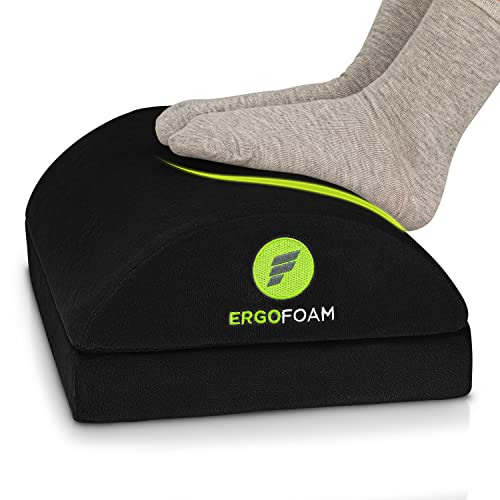
ErgoFoam Ergonomic Foot Rest
A large wedge of high density memory foam with a washable velvet cover makes this the shape most people picture as an ergonomic footrest. Its height suits standard desks between 71 and 76 centimeters, and the angled slope keeps heels planted instead of sliding forward. Owners report the foam holds its shape far longer than cheaper polyurethane blocks.
Pros
- Foam stays firm rather than flattening under daily use
- Cover unzips for washing, which matters for shared desks
- Wedge angle keeps feet from sliding off the front
Cons
- No height or tilt adjustment at all
- Too tall for very low desks or shorter users

Everlasting Comfort Foot Rest Under Desk
Slightly softer foam and an optional mesh cover separate this model from the ErgoFoam, and the mesh breathes better in warm rooms. It suits people who rest their feet flat rather than press hard into the surface. Its teardrop profile also doubles as a knee or ankle prop away from the desk.
Pros
- Breathable cover reduces heat build up in summer
- Curved top suits both flat and angled foot positions
- Light enough to move between home and office
Cons
- Softer foam compresses more under heavier users
- Slides on hard floors without a rug underneath

Kensington SoleMate Plus Adjustable Foot Rest
Pin locked height settings and a tilting deck let you dial in an exact angle instead of accepting a fixed wedge shape. Textured platform material grips socks and shoes alike. Based on specifications, it fits a wider range of desk heights than any foam wedge in this list.
Pros
- Height and angle both adjust, unlike foam models
- Hard deck suits people who wear shoes at the desk
- Built for long office use rather than seasonal replacement
Cons
- Hard surface is less comfortable in bare feet
- Bulkier and heavier to shift around

Fellowes Professional Series Ultimate Foot Support
Fellowes built this for the common cubicle problem of a desk fixed too high to lower. The platform rocks freely to encourage small ankle movements, and its height range covers taller work surfaces where foam wedges fall short. Soft touch material covers the deck rather than hard plastic.
Pros
- Free rocking motion keeps ankles moving through the day
- Genuinely wide, so feet do not hang off the edges
- Height range covers desks other rests cannot reach
Cons
- Rocking action is not lockable for people who want it still
- Takes up more floor area than a wedge

HUANUO Adjustable Under Desk Foot Rest
A compact plastic platform combines a ridged massage surface with several locked tilt positions. It fits tight home office corners where a large foam block would crowd the footwell. Some owners report the ridged texture helps with restlessness during long calls.
Pros
- Small footprint fits cramped desks and shared spaces
- Locked angles stay put rather than drifting
- Wipes clean instantly, no fabric to wash
Cons
- Ridged surface is uncomfortable for long barefoot sessions
- Plastic build feels lighter than office grade rests

3M Adjustable Foot Rest FR330
3M built quick changeover into this design, so tilt adjusts with a foot press rather than a knob. A moulded plastic deck with a gentle instep curve forms the platform. That makes it a sensible choice for a hot desk or a workstation shared across shifts.
Pros
- Angle changes without bending down or using hands
- Easy to sanitise between users
- Stable base that does not creep across carpet
Cons
- No height adjustment, only angle
- Firm plastic offers no cushioning

StrongTek Wooden Rocking Foot Rest
A curved plywood rocker with an anti slip mat topper keeps this the simplest option in the lineup. Nothing here adjusts or can break, and the rocking curve encourages ankle movement without any mechanism. Owners report it also works as a small step or calf stretcher away from the desk.
Pros
- No mechanism means nothing to wear out
- Sturdy enough to stand on for a moment
- Looks better than plastic in a visible home office
Cons
- Fixed curve suits only one rough height
- Hard surface needs shoes or thick socks
How they stack up
| # | Model | Material | Best for | Score | Price |
|---|---|---|---|---|---|
| 1 | ErgoFoam Ergonomic Foot Rest | High density memory foam | Best overall | 9.4 | Check price |
| 2 | Everlasting Comfort Foot Rest Under Desk | Memory foam core | Best value | 9.2 | Check price |
| 3 | Kensington SoleMate Plus Adjustable Foot Rest | Rigid adjustable platform | Best for adjustability | 9.0 | Check price |
| 4 | Fellowes Professional Series Ultimate Foot Support | Rocking platform | Best for tall desks | 8.8 | Check price |
| 5 | HUANUO Adjustable Under Desk Foot Rest | Tilting plastic platform | Best for small spaces | 8.6 | Check price |
| 6 | 3M Adjustable Foot Rest FR330 | Foot adjusted tilt platform | Best for shared workstations | 8.3 | Check price |
| 7 | StrongTek Wooden Rocking Foot Rest | Laminated bent plywood | Best budget | 8.0 | Check price |
How to pick the right one
What height should a footrest actually be A footrest closes the gap between your feet and a floor that sits effectively too far away. Aim for thighs roughly parallel to the ground with knees near a right angle, which usually means a rest between 8 and 15 centimeters tall for a standard desk. If your desk is fixed high, a foam wedge often will not reach, and an adjustable platform like the Fellowes or Kensington becomes the real answer.
Foam wedge or rigid platform Foam wedges run quieter, warmer underfoot and more pleasant in socks, which is why they dominate home office picks. Rigid platforms win when you wear shoes, need a specific angle, or share the desk. Comfort trades against precision here. A platform locks in an angle you already know works, while foam adapts as you shift position through the day.
Why constant movement matters more than static support Ankles stiffen when they hold one position for hours, so static support alone only solves half the problem. Rocking designs such as the Fellowes and the StrongTek encourage small continuous movement that keeps circulation going. Owners report noticeably less evening ankle swelling with rockers than with fixed blocks. Anyone who already fidgets can stick with a fixed wedge.
Surface grip and floor type Two failure points show up repeatedly in owner feedback. A cover slipping off the foam is one, solved easily by a zip fastening. The rest sliding forward on hard flooring every time you push against it is the other. Textured undersides help, but on laminate or tile a thin rug under the rest does more than any grip pad. Carpet users rarely see this problem.
Good to know
How tall should an ergonomic footrest be?
For a standard desk around 73 centimeters, most people land between 8 and 15 centimeters of footrest height. The target is thighs level with the floor and knees close to a right angle. Shorter users and higher desks need more height, which usually rules out fixed foam wedges.
Do footrests actually help lower back pain?
They can help indirectly. Raising the feet reduces forward pelvic tilt and eases strain on the lower spine when a chair sits too high. It is not a treatment for an existing back problem, and it works best alongside proper chair height and lumbar support.
Should I use a footrest with shoes on or off?
Either works, but the material should match. Foam wedges with fabric covers suit socks or bare feet far better. Hard platforms with textured decks handle shoes better and clean up more easily. A platform is the more tolerant choice for switching between both.
Is a rocking footrest better than a fixed one?
Rocking models suit people who sit very still, since the motion keeps ankles and calves working. Fixed wedges suit people who already shift position often and want stable support. Neither wins universally, and the decision comes down to how much you naturally move.
Will a memory foam footrest flatten over time?
Density decides this. Higher density foam like the ErgoFoam holds its shape for years of daily use, while softer budget foam compresses noticeably within months. Heavier users see flattening sooner, so density matters more the more weight rests on it.
Can a footrest stop my feet going numb at the desk?
Often yes, when the numbness comes from chair edge pressure on the back of your thighs. Supporting the feet removes that pressure point. Persistent numbness with the feet properly supported is worth raising with a clinician rather than solving with more equipment.
Do I still need a footrest with a standing desk?
Yes, for the seated portion of the day. Adjustable standing desks let you lower the surface instead, so a footrest matters less at that setting. Most people using a sit stand desk still sit for hours, and a rest helps once the desk goes back down.
How do I stop a footrest sliding on hard floors?
Anti slip undersides help but rarely solve it completely on laminate or tile. A small rug or chair mat under the rest gives the grip surface something to bite into. Heavier rigid platforms also creep less than light foam wedges.
Foam wedge vs adjustable platform, which lasts longer?
Rigid platforms with pin or dial adjustment tend to outlast foam, since foam density is the part that degrades first. A platform has more moving parts that could wear, but the core structure itself rarely fails the way compressed foam does.
The bottom line
ErgoFoam Ergonomic Foot Rest is the safest pick for a standard desk, with firm foam that holds up and a height that suits most seated postures. Choose Everlasting Comfort Foot Rest for the same idea at better value, or Kensington SoleMate Plus when your desk height is unusual and real adjustment matters more than a fixed wedge.
