Fertilizer Spreaders Compared: Broadcast vs Drop
The Scotts Turf Builder EdgeGuard DLX Broadcast Spreader is our top fertilizer spreader thanks to its edge blocking shield and consistent gate calibration. The Scotts Wizz is the best value for small lawns, and the Agri-Fab 45-0463 tow behind suits properties measured in acres.
The Scotts Turf Builder EdgeGuard DLX is the fertilizer spreader most lawns are best served by, with the handheld Scotts Wizz for small gardens and the Agri-Fab 45-0463 tow behind for anyone covering acres rather than square metres.
The problem with spreaders is that a badly calibrated one either burns stripes into a lawn or wastes half a bag on the driveway, and the calibration numbers printed on fertilizer bags assume a specific model. We compared hopper capacity, gate control and calibration systems, edge guard designs and frame construction, alongside what owners report about clogging in damp product and gates drifting out of setting, then ranked spreaders by lawn size and product type.
The best picks, ranked

Scotts Turf Builder EdgeGuard DLX Broadcast Spreader
The EdgeGuard shield is the feature that justifies this spreader over cheaper broadcast models: it blocks the right hand side of the spread pattern so product goes on the lawn instead of the path, the flower bed or the pond. The hopper covers a substantial area per fill and the gate settings correspond to the numbers printed on Scotts bags, which removes most of the calibration guesswork. It arrives assembled apart from the handle.
Pros
- Edge guard keeps product off paths and beds
- Gate settings match printed bag numbers
- Large hopper reduces refill stops
Cons
- Plastic frame is less durable than steel
- Wide spread pattern is awkward in small gardens

Scotts Wizz Handheld Spreader
For a small lawn, a push spreader is more machine than the job needs, and the battery powered Wizz covers the same ground in less time with far less storage space. The powered impeller gives a more even pattern than a hand crank spreader, and the EdgeGuard control works the same way as on the larger models. It also handles grass seed and ice melt, which makes it useful year round.
Pros
- Powered impeller spreads more evenly than hand crank units
- Takes almost no storage space
- Handles seed and ice melt as well as fertilizer
Cons
- Small hopper needs frequent refilling
- Tiring to hold for larger lawns

Agri-Fab 45-0463 Tow Behind Broadcast Spreader
Once a property runs to acres, walking a push spreader stops being practical, and this Agri-Fab hitches to a ride on mower or garden tractor to cover the ground in a fraction of the time. The large hopper means far fewer stops, and the enclosed gearbox handles the load. Setup takes real assembly time out of the box, and the wide pattern is unsuited to gardens with tight boundaries.
Pros
- Covers acres in a fraction of the walking time
- Very large hopper means few refills
- Enclosed gearbox stands up to load
Cons
- Substantial assembly required
- Needs a ride on mower or tractor to pull it

Earthway 2150 Commercial Broadcast Spreader
Earthway builds for landscapers, and the 2150 shows it with a diamond tread pneumatic tyre setup, a stainless steel gear system and a frame designed to be used every working day. The three hole drop pattern gives an even spread and the gate control is repeatable, which matters when you are applying to client lawns. It costs more than homeowner spreaders and repays that only if you use it heavily.
Pros
- Built for daily commercial use
- Stainless gearing resists fertilizer corrosion
- Pneumatic tyres roll easily over rough ground
Cons
- Priced well above homeowner spreaders
- No edge blocking shield as standard
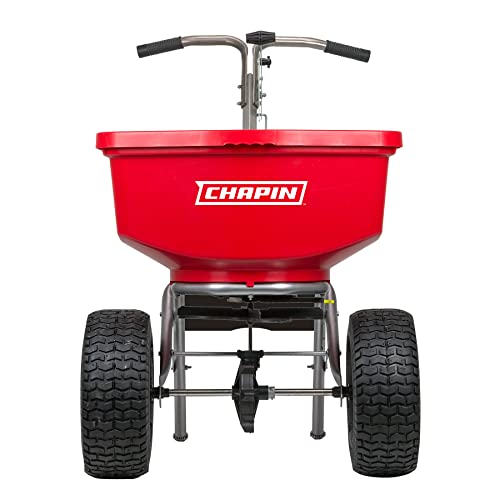
Chapin 8400C Professional Turf Spreader
Chapin fits this spreader with a gate system that opens and closes crisply rather than dragging, which is what keeps the application rate consistent from the start of a pass to the end. The frame is powder coated steel and the hopper is generously sized without becoming unwieldy on a domestic lawn. Owners report it as the spreader that stays in calibration when others drift.
Pros
- Gate holds its setting reliably
- Steel frame outlasts plastic homeowner models
- Large hopper without becoming hard to push
Cons
- Heavier than plastic framed spreaders
- Wide pattern needs care near beds
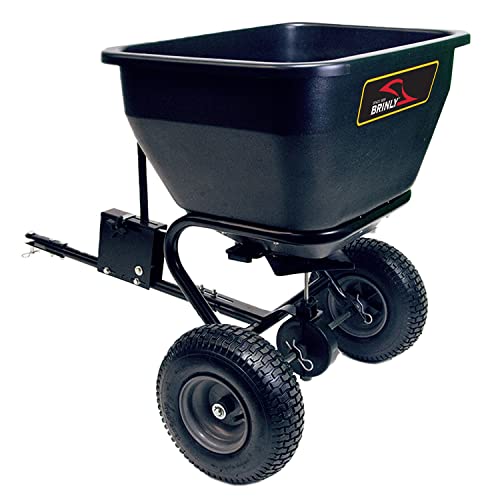
Brinly BS36BH-A Push Broadcast Spreader
Brinly’s push spreader uses a wide wheelbase and large diameter wheels, which keeps the hopper level and the spread pattern consistent across bumpy or sloped lawns where narrower spreaders wander. The hopper screen keeps clumped product out of the impeller, a genuine problem with fertilizer that has absorbed moisture. Assembly is straightforward and the frame feels solid in use.
Pros
- Stable across bumpy and sloping lawns
- Hopper screen prevents clumps reaching the impeller
- Solid steel frame construction
Cons
- Wide track is awkward through narrow gates
- No side blocking shield

Solo 421 Portable Chest-Mount Spreader
The chest mounted Solo 421 is the answer for ground a wheeled spreader cannot reach: steep banks, narrow strips between beds, gravel areas and rough paddock edges. A hand crank drives the impeller so there is no battery to run flat, and the harness spreads the load across your shoulders. It is slower per area than a push spreader, so use it for the awkward bits rather than the main lawn.
Pros
- Reaches ground wheeled spreaders cannot
- No batteries or power needed
- Harness distributes the weight comfortably
Cons
- Slower than a push spreader over open lawn
- Crank speed affects spread width and needs a steady rhythm
What matters most
Broadcast or drop depends on how much precision you need A broadcast spreader throws product in an arc from a spinning plate, covering ground quickly with a pattern that overlaps on each pass. A drop spreader releases product straight down between the wheels, giving an exact boundary with no throw. Broadcast is right for open lawns and is what almost every spreader on this list is. Drop spreaders are worth the slower going where beds, ponds or paths run right along the lawn edge.
Calibration is the difference between a green lawn and a striped one Every fertilizer bag prints settings for common spreader models, and those numbers are the starting point rather than the answer, because walking speed and product density both change the rate. Start one setting below the recommendation, apply half the product in one direction and the other half at right angles, and check coverage as you go. Under applying is easily corrected. Over applying burns stripes that take a season to grow out.
Match hopper size to your lawn honestly A large hopper reduces refills but also gets heavy and awkward. For a typical suburban lawn a fifty pound hopper is ample. For anything under a couple of hundred square metres a handheld unit does the job in less time than it takes to fetch a push spreader from the shed. Only properties measured in acres genuinely need a tow behind, and those need something to tow it with.
Rinse the spreader every single time Fertilizer is corrosive and any residue left in the hopper or on the gearing will eat metal parts and seize the gate mechanism. Rinse thoroughly with a hose immediately after use, let it dry fully and store it under cover. This one habit accounts for most of the difference between a spreader that lasts fifteen years and one that jams in its third season.
How they compare
| # | Model | Type | Best for | Score | Price |
|---|---|---|---|---|---|
| 1 | Scotts Turf Builder EdgeGuard DLX Broadcast Spreader | Push broadcast spreader | Best overall | 9.4 | Check price |
| 2 | Scotts Wizz Handheld Spreader | Handheld battery powered | Best value | 9.2 | Check price |
| 3 | Agri-Fab 45-0463 Tow Behind Broadcast Spreader | Tow behind broadcast | Best for large properties | 9.0 | Check price |
| 4 | Earthway 2150 Commercial Broadcast Spreader | Push broadcast spreader | Best build quality | 8.8 | Check price |
| 5 | Chapin 8400C Professional Turf Spreader | Push broadcast spreader | Best spread control | 8.6 | Check price |
| 6 | Brinly BS36BH-A Push Broadcast Spreader | Push broadcast spreader | Best for uneven ground | 8.3 | Check price |
| 7 | Solo 421 Portable Chest-Mount Spreader | Chest mounted hand crank | Best for awkward areas | 8.0 | Check price |
Common questions
What spreader setting should I use?
Start with the number printed on the fertilizer bag for your spreader model, then go one setting lower and apply in two passes at right angles. Under applying is easy to correct, over applying burns the lawn.
Broadcast or drop spreader for a home lawn?
Broadcast for almost all home lawns, because it is faster and gives a more forgiving overlap. Choose a drop spreader only if precise edges next to beds, paths or water are the main concern.
Can I use the same spreader for grass seed and ice melt?
Yes, most broadcast spreaders handle all three, though the gate setting differs for each because the granule size and density change. Rinse thoroughly between fertilizer and ice melt, since salt is highly corrosive.
Why is my spreader leaving stripes?
Usually insufficient overlap between passes or a rate set too high. Overlap the wheel track of the previous pass, and split the total product into two applications run at right angles to each other.
How do I stop fertilizer clogging the spreader?
Keep product dry, break up clumps before loading, and use a hopper screen if your spreader has one. Damp fertilizer bridges over the gate opening and stops flowing, which is the most common cause of missed strips.
Should I water after applying fertilizer?
For most granular fertilizers, yes, unless the label says otherwise. Watering moves the granules off the leaf blades and into the soil, which reduces the chance of leaf burn and starts the product working.
How do I keep fertilizer off my driveway?
Use a spreader with an edge blocking shield such as the EdgeGuard models, close the gate before you reach a hard surface, and sweep any stray granules back onto the lawn rather than leaving them to wash into drains.
How should I store a spreader over winter?
Rinse it thoroughly, dry it completely, apply a little light oil to the gearing and moving parts, and store it under cover. Leaving fertilizer residue in the hopper over winter is what corrodes gate mechanisms.
Final word
The Scotts Turf Builder EdgeGuard DLX is the fertilizer spreader we would buy for a typical lawn, because the edge blocking shield and bag matched calibration remove the two things most likely to go wrong. Small gardens are better served by the handheld Scotts Wizz, and properties large enough to need a ride on mower should skip straight to the Agri-Fab 45-0463 tow behind.


