How Automatic Fish Feeders Fail, and Which Ones Don’t
Eheim’s Everyday Fish Feeder wins for sealed, humidity resistant scheduling across up to eight feedings a day. The Fish Mate F14 suits two week trips with fourteen pre measured compartments instead of a shared hopper. NICREW’s Automatic Fish Feeder covers single community tanks affordably with a 200 millilitre hopper.
Eheim’s Everyday Fish Feeder leads this comparison, built around a sealed hopper that resists the humidity most feeders eventually lose to. Compartment based designs like the Fish Mate F14 take over for absences beyond a week. NICREW’s Automatic Fish Feeder handles single tank scheduling for less.
Failure here rarely looks like a refund request. It looks like clumped food jammed in a drum, or fish that went unfed for days while an owner traveled. We compared published hopper capacities, feeding intervals, mounting styles and what owners report about clogging and battery life on real trips.
What we recommend

Eheim Everyday Fish Feeder
Moist air rising off the water surface clogs most feeder hoppers, and Eheim fights that with an internal fan plus a sealed drum. Owners can schedule up to eight feedings a day, useful for several small meals rather than one large dump. Long holiday trips are where this unit earns its reputation, according to owner reports.
Pros
- Sealed drum and internal fan resist humidity
- Up to eight feedings a day for fine portion control
- Two AA batteries run for months of use
Cons
- Menu programming needs the manual on first setup
- Large pellets can bridge and stop feeding
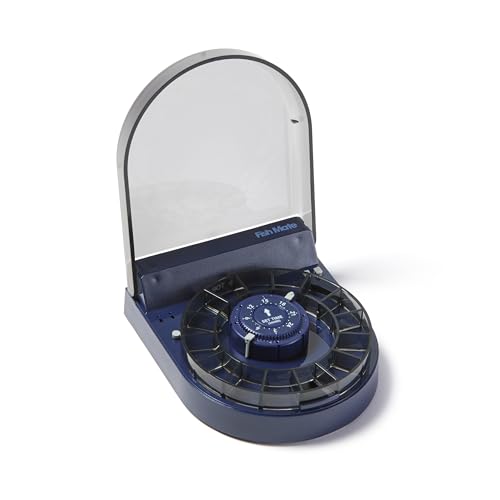
Fish Mate F14 Aquarium Fish Feeder
Fourteen separate compartments replace the single hopper found on drum feeders, so each meal is measured by hand before departure. A clog in one slot cannot affect the other thirteen, removing the main failure mode of drum designs. Two week trips suit this mechanical layout better than any electronic alternative here.
Pros
- Pre measured compartments prevent overfeeding
- Handles bulky pellets that jam drum designs
- Simple mechanical build with few parts to fail
Cons
- Fourteen feedings is the hard ceiling before refilling
- Takes up more space on the rim than a drum unit

NICREW Automatic Fish Feeder
A 200 millilitre hopper and an adjustable slide gate cover the basics NICREW aims for, with up to four feedings a day. Single community tanks needing steady weekday feeding fit this unit well, rather than extended holiday absences. Most standard rim widths accept the mounting bracket without modification, based on the listing.
Pros
- 200 millilitre hopper holds about a week of food
- Slide gate adjusts for flake or small pellets
- Mounting bracket fits most standard rims
Cons
- No sealed chamber, so humidity resistance trails premium units
- Bracket can flex on thick rimless glass

Fluval Digital Fish Feeder
Lidded, heavily planted tanks trap the most humidity above the waterline, and Fluval built this feeder for that exact scenario. An LCD screen displays the active schedule, and an adjustable arm drops food away from the glass rather than at the edge. Two programmed feedings a day is fewer than rival units offer.
Pros
- Moisture control chamber suits lidded, humid tanks
- LCD display confirms the schedule at a glance
- Arm delivers food over open water, not against glass
Cons
- Two feedings a day trails units offering four or more
- Hopper holds less food than the largest drum feeders
Petbank Automatic Fish Feeder
Nano and desktop tanks rarely need a full size hopper, and this rechargeable unit stays compact enough not to dominate a small lid. USB charging replaces disposable batteries, which suits owners prone to forgetting battery checks. Portion sizes stay small by design, so heavily stocked tanks will run through it fast.
Pros
- USB rechargeable, no battery swaps required
- Compact footprint suits desktop and nano tanks
- One button scheduling keeps setup simple
Cons
- Portion volume is too small for larger, stocked tanks
- Needs a full charge before any extended trip

Torlam Auto Fish Feeder
Entry level pricing does not remove the core function here, with a rotating drum, adjustable opening and an unattended schedule for short absences. Weekend trips suit this feeder better than a two week holiday. Dry flake dispenses reliably, though owners report damp food clogs the opening quickly.
Pros
- Low cost way to cover a weekend of feeding
- 200 millilitre hopper holds roughly a week of flake
- Mounts and refills without tools
Cons
- Minimal moisture protection inside the chamber
- Build quality trails premium sealed units

Eheim Battery Fish Feeder Twin
Splitting the drum into two independent chambers lets one feeder dispense two different foods, useful in tanks mixing surface feeders and bottom dwellers. Each chamber holds less volume than a single hopper unit, so refills come sooner. Mixed community tanks are the specific problem this design solves.
Pros
- Two chambers dispense two food types on one schedule
- Suits tanks mixing surface and bottom feeders
- Uses the same clamp mounting as other Eheim feeders
Cons
- Each chamber holds less food than a single hopper unit
- Costs more than a standard single chamber feeder
How they stack up
| # | Model | Hopper capacity | Best for | Score | Price |
|---|---|---|---|---|---|
| 1 | Eheim Everyday Fish Feeder | About 100 millilitres | Best overall | 9.4 | Check price |
| 2 | Fish Mate F14 Aquarium Fish Feeder | Fourteen separate compartments | Best for long trips | 9.2 | Check price |
| 3 | NICREW Automatic Fish Feeder | About 200 millilitres | Best value | 9.0 | Check price |
| 4 | Fluval Digital Fish Feeder | Up to two programmed | Best for planted tanks | 8.7 | Check price |
| 5 | Petbank Automatic Fish Feeder | USB rechargeable battery | Best for small tanks | 8.5 | Check price |
| 6 | Torlam Auto Fish Feeder | About 200 millilitres | Best budget | 8.2 | Check price |
| 7 | Eheim Battery Fish Feeder Twin | Two independent hoppers | Best for two food types | 8.0 | Check price |
What matters most
What to check before buying an automatic fish feeder Four things decide whether a feeder works: mechanism, power source, mounting and food compatibility. Drum feeders share one hopper across every meal, while compartment feeders like the Fish Mate F14 measure each meal separately. AA and AAA batteries keep running through a power cut, while USB rechargeable units need a full charge before any trip. Confirm the bracket fits your rim style, and that the unit is rated for your food shape, not flake alone.
Match the mechanism to how long you’ll be gone A weekend away barely stresses any feeder, so a basic drum unit like the Torlam covers it without issue. Two week holidays are where compartment designs pull ahead, since a clog in one slot of the Fish Mate F14 cannot spoil the other thirteen. Drum feeders such as the Eheim Everyday still work for long trips, provided the hopper stays sealed against humidity.
Why humidity is the real cause of feeder failure Warm tank water sends moisture straight up into whatever sits above it. Flake food absorbs that moisture and cakes into a plug that jams the drum opening. Sealed hoppers, internal fans and desiccant pockets all exist to fight this one problem. Tanks with a tight lid and a heater set high need active moisture control more than any other feature.
Calibrate the portion size before you leave Every feeder needs testing, since the same slot width releases very different amounts of small granules versus large pellets. Set the unit up at least three days before departure and watch how much food actually lands per cycle. Underfeeding beats overfeeding by a wide margin, because uneaten food fouls water quality fast while healthy adult fish tolerate lean rations easily.
Questions worth asking
How long can fish safely go without food?
Most healthy adult community fish tolerate several days without any feeding, and many keepers report no issues over a long weekend. Fry, very small species and heavily stocked tanks are the exceptions. A feeder still helps on longer trips, mainly to keep feeding consistent rather than to prevent starvation.
Do automatic feeders end up overfeeding a tank?
They can, and it is the most common complaint owners raise. Calibrating the portion setting for several days before relying on it fixes most cases, erring small rather than large. Uneaten food breaks down and raises ammonia, which threatens fish far more than a slightly light ration.
Can a feeder handle pellets as well as flake food?
Most drum feeders manage flake and small pellets without trouble, though larger pellets can bridge across the opening and stop dispensing. Compartment feeders such as the Fish Mate F14 cope best with bulky food, since each meal gets placed by hand. Check listed food compatibility before buying for larger sinking pellets.
What stops food from clumping inside the hopper?
Mount the feeder away from the warmest, most humid air, keep the tank lid closed except where the arm passes through, and pick a unit with a sealed chamber or internal fan. Some keepers add a small desiccant sachet inside the hopper, refreshed before each trip.
Is one feeder enough for two separate tanks?
No, each tank needs its own unit, since a feeder mounts to a single rim on a fixed schedule. The Eheim twin model dispenses two food types into one tank, which differs from serving two tanks at once. Running two separate feeders is the practical route.
Are rechargeable feeders better than battery powered ones?
Rechargeable units such as the Petbank feeder skip battery swaps and suit small tanks, but need a full charge before a long absence and cannot be revived mid trip. Disposable AA and AAA cells are easier to plan around for holidays, since a fresh set often outlasts the trip itself.
Where on the tank should a feeder be mounted?
Position it so food falls over open water rather than against the glass or into a filter intake, and keep the hopper clear of the heater plume. Owners report better dispersal when the outlet sits near a gentle surface current, which spreads food so shy fish get a share.
Should someone still check the tank during a trip?
For trips beyond a week it helps to have someone glance at the tank every few days, mainly to confirm the feeder is still turning and the equipment is running. Ask them to look rather than to feed, since a well meaning extra pinch is a classic cause of fouled water.
The bottom line
Eheim’s Everyday Fish Feeder is the pick we would trust for most tanks, since its sealed hopper attacks the humidity problem behind most feeder failures. For a two week absence, the Fish Mate F14 and its pre measured compartments offer the safer mechanical route, while NICREW’s Automatic Fish Feeder covers everyday single tank scheduling for less.


